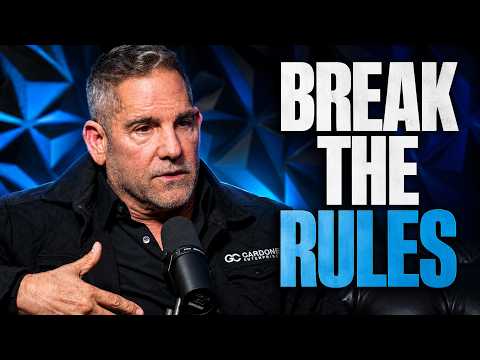
Success rarely comes from being the smartest person in the room. According to Grant Cardone, speaking candidly at what appears to be a private mastermind event, it comes from building the right systems, positioning yourself around the right people, and keeping your eyes open for where markets are broken. From multifamily real estate to the health industry to wealth management, Cardone laid out a framework for spotting opportunity that most people miss — not because they lack intelligence, but because they lack exposure.
Systems Beat Talent Every Time
Cardone's core argument is blunt: the gap between successful people and everyone else is not raw ability. It is infrastructure. Jeff Bezos did not build Amazon through genius alone — he built a system. MrBeast, often celebrated as a self-made viral creator, had funding behind him that gave him time to iterate and refine. With capital, you can afford quality. Without it, you have to compete on volume.
Cardone applies the same logic to his own early career. He could not afford quality production or a slow build, so he defaulted to quantity. That constraint shaped his strategy. The lesson is not that money solves everything — it is that understanding your actual constraints lets you build around them rather than pretend they do not exist.
For someone getting started in multifamily real estate, his advice is concrete: bring in a fractional revenue consultant to track income targets and deal flow. Join a community with accountability structures. The challenge is not whether you will face obstacles — it is whether you have systems in place to push through them when they arrive.
Finding the 'Glitch': Where Broken Industries Create Opportunity
Cardone uses the word glitch to describe industries where the standard model is so fundamentally flawed that a better operator can step in and dominate. His examples: the health industry is a glitch. Insurance is a glitch. Finance, he says flatly, is completely broken.
The catch is that glitches are nearly invisible to people who already have money. Wealth insulates you from the friction that reveals where systems fail. The people best positioned to see and exploit broken markets are often those who have had to navigate them without a safety net.
He is in the process of launching Cardone Wealth Advisors, deliberately structured to avoid certain regulatory credentials — his reasoning being that operating outside those credentials keeps him a more honest, unrestricted guide rather than a captured insider. Whether that logic holds up is debatable, but the underlying instinct — that being outside a broken system can be an asset — is consistent with his broader philosophy.
The $360 Million Moment
The most striking story Cardone tells is about 92 days he spent with billionaire Bob Duggan. He was not selling anything. He was not being paid. He describes himself as a bag boy — just present, absorbing, watching how someone at that level operated.
 14:20
Grant Cardone describing the moment he asked to see Bob Duggan's financial statements
Watch at 14:20 →
14:20
Grant Cardone describing the moment he asked to see Bob Duggan's financial statements
Watch at 14:20 →
At some point, Duggan asked him what he wanted out of the arrangement. Cardone's answer: "Can I see how much cash you got?" He was not asking for a check or a deal. He wanted to see the statements. Duggan obliged, and Cardone saw $360 million sitting in a single account.
That moment, he says, reoriented everything. He had never seen that concentration of capital before. Seeing it made it real and made it a target. The takeaway is not that proximity to wealth transfers wealth — it is that most people have never genuinely confronted what scale looks like, and that unfamiliarity keeps their ambitions artificially small.
Getting Around the Right People — Repeatedly
When asked what he would have done differently in the early years of building his business, Cardone is candid: there was no master plan. He was grinding without a fully formed strategy. The shift came when his partner Elena pushed him to think bigger, and when both of them invested heavily in their own development — spiritually, intellectually, relationally.
His advice for replicating that shift is simple and repetitive by design: keep returning to environments like the one he is speaking in. Get around the right people over and over. He is not promising a single breakthrough moment. He is describing a slow accumulation of exposure and perspective that eventually tips into something different.
He is openly envious of Elon Musk — not for the money, but for the intensity of passion Musk brings to problems that may not even be solvable. That kind of obsessive drive, Cardone says, is something he aspires to rather than something he claims to have fully achieved.
When Motivation Fails, Return to the Target
Cardone is straightforward about his own struggles. The relentless media criticism wears on him. There are moments he wants to quit. His recovery mechanism is not motivational content or mindset rituals — it is returning to the specific target. What is the number one priority? Go back to that. When everything feels overwhelming, the answer is not to push through everything simultaneously. It is to re-anchor to the single most important objective and move from there.
The same discipline applies to the people he works with. Whether it is a foster care advocate building housing communities for at-risk youth or a new real estate investor navigating their first multifamily deal, the framework is consistent: define the target clearly, build systems around it, get into rooms where the standard is higher than your current one, and keep showing up until the environment starts shaping you.
The infinite potential of the individual, as Cardone frames it, is not a motivational slogan. It is the practical argument for why excuses — not enough money, not enough time — are the real obstacle. That is exactly where invention begins.