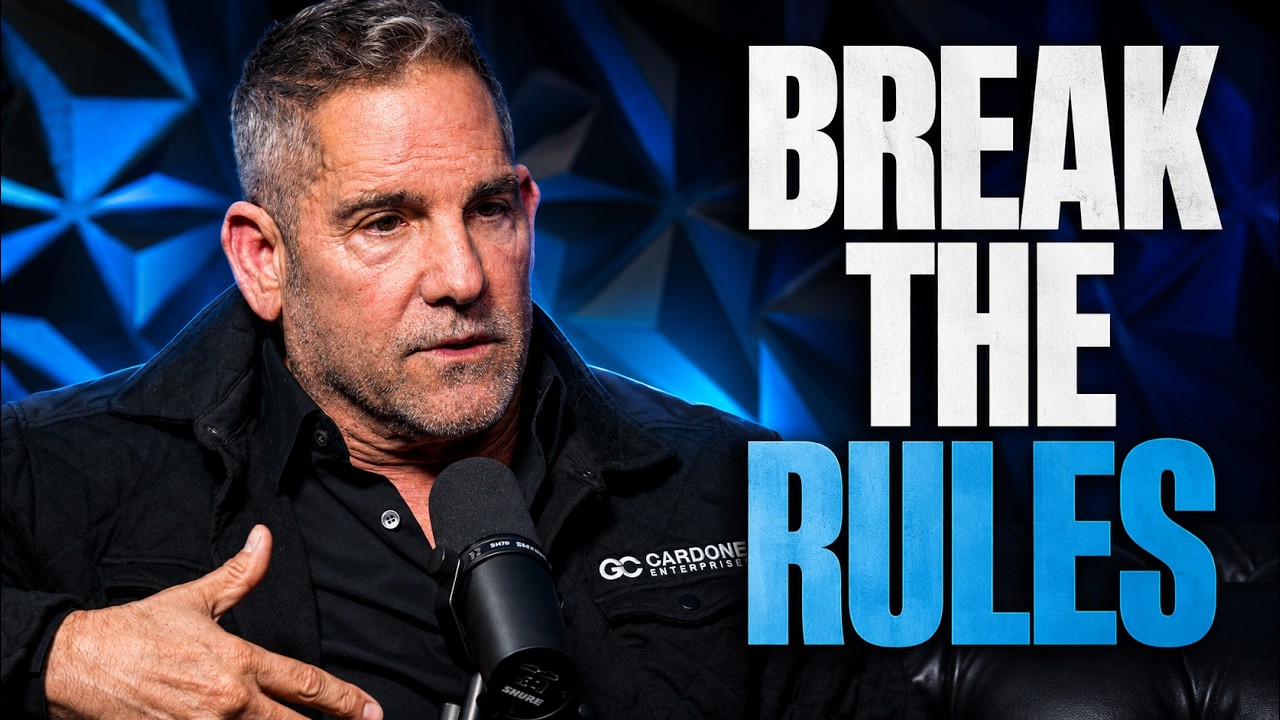

Before Grant Cardone became a bestselling author and real estate investor, he was outselling every salesperson in a small Toyota dealership in Lake Charles, Louisiana — not by being more persuasive, but by doing the opposite of what everyone else did. His insight was simple: stop withholding information and just give customers what they came for. That single idea, developed on a car lot in a refinery town, eventually reshaped how Ford, Nissan, Toyota, and Lexus structured their entire customer experience.
"I Don't Know What I'm Doing" Is the Real Meaning of "I'm Not Good at This"
Cardone spent nearly two decades in formal education — including five years earning an accounting degree — without ever learning how to get a client. When he first started selling cars, he was bad at it, and he stayed bad at it for two years. His explanation for why is worth sitting with: when someone says they're not good at something, what they're really saying is they don't know how to do it.
"If you don't know how to dance, you tell people you don't like to dance," he says. "I didn't like to sell because I didn't know how to sell." He didn't know how to greet customers, qualify them, find out what they needed, handle objections, or negotiate. Once he got formal sales training, that changed — and so did his results.
The Old Model: Build Value Before Revealing the Price
The standard car-sales process of that era was built on a principle that traces back roughly a hundred years: never give the customer a price until you've built sufficient value. A typical transaction could take four or five hours. Salespeople were taught to develop rapport, walk customers through the vehicle, and establish an emotional connection before any numbers were discussed.
The logic made sense in theory — price without context feels arbitrary, so you create the context first. But Cardone watched what actually happened when customers walked into dealerships: they would find a car they liked, touch it, and immediately reach for the price tag. The information they wanted most was being deliberately withheld from them.
 08:30
Illustration of customer behavior: touching a product and immediately looking for the price
Watch at 08:30 →
08:30
Illustration of customer behavior: touching a product and immediately looking for the price
Watch at 08:30 →
The Disruption: Lead With Everything They Want
Cardone flipped the model. Instead of building to the price, he opened with it — along with the monthly payment, down payment, and trade-in value. His opening line was essentially: "I'm sure you're here to get a price, a payment, a down payment, and figures on your car." Customers, who had often already visited two or three dealerships that stonewalled them on exactly these questions, were visibly relieved.
The counterintuitive result: by leading with full disclosure, he built more trust than salespeople who spent hours cultivating it artificially. Transparency wasn't a concession — it was the sales strategy. Customers who felt respected and informed were more willing to pay a fair price. Cardone ended up making more money per car on average than any of his colleagues, even though he spent far less time per customer.
For customers who were determined to pay rock bottom regardless — what Cardone calls "getting his ass whipped" — his approach was equally efficient: close it fast, accept the loss, and move on to the next person. A quick bad deal beats a slow bad deal. Volume and trust compound over time; grinding through a five-hour negotiation to lose money does not.
14:20
Cardone describing his process of giving customers price, payment, and trade-in figures upfront at the dealership
Watch at 14:20 →
From One Dealership to an Industry
When the dealership owner asked what Cardone was doing differently, his answer was straightforward: giving people what they want. He was then sent to a second dealership, where he outsold a team of ten. Word spread. By his early thirties, he was cold-calling dealerships across the country, pitching his methodology to some of the most skeptical buyers imaginable — car dealers.
His pitch was blunt and personal. If a dealer hung up on him, Cardone would show up in person: "I'm the guy you hung up on. You hung up on me before I could tell you I was coming to bring you a cup of coffee." He was broke, looked about twelve years old, and was selling a concept that hadn't been proven at scale. But he found early adopters, made it work, and the claims became results.
Ford, Nissan, Toyota, and Lexus eventually hired him. Ford implemented one-price selling and employee pricing programs. Lexus rolled out a nationwide format where every vehicle in the showroom displayed complete payment options — purchase and lease, across multiple term lengths — without a customer having to ask. Cardone considers himself the originator of what later became the Carvana model and TrueCar's pricing transparency approach.
No Interest Is Still Interest
One of Cardone's more contested ideas is his treatment of rejection. He argues that zero interest is itself a form of interest — the first step on a scale, not an absence from it. A hang-up means someone picked up the phone. A cold brush-off means someone heard your name. A hard no today is data about where someone is today, not a permanent verdict.
"No right now doesn't mean no right tomorrow," he says. He applies the same logic to first impressions: he doesn't believe they matter as much as conventional wisdom suggests. The last impression, he argues, is far more important — because it's the one you can actually control and improve. A bad first impression can be overcome. A good first impression followed by a stupid mistake cannot.
The underlying principle connecting his sales philosophy, his cold-calling persistence, and his view on rejection is the same: most resistance is situational, not categorical. The customer who walks out, the dealer who hangs up, the investor who says no — they're all in the middle of something else. Timing and follow-through matter more than a perfect opening line.