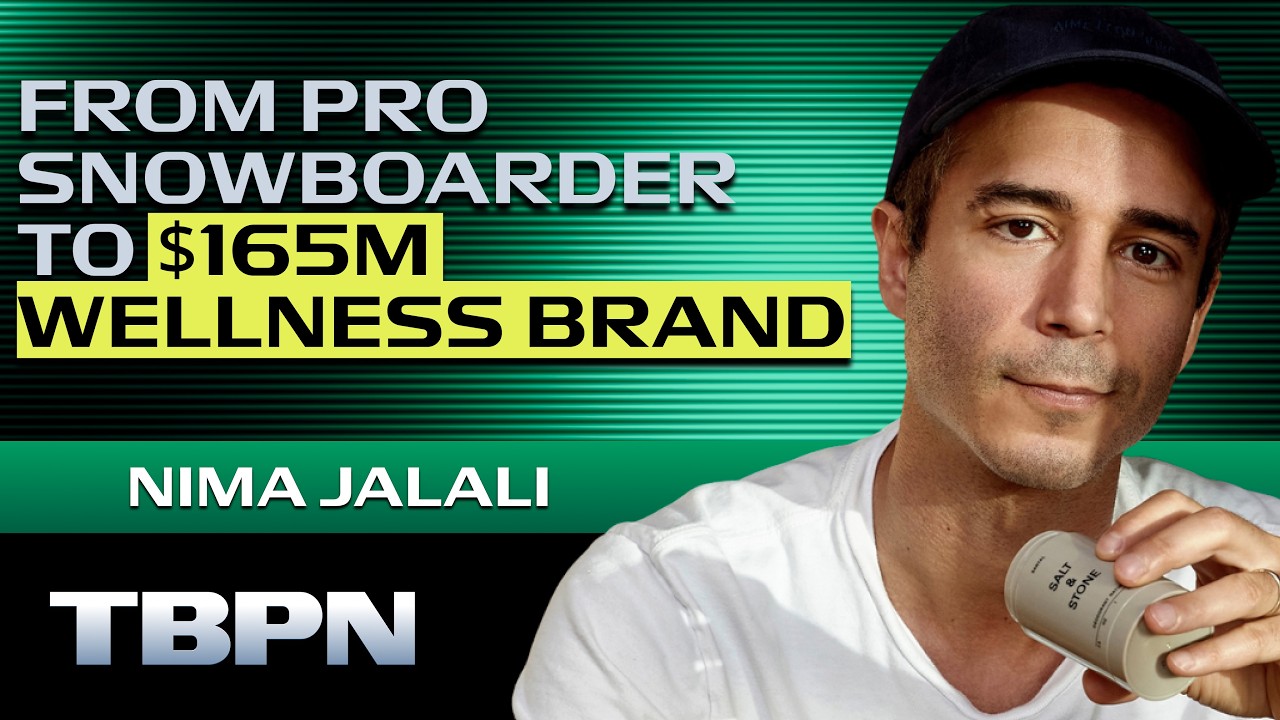

Salt and Stone hit $165 million in annual revenue, became the bestselling deodorant on Amazon, and landed on shelves at Sephora across the US, UK, Europe, Canada, and the Middle East — all without venture capital, without a sales team, and with a founding team that stayed at just two people for years. Founder Nema Jalali, a former pro snowboarder from the San Gabriel Valley, recently sat down to tell the full story for the first time. What he describes is less a hero's journey filled with near-death moments and more a masterclass in obsessive product development, disciplined spending, and knowing exactly what kind of brand you want to build.
How Did Salt and Stone Become a $165M Beauty Brand?
The short answer: Nema made a product he actually wanted to use, and it turned out everyone else wanted the same thing. Salt and Stone launched with sunscreen first — not because it was the vision, but because the formulation came together faster. The real north star was always deodorant. Nema had a specific problem with everything on the market: clean deodorants either didn't work, smelled like toothpaste, or looked like they belonged in a health food co-op from 1997.
His approach was straightforward but relentless. He lined up every competitor product on a shelf, identified exactly what was missing, and worked with contract manufacturers and chemists until the formulation was genuinely better — not marginally better, category-redefining better. He and his wife were literally smelling each other's underarms to test iterations. That's the level of product obsession that built this brand.
When deodorant launched, retailers started coming to Salt and Stone — not the other way around. That pull-based dynamic is a signal that almost no early-stage CPG brand achieves, and it became the engine for everything that followed.
Can You Build a CPG Brand Without Venture Capital?
Nema's answer is a firm yes — and his company is proof. Salt and Stone has been profitable from day one. Nema funded the launch out of his own pocket and paid himself back quickly once retail orders started coming in. The raises he did do were secondary events, largely structured as ways to take chips off the table rather than inject growth capital into a struggling business.
He's explicit about his distaste for the traditional VC playbook: "Venture capital, not really my cup of tea." And the numbers back him up. The company scaled to $165M with a team of just 50 to 55 people, all remote, with a high bar for every hire. That's an extraordinary revenue-per-employee ratio that most VC-backed competitors couldn't touch.
The lesson here isn't that funding is always bad. It's that if your product is strong enough, profitability buys you something more valuable than capital: control. Nema chose his private equity partner, Advent, because he wanted to keep building — not because he needed a lifeline.
How Did Salt and Stone Get Into Retail With No Sales Reps?
This is one of the most counterintuitive parts of the Salt and Stone story. Most CPG founders assume you need a sales team to get into retail. Nema never hired one.
His philosophy: create a brand that retailers need to carry, not one you have to push on them. Early on, he did land 40 to 50 individual boutique retailers by making direct outreach himself. The minimum order was a 12-unit case pack, roughly $300. Small bets, real proof of concept.
But the real inflection point came with the deodorant launch. Once the product was out and performing, stores started calling Salt and Stone. The brand had built enough digital presence, enough consumer demand, and enough aesthetic credibility that being without it was the retailer's problem, not Nema's.
He spent roughly six months becoming what he describes as an advertising expert — not by reading textbooks, but by obsessively studying how the best brands in the world communicate. Not other indie beauty brands. Nike. Legacy brands built to last a century. He was personally picking models, directing photographers, dropping text overlays in Figma, and iterating on creative until it was right.
What Made Salt and Stone's Deodorant Actually Work?
The clean beauty category had a reputation problem before Salt and Stone arrived. Products either worked but smelled clinical, or smelled interesting but failed as actual deodorant. The aesthetic ranged from forgettable to actively off-putting. Nobody had cracked the combination of efficacy, sophisticated scent, and premium visual identity — at least not in the clean segment.
Nema's insight was simple: why shouldn't your deodorant smell as good as your cologne? He approached the product not as a beauty founder would, but as someone with deep roots in skate, surf, and snowboard culture — someone who cared about things being genuinely cool, not just clinically effective. That outsider perspective was an asset. He wasn't constrained by category conventions because he didn't fully know them.
The result was a product that, as one investor described after trying dozens of clean alternatives, was just obviously better. Not incrementally better. Categorically better. The kind of product that creates permanent retention without a single email marketing flow.
When Is the Right Time to Expand a Brand Internationally?
Salt and Stone didn't wait until a big acquirer came along to go international. By the time Nema did his partial exit to Advent, the brand was already live in Sephora Canada, Sephora UK, Space NK in the UK, Sephora Europe, and had launched across the Middle East and Southeast Asia.
But the international expansion was also a reason he chose Advent as a partner. They have operational depth in global markets that would accelerate what Salt and Stone had already started. Nema's approach: don't go international until you have the domestic proof of concept, but don't wait for an acquirer to do it for you either. Build the foundation, then find a partner who can scale what you've already proven.
How Do You Know When It's Time to Sell Your Company?
Nema's answer is refreshingly un-dramatic. He had a relationship with Raymond James, and whenever private equity firms reached out — which was often — he'd forward the inquiry to them. When the advisors said the timing was right, they went to market. No single catalyzing crisis, no burning platform, no ultimatum from investors.
He's also clear that this wasn't a full exit. He chose Advent specifically because they're aligned on where the brand goes next. His stated goal: build something his grandkids can point to. A legacy brand, not a quick flip. He's seen what happens when founders hand brands off to the wrong buyers and watch them become discount shelf-fillers. That wasn't an option.
The framework he used for evaluating buyers: integrity, vision alignment, and genuine belief that they could build together. He'd applied the same framework two years earlier when he worked with Humble Growth, choosing them from a pool of 15 private equity funds based on who the people actually were.
What Advice Does Nema Jalali Give First-Time CPG Founders?
Nema didn't build Salt and Stone by reading entrepreneurship books or listening to founder podcasts. He went on instinct and sheer intensity. His advice reflects that:
- Go all in. Work-life balance is a luxury for people who aren't trying to build something from nothing. If you're treating it like a job, someone else is treating it like a calling.
- Love what you're building. The only way to sustain the kind of around-the-clock focus required is genuine passion for the product and the brand.
- Stop watching your indie competitors. Study the brands that have been around for a hundred years. Figure out why they lasted. Build toward that.
- Don't waste early capital on things you can't measure. Skip the pop-up events and activations until your unit economics are solid. Pour fuel on what's already working.
- Hire people who are better than you at what you're not good at. Nema's first key hire took everything operational off his plate. That freed him to focus on brand and product — and the business accelerated immediately.
The Salt and Stone story isn't the one most founders expect to hear. There's no near-bankruptcy, no dramatic pivot, no last-minute rescue round. It's just a founder who knew exactly what he wanted to build, refused to make a product that wasn't exceptional, and outworked everyone around him for eight years. Sometimes the most radical thing you can do is exactly that.