
After surveying 10,000 millionaires, one pattern emerges clearly: genuinely wealthy people don't look the part. They drive modest cars, live in understated homes, and blend into a crowd. Real wealth whispers — it doesn't announce itself. Reddit users recently weighed in on the subtle signs that someone is actually rich, and the answers reveal far more about the psychology of money than any luxury brand ever could.
The Quiet Luxuries They Spend On
One of the top Reddit responses described a high school friend whose family had a large home in a nice neighborhood, drove a pair of VW Jettas, and came across as perfectly normal. The tell? Fresh-cut flower arrangements in every room, delivered twice a week. With more than one bouquet per room across a large house — roughly 20 arrangements at an average of $50 each, twice weekly — that's a minimum of $2,000 per week, or over $100,000 annually just on flowers.
That's the nature of subtle wealth: you wouldn't walk into someone's home and immediately think rich because there are fresh flowers. But the consistency and scale of it quietly signals that money is not a constraint. One or two arrangements can make a home feel warm and alive without the six-figure price tag.
How They Handle Money in Social Situations
Several Reddit commenters pointed to the same behavior: wealthy friends always pick up the tab — not because they're showing off, but because it's effortless for them. They don't run the bill up or pay for elaborate group vacations. They simply cover dinner or drinks without announcement or expectation.
There's a meaningful difference between generosity and obligation, though. Picking up the check because you genuinely want to is a beautiful thing. Doing it out of social pressure — or creating an expectation in others that you always will — is a trap. Even wealthy people need to budget for generosity, because unchecked spending in any category can quietly erode the wealth that made generosity possible in the first place.
The most powerful version of this is anonymous generosity: covering a stranger's bill, paying it forward without recognition. Wealth used that way creates a kind of ripple effect that no status symbol can replicate.
The Freedom Their Wealth Actually Buys
Another Reddit thread pointed to suspicious amounts of free time as a subtle wealth indicator. The idea has merit — wealthy people can buy their time back, stepping away from rigid schedules and choosing how to spend their hours. But it cuts both ways: the same observation applies equally to the chronically unemployed.
The more precise signal is spontaneity. Wealthy people can say yes to things with little notice and no budget panic — an impromptu trip, a last-minute dinner reservation, an unplanned weekend away. That flexibility isn't luck; it's the result of building financial margin over time. When you're not chained to the next paycheck or the next minimum payment, options open up.
Similarly, wealthy people don't know when payday is — not because they're careless, but because their finances aren't structured around the anxiety of timing. That said, ignoring your cash flow entirely is a bad habit regardless of income. The real flex isn't ignorance of your bank balance; it's having a full month's expenses sitting in your checking account on the first of the month, so every dollar is intentional before it's ever spent.
What They Don't Do With Their Money
Perhaps the sharpest Reddit observation: people confuse wealth with income. High earners who spend lavishly often accumulate nothing. The person making $200,000 a year and financing a lifestyle to match has less actual wealth than a teacher who lived below their means for 30 years.
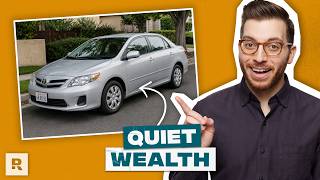
The millionaire study data backs this up. The typical American millionaire drives a used car — on average about four years old — and the top makes are Toyota and Honda, not Lamborghini. They shop with grocery lists (85% of millionaires in the national study do). They pay cash for home repairs instead of financing them, not because they're lucky, but because they built emergency funds and planned for predictable expenses like roof replacements.
The person who puts anything they want in a grocery cart without checking prices but can't afford a house isn't demonstrating wealth — they're demonstrating the exact habit that prevents wealth from forming. Spending flippantly in small categories adds up to a very large hole.
 18:45
Chart or graphic illustrating millionaire car-buying habits: average age, top makes
Watch at 18:45 →
18:45
Chart or graphic illustrating millionaire car-buying habits: average age, top makes
Watch at 18:45 →
The Real Signature of Wealth: Calmness and Silence
Two Reddit comments cut to the heart of it. First: they don't ever talk about it. People who talk about money constantly are usually performing — projecting an image of wealth they don't fully have. People who actually have money feel no need to mention it. They're secure. There's nothing to prove.
Second: just a calmness. Nothing can really phase them. This isn't about having unlimited funds. It's about having enough margin that problems become inconveniences rather than crises. An unexpected car repair, a medical bill, a broken furnace — these things hurt when you're paycheck-to-paycheck. When you have an emergency fund, they're annoying. When you have real wealth, they're barely a footnote.
Financial peace — the kind that produces visible calm — doesn't require being a millionaire. It requires getting out of debt, building an emergency fund, and creating enough margin that life's surprises stop feeling like catastrophes. Real wealth is just that principle, compounded over decades.
The through-line in every one of these Reddit observations is the same: genuine wealth is defined by net worth, not income, not appearance, and not how loudly someone announces it. Take what you own, subtract what you owe, and if the result has seven digits, you're a millionaire — regardless of what you drive or what you're wearing. Everything else is just noise.