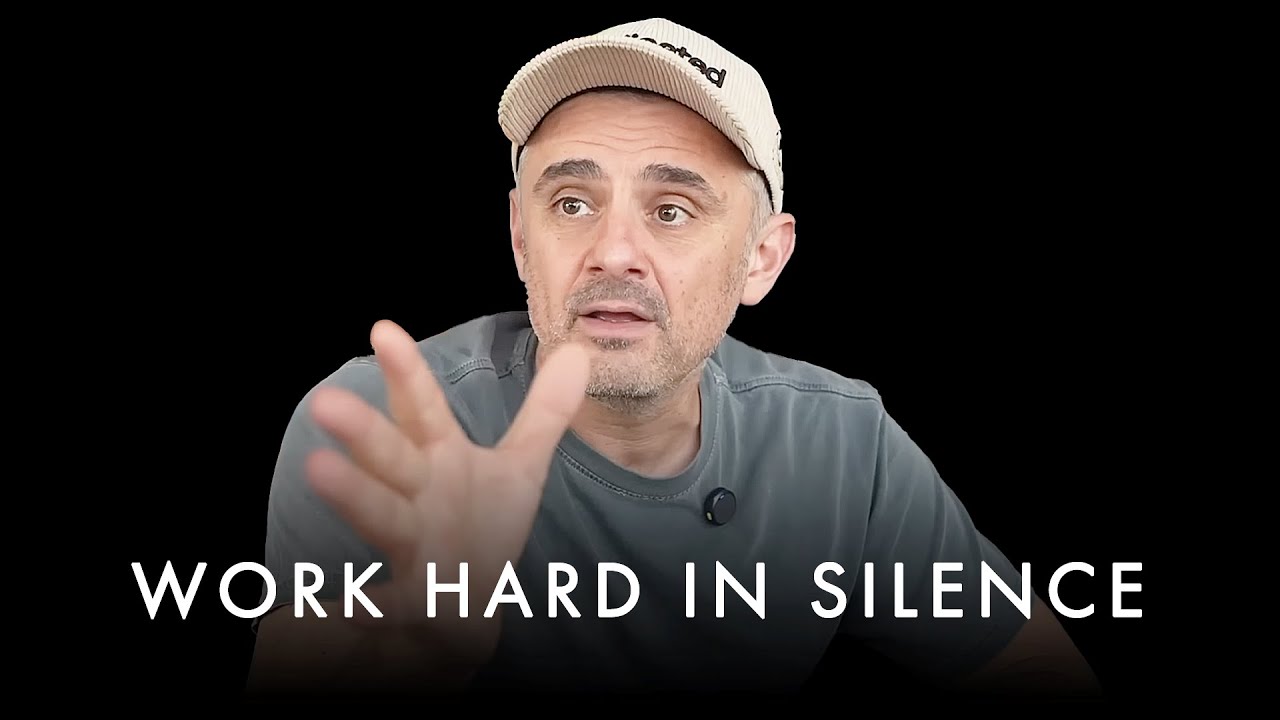

Hard work has always been at the center of Gary Vaynerchuk's worldview — but the language around it keeps shifting. As the word "hustle" became culturally loaded, Vaynerchuk adapted his vocabulary without changing his thesis: effort is irreplaceable, context is everything, and the biggest mistake most people make is letting someone else define what winning looks like for them.
The Hustle Porn Myth and How Context Shapes Messaging
In 2008, Vaynerchuk published Crush It — a book that would later get him labeled the "poster child of hustle porn" in a widely circulated Medium article. He maintains that characterization was built on fabrications. The book itself, he points out, explicitly states that someone working 9-to-6, earning $63,000 a year and genuinely happy, has already won.
His message at the time was targeted at people who were miserable — stuck in jobs they hated during a recession, unaware that the internet was about to create an entirely new economy. "Use 6 p.m. to midnight if you are miserable," was the argument. Work harder in the short term to escape a situation that's poisoning you. That's a very different thing from glorifying overwork as a universal virtue.
The author of that original Medium article eventually sent Vaynerchuk a private apology, acknowledging he had used the framing for his own advancement. But the damage to the "hustle" label had already spread. Today, Vaynerchuk defaults to "hard work" — not because his thinking changed, but because he'd rather not lose people over a word before the conversation even begins.
His broader point is that his content has always been a direct response to cultural conditions. In 2008, the problem was a lack of opportunity and awareness. Today, the problem is something different: entitlement, nastiness, and young people who want fame and wealth but expect them without effort. That's why his current messaging leans heavily on kindness, patience, and self-awareness. "I will always be a vessel of what I think the culture needs," he says.
Effort, Compensation, and What You Can Reasonably Expect from Employees
One of the more practically useful threads in Vaynerchuk's thinking is his stance on employee work ethic. He expects nothing from the people around him in terms of matching his own output — because they are not compensated at his level. Expecting otherwise, he argues, is delusional and unfair.
He employs people who are firmly nine-to-five. They leave at five, disconnect on weekends, and he doesn't judge them for it. What he does do is make sure they understand the tradeoffs clearly. If you're off the grid every evening and weekend, the path to CEO is effectively closed — not as punishment, but as arithmetic. Ambition and availability are correlated with advancement. His job is to articulate that honestly, not to resent people for the life choices they make.
He's also watched employees evolve. Someone who at 25 declared they'd run the company one day may, by 35, have fallen in love, moved to the suburbs, and decided that every softball game matters more than the next promotion. He considers that a beautiful outcome, not a failure. Title and compensation slow down for that person — and that's okay.
His advice to founders who constantly complain about underperforming staff is direct: you're in charge. Fire the person if they're genuinely the problem. But if you've fired six "right hands" in two years, the common denominator is you. Self-awareness at the top is not optional — it's the foundation of functional leadership. "Every single thing in my company that's a problem is 100% my fault," he says. Not because he left a door open, but because he hired the person who did, or hired the person who hired that person. That level of accountability, counterintuitively, produces less anxiety rather than more.
Patience, Insecurity, and the Real Source of Burnout
Vaynerchuk is emphatic that burnout does not come from hard work. It comes from insecurity and a lack of self-awareness. The person working 14-hour days chasing a million dollars to impress others will burn out — not because of the hours, but because the fuel is external validation, which is an endless and corrosive engine.
The person who works 15 hours a day because they genuinely prefer it to anything else they could be doing — more than watching films, more than playing sports, more than any leisure activity — is practically guaranteeing themselves good mental health. The hours aren't the variable. The motivation is.
Patience gets similar treatment. He's observed that most young people who push back on his advocacy for patience are confusing it with complacency or indecisiveness. They're not the same thing. Patience is the strategic willingness to let things compound over time rather than forcing shortcuts that cap your upside. Most impatience, in his view, has a single root cause: insecurity. The need to make a million dollars now is almost always about what that million dollars signals to other people — not what it actually provides in lived experience.
Shortcuts and missteps directly correlate with limiting your ceiling. The more patience you apply, the more likely you are to exceed what impatience would have allowed you to reach.
Defining Success for Yourself, Not Others
Much of Vaynerchuk's talk circles back to one central idea: the single greatest waste of energy is building toward a definition of success that someone else wrote for you. Parents, partners, peers, social media — they all push definitions of winning that may have nothing to do with what actually produces happiness for a specific individual.
His method for pressure-testing this came from an unconventional source. He spent much of his twenties seeking out elderly strangers — people in airports, in public spaces, anyone who looked close to the end of a long life — and drilling them with questions about what mattered. Across fifty to a hundred of those conversations, the pattern was consistent: how you made your money matters more than how much you made. Doing what you wanted, rather than what everyone else wanted for you, was the variable that separated contentment from regret.
He applies this personally. His stated professional goal is to buy the New York Jets. But he runs a thought experiment on himself: if he bought the Jets tomorrow and his parents died in a car crash the next day, would he be happy? No. So why structure your days as though the professional milestone is the real prize?
He flew back from San Francisco after a Monday night Jets loss, landed late, and drove an extra hour and a half to wish his father happy birthday — then drove two hours back. In the middle of his busiest season. Not because he does this for every micro-moment, but because it was his father's birthday, and that filters differently.
AI, the Tractor, and Why Ignoring the Wave Is Not a Strategy
On artificial intelligence, Vaynerchuk draws a historical parallel. Before the tractor was invented, somewhere between 80 and 90 percent of the global population worked in agriculture.
 58:20
Gary pulls up ChatGPT live during the conversation to look up the percentage of humans who worked on farms before the tractor was invented
Watch at 58:20 →
The tractor didn't end human work — it redirected it. Every major technology shift since has done the same: planes, trains, television, the internet, smartphones. Each one looked threatening to certain categories of labor and ended up creating entirely new ones.
58:20
Gary pulls up ChatGPT live during the conversation to look up the percentage of humans who worked on farms before the tractor was invented
Watch at 58:20 →
The tractor didn't end human work — it redirected it. Every major technology shift since has done the same: planes, trains, television, the internet, smartphones. Each one looked threatening to certain categories of labor and ended up creating entirely new ones.
AI is that shift, operating at a scale and speed that's harder to comprehend than previous waves. His advice is unambiguous: stop waiting for governments to regulate it into irrelevance, stop hoping it's a fad, and start using it today. Download ChatGPT, Perplexity, and comparable tools and begin integrating them into your workflow. For designers, copywriters, researchers, and brand strategists, the craft is changing. The people who treat AI as a co-creative partner will become disproportionately productive. The people treating it like a threat to ignore are positioning themselves in front of a wave without a surfboard.
The closing frame is simple: play your own game, develop real skills, know what winning means to you specifically, and be patient enough to let it compound. Ambition is most powerful when it's aimed honestly — not at the version of success your parents or your peers or your feed decided you should want, but at the thing you'd actually choose if no one else was watching.