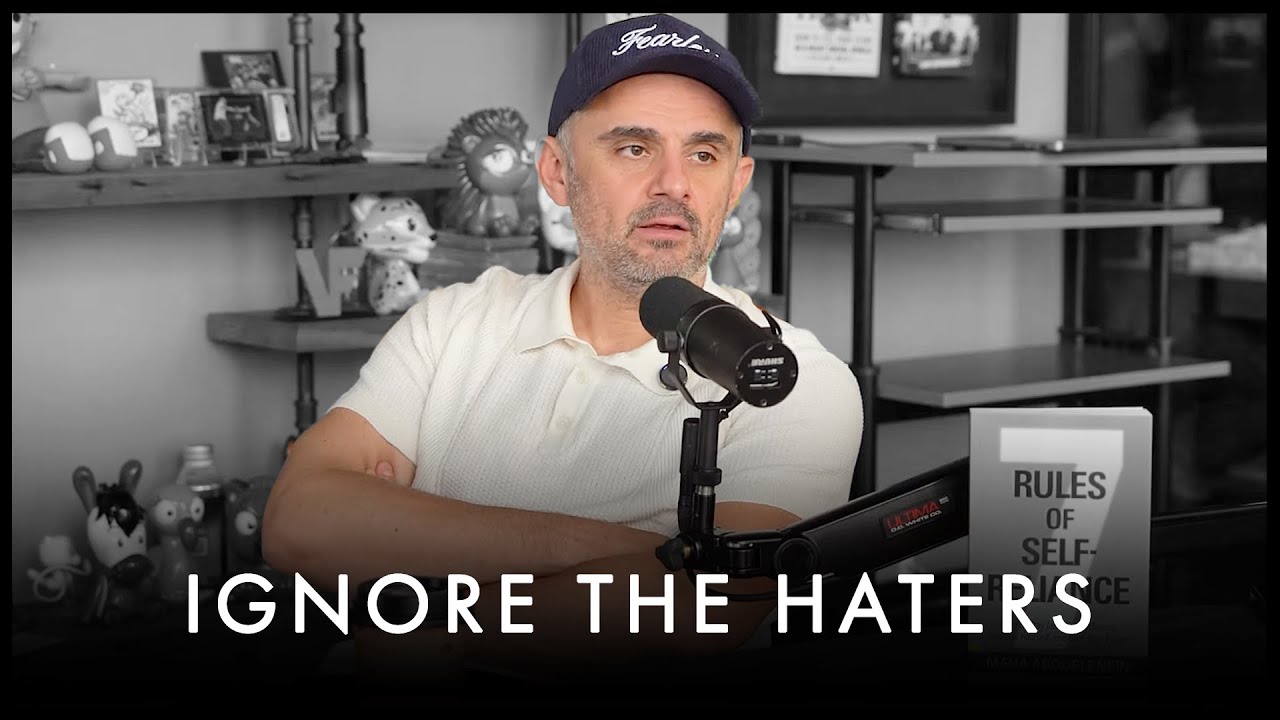

Most leaders spend enormous energy frustrated by the people around them — their work ethic, their ambition, their output. Gary Vaynerchuk thinks that frustration is a fundamental misunderstanding of how leadership works. His alternative framework centers on radical accountability, honest expectation-setting, and the liberating belief that every single problem in your organization is ultimately your own fault.
Stop Expecting Others to Work Like You
Vaynerchuk is blunt about one thing: he has zero expectation that the people around him will work as hard as he does. To him, expecting otherwise is not just unrealistic — it's "audacious and delusional." The reason is simple: they aren't compensated at the same level, so they don't carry the same stakes.
Rather than resenting employees who work nine-to-five and disconnect on weekends, he accepts it as a legitimate choice. His job, as he sees it, isn't to judge their ambition — it's to be honest about what their ambition will and won't produce. Someone who clocks out at five and stays off the grid all weekend is unlikely to become the next CEO. That's not a moral failing; it's just a consequence worth stating clearly.
He also acknowledges that ambition shifts over time. Employees who declared big goals at 25 often recalibrate as life changes — relationships, families, moves to the suburbs. Vaynerchuk says he finds that evolution genuinely beautiful, even when it means their titles and compensation slow down relative to colleagues who kept pushing. Judging how people choose to live isn't his role. Communicating the trade-offs honestly is.
If You Keep Firing the Same Role, Look in the Mirror
Where many founders complain endlessly about difficult employees, Vaynerchuk's response is direct: you're in charge. If someone isn't working, fire them. The authority is yours. What he can't understand is leaders who repeatedly bemoan problem employees without acting — or without examining their own role in the pattern.
His rule of thumb: if you've fired six people in the same role over two years, the common denominator isn't the employees. It's you. At that point, pointing fingers outward is just avoiding the harder, more productive exercise of pointing thumbs inward.
He credits this framing to a leadership principle he's internalized deeply — asking what about your own leadership has produced this result. That question, he argues, is both rarer than it should be and far more useful than most leaders realize.
Radical Accountability Reduces Anxiety, Not Just Blame
Vaynerchuk makes a claim that sounds counterintuitive at first: believing that every problem in your company is 100% your fault actually leads to less anxiety and more happiness. The logic is that this level of ownership removes the psychological burden of constant blame-shifting. You hired the person who made the mistake. Or you hired the person who hired them. Either way, the chain leads back to you — and accepting that is clarifying, not crushing.
He describes this orientation as liberating. When you stop looking for external culprits, you free up enormous mental energy that would otherwise be spent on frustration and defensiveness. He also believes it's simply accurate — not a mindset trick, but an honest description of how organizational accountability actually works at the top.
Scaling Through People and Staying Close to the Work
With a portfolio that includes VaynerX — a holding company of roughly 2,500 people generating $330 million in revenue — plus separate entities like VaynerSports, VaynerWatt, and Vee Friends, Vaynerchuk's approach to focus is built on trusted people running day-to-day operations in each business while he plays the role of guidance counselor, coach, and connector.
 18:45
Gary references his various companies within the VaynerX portfolio and those sitting outside it
Watch at 18:45 →
18:45
Gary references his various companies within the VaynerX portfolio and those sitting outside it
Watch at 18:45 →
He describes his attention allocation like a parent with multiple children: you're only as happy as your most unhappy child. He watches across his businesses and deploys focus wherever the need is greatest — either extreme offense when there's a real opportunity to accelerate, or extreme defense when something is in trouble. His mental model is a fleet of boats: you either spot a hole and go plug it, or you spot a race you can win and take the wheel.
Importantly, he makes no claim that this approach maximizes financial return. His brother AJ runs VaynerSports. Eric Wattenberg runs VaynerWatt. Mark Yudkin, Alan Harker, and others run VaynerX alongside him. Even Wine Library, his original family business, still gets his attention — he texts his childhood best friend who manages it daily. The structure works because he genuinely enjoys the relationships and the operational challenge, not because it's the most efficient path to wealth.
Why He'd Rather Be COO Than Chairman
Conventional advice for founders who build large organizations pushes toward becoming a chairman — stepping back, thinking bigger, delegating everything. Vaynerchuk acknowledges it's not bad advice. It's just not advice that fits him.
He identifies as having far more COO DNA than chairman DNA. HR challenges, restructures, the daily texture of running businesses — these aren't obligations he tolerates on the way to something better. They're the point. He compares his situation to entrepreneurs who build businesses primarily to fund the lifestyle they actually want: the yacht, the golf, the travel. For those people, stepping back makes sense. For him, running the business day-to-day is the lifestyle he wants.
His stated goal is to never become chairman — and to keep his hand on the wheel until the day he dies. Whether that's sustainable is a separate question. But as a philosophy of leadership, it's coherent: know what you actually enjoy, build structures that let you do it, and stop pretending the goal is to eventually stop working.