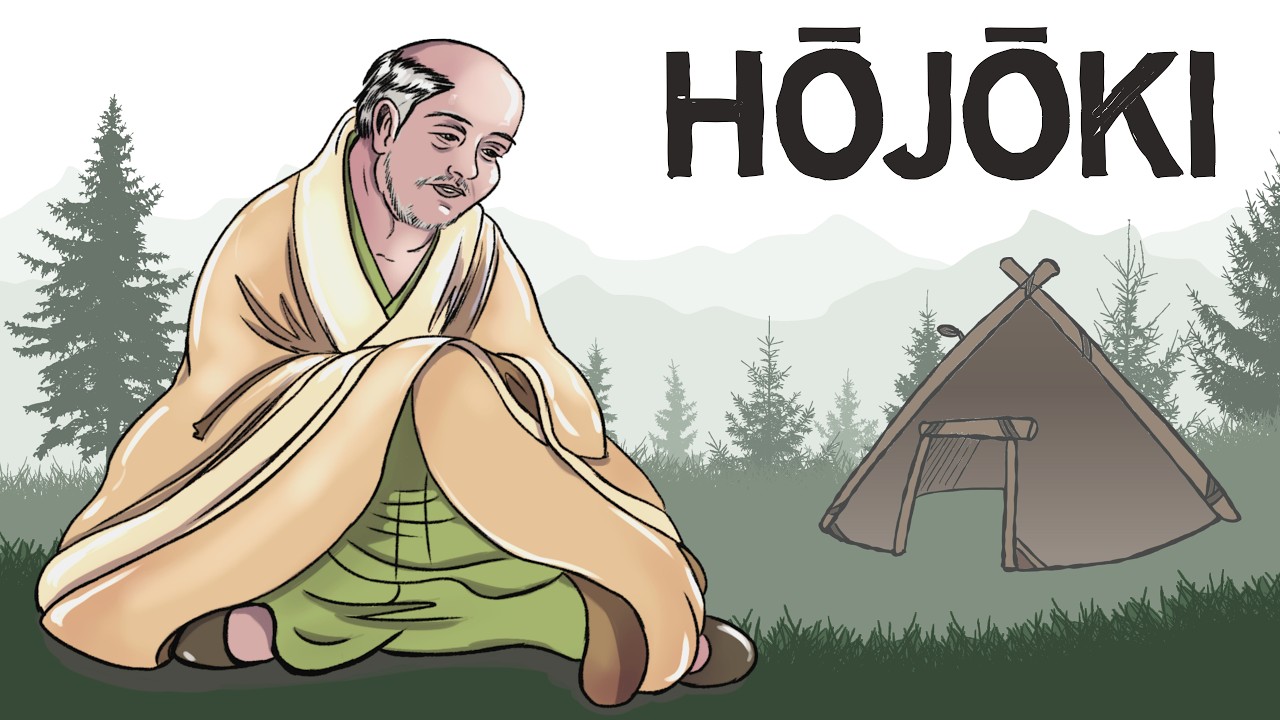

What does Hōjōki teach about impermanence and how to live? In short: that nothing lasts, that clinging to what is temporary causes suffering, and that even our escape from the world can become its own trap. Written over 800 years ago by the Japanese poet Kamo no Chōmei, Hōjōki — or An Account of My Hut — is a short but devastating meditation on a world in constant decay. It is also, unexpectedly, one of the most honest accounts of what happens when a person tries to opt out of society entirely. And the lessons it offers are just as sharp today as they were in 12th-century Japan.
What Is Hōjōki and Who Was Kamo no Chōmei?
Kamo no Chōmei was born into a well-connected Shinto family in Kyoto. From an early age, he studied poetry and music, and by all appearances, he was on a clear path toward a prestigious position within an important Shinto sanctuary — the role his father had held before him. But life had other plans.
 01:45
Chōmei's early life in Kyoto and the cascade of disasters that shaped his worldview
Watch at 01:45 →
01:45
Chōmei's early life in Kyoto and the cascade of disasters that shaped his worldview
Watch at 01:45 →
When his father fell ill and died, Chōmei was passed over for the family position, which went to his cousin instead. He was later forced out of his grandmother's home under murky circumstances. Meanwhile, the world around him was literally and figuratively falling apart: great fires consumed Kyoto, famines swept through the region, earthquakes shook the earth, and rival military clans battled for control of the capital.
Scholars of the period note that these disasters led many people to believe the world had entered what Buddhists call a final stage of karmic degeneracy — a period of decline in which true enlightenment is nearly impossible. Chōmei seemed to agree. By the time he reached his late fifties, he had completed a long, gradual withdrawal from society. He built a tiny hut in the hills of Southeast Kyoto and retreated into solitude. There, he wrote Hōjōki, a reflective essay that would become one of the foundational texts of Japanese literature.
What Does Hōjōki Teach About Impermanence?
The very first lines of Hōjōki set the tone with striking clarity:
04:10
The opening lines of Hōjōki — the river metaphor for impermanence
Watch at 04:10 →
The flow of the river never ceases, and the water never stays the same. Bubbles float on the surface of pools, bursting, re-forming, never lingering. They're like the people in this world and their dwellings.
This is the central insight of the entire work: nothing is permanent. Buildings that seem eternal are neither very old nor destined to last. The people around us who feel like fixtures of our lives will be gone before we know it. Wealth, status, health, relationships — all of it is subject to change, loss, and decay.
Chōmei didn't arrive at this insight through abstract philosophy. He arrived at it by living through one catastrophe after another and watching everything he had built or hoped for dissolve. That's what gives Hōjōki its unusual weight. This isn't a detached intellectual exercise. It is hard-won wisdom soaked in genuine grief.
What Are the Eight Worldly Winds in Buddhism?
Chōmei's reflections align closely with a core concept in Buddhist thought known as the Eight Worldly Winds. These are the eight forces that constantly push and pull us through life — gain and loss, pleasure and pain, praise and blame, fame and obscurity. According to Buddhist teaching, suffering arises because we are buffeted by these winds, desperately clinging to the pleasant ones and resisting the painful ones.
07:30
Chōmei's self-questioning in the quiet dawn — the pivotal moment of Hōjōki
Watch at 07:30 →
Chōmei saw these forces at work everywhere around him. The wealthy suffered from anxiety about losing their wealth. The poor seethed with resentment. Those who depended on others were trapped by that dependency. Those who followed social rules felt hemmed in; those who broke them were cast out as mad. As Chōmei put it directly: regardless of where you stand in the social hierarchy, you'll always end up cheated.
His conclusion was logical, if radical: if every position in society carries its own unique form of suffering, and if attachment to pleasant circumstances is the root cause of that suffering, then the answer must be detachment. And the surest path to detachment, he reasoned, was to leave society behind entirely.
Why Did Kamo no Chōmei Abandon Society?
Chōmei's retreat wasn't impulsive. It was the final step in a long, gradual withdrawal that unfolded over decades. After losing his expected position at the sanctuary, being forced from his grandmother's home, and watching Kyoto burn and starve and shake apart, he simply stopped believing that the world had anything lasting to offer him.
He was also, notably, free to leave in ways that many people are not. He had no wife, no children, no dependents. The social bonds that anchor most people to conventional life were absent in his case. And so, without much holding him back, he built his small hut — just enough space for one man to sleep and sit — and made solitude his home.
There, he found unexpected joy. He observed the seasons changing outside his window. He wrote poetry. He played music. He felt a kind of freedom that had eluded him during all his years navigating the social world. He even pitied those still trapped in the city, grinding away in pursuit of wealth and status, blind to the simple pleasures he now savored daily.
How Do You Detach From Suffering, According to Buddhism?
Buddhist philosophy, which deeply informed Chōmei's thinking, offers a clear framework here: suffering arises from attachment. When we cling to things we want to keep, or push away things we don't want, we set ourselves up for inevitable pain — because the world is always changing, regardless of our preferences.
The logical solution, then, is non-attachment. Don't hold on. Don't resist. Let circumstances arise and pass without gripping them. Chōmei understood this intellectually, and his retreat to the hut was his attempt to practice it physically. By owning almost nothing, he had almost nothing to lose. By avoiding social entanglements, he sidestepped the anxieties and resentments they generate.
But here is where Hōjōki becomes truly interesting — and deeply honest. Because Chōmei eventually noticed something uncomfortable about his so-called freedom.
Can Solitude Become a Prison Instead of Freedom?
The troubling realization that ends Hōjōki is this: Chōmei had become attached to his hut. He loved his solitude. He relished his simple life. And in the light of the Buddhist teachings he followed, this was a problem — because attachment to pleasant things, even simple and harmless ones, still waters the seeds of suffering.
He had successfully escaped the attachments of wealth, status, and social belonging. But in their place, he had cultivated new attachments: to aloneness, to quietude, to the particular pleasures of his hermit's life. He had, in his own words, jumped from the frying pan into the flames.
He wrote with painful self-awareness: In the quiet dawn, I ponder this and question my own heart: you fled the world to live among forest and mountain in order to discipline the mind and practice the Buddhist Way. But though you have all the trappings of a holy man, your heart is corrupt.
Chōmei could find no clean resolution to this dilemma. He meditated, he prayed, and then he fell silent. That silence is how Hōjōki ends — not with a tidy answer, but with an open, honest question hanging in the air.
Is Minimalism Just Another Form of Attachment?
Chōmei's predicament speaks directly to a tension that many people seeking simplicity encounter today. Minimalists who strip their lives of unnecessary possessions often find themselves fiercely attached to the idea of minimalism itself — and distressed when clutter creeps back in. People who seek solitude to recover from burnout or social pain can find that solitude gradually becomes a condition for their wellbeing rather than a choice.
The goal, in Buddhist terms, is not to replace one set of attachments with a shinier, more spiritual-looking set. It is to hold everything — including your carefully curated simple life — a little more lightly. As long as we depend on any particular arrangement of circumstances to feel okay, we remain vulnerable to suffering when those circumstances change.
This doesn't mean solitude is bad, or that simplicity is misguided, or that retreating from a toxic environment is wrong. Sometimes those are exactly the right moves. But Chōmei's story is a cautionary reminder: the tool can become the cage. The hut built for freedom can quietly become a prison if we clutch it too tightly.
What Can We Take From Hōjōki Today?
Hōjōki doesn't offer a comfortable roadmap. It offers something rarer and more valuable: radical honesty about the difficulty of the human condition. Chōmei tried, genuinely and earnestly, to free himself from suffering — and he found that even his escape contained a new form of the same trap. That is not a failure. That is the human condition, observed with unusual clarity and courage.
The world still moves fast. The headlines are still alarming. The temptation to withdraw, to simplify, to build a metaphorical hut in the hills, is understandable and often healthy. But Chōmei's eight-centuries-old warning is worth carrying with us: whatever you use to escape the world, be careful not to make a prison of it.