When Congressman Ro Khanna was detained in the West Bank, the political world briefly paid attention — but not necessarily for the reasons Khanna intended. The California Democrat showed up unannounced to a contested area of the West Bank, was stopped by Israeli settlers and IDF soldiers, held for roughly 75 minutes, and immediately went on television to announce he was thinking about running for president in 2028. That sequence of events tells you pretty much everything you need to know about what this trip was actually about.
What Actually Happened When Ro Khanna Was Detained?
According to Khanna himself, he and his team were visiting a Palestinian hamlet called Khirbet Zanuta — a small village whose residents were reportedly displaced by violent settler activity following the October 2023 Hamas attacks on Israel. While surveying the area, a group of armed Israeli settlers arrived, blocked the road, and called in the IDF.
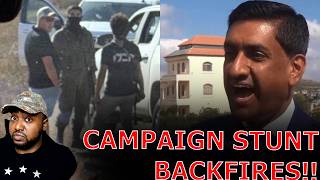 04:15
Ro Khanna describing the detention by Israeli settlers and IDF soldiers in the West Bank
Watch at 04:15 →
04:15
Ro Khanna describing the detention by Israeli settlers and IDF soldiers in the West Bank
Watch at 04:15 →
Khanna says they were held for about 20 minutes by settlers brandishing M4 rifles, followed by an additional detention after IDF soldiers arrived and told his translator they were siding with the settlers. His team called the US Embassy in Jerusalem, and after roughly 75 minutes total, they were allowed to leave. No one was physically harmed.
The IDF released its own statement telling a different story: troops were dispatched quickly, dispersed the civilians, and reopened the road. The IDF explicitly stated their soldiers did not take part in blocking the road. Khanna fired back calling the IDF statement a lie and demanded Prime Minister Netanyahu open an investigation into the settlers and the four IDF officers he claims were involved.
Here's the thing though — if Khanna knew this area was volatile, knew settlers had been violent there, and knew this was contested territory, why did he show up unannounced without coordinating with Israeli authorities or the US Embassy in advance? That question answers itself.
08:40
Khanna on camera saying the West Bank trip increased his resolve to consider a 2028 presidential run
Watch at 08:40 →
Is Ro Khanna's West Bank Trip a 2028 Campaign Stunt?
Let's be direct: yes, almost certainly. The pattern here is impossible to ignore. Khanna traveled to a foreign country, attempted to enter a politically sensitive and contested area without announcing his presence, got stopped — which anyone with a basic understanding of the region could have predicted — and then immediately used the incident to boost his profile as a 2028 presidential contender.
Within days of the detention, Khanna was on television saying the experience had increased his resolve to consider a White House bid. That's not the response of someone who was traumatized or genuinely alarmed. That's the response of a politician who got exactly the news cycle he was looking for.
The broader political context matters here too. Israel's favorability rating among Democrats has cratered — dropping from 59% in 2018 to just 22% in May 2025 according to Reuters/Ipsos polling. An increasing number of Democratic lawmakers are pushing to cut off military aid to Israel entirely. For a progressive Democrat angling for a 2028 primary run, being seen as a fearless advocate who physically went to the West Bank and got detained by the IDF? That's political gold in a Democratic primary field.
The problem is the stunt is transparent. You don't show up unannounced to a geopolitically sensitive area of a foreign country and then act shocked when border enforcement actually enforces a border. Other countries take their borders seriously. That's not a scandal — that's just how sovereign nations operate.
What Did the IDF Say About Detaining an American Lawmaker?
The Israeli military's account directly contradicted Khanna's version of events. In their statement, the IDF said troops and police officers intervened after receiving a report of settlers blocking vehicles near Khirbet Zanuta. Critically, they stated that IDF soldiers did not participate in the initial blockade and acted to resolve the situation.
14:22
Khanna acknowledging he got the Graham Platner endorsement wrong and asking for accountability
Watch at 14:22 →
Israel's police did not respond to media requests for comment, nor did the US Embassy in Jerusalem issue a public statement. Khanna's office said an embassy official named David Brownstein ultimately helped facilitate their release.
The dueling accounts leave a muddled picture, but one fact is undisputed: Khanna was not beaten, was not arrested, was not charged with anything, and was released after 75 minutes. For someone traveling unannounced through a militarized contested territory, being asked to stop and identify yourself is not a human rights violation — it's a border checkpoint.
What Is the Epstein Transparency Act and Who Does It Expose?
Separate from the West Bank drama, the video also touches on the Epstein Transparency Act, a bill designed to force the FBI to unredact its files related to Jeffrey Epstein's network. The bill was championed by lawmakers including Thomas Massie, who claims that in just two hours of digging, he and a colleague were able to identify six previously hidden individuals connected to the Epstein case.
The argument behind the bill is straightforward: if investigators could surface six names in two hours that the FBI had been concealing, what else is buried in the full three million files? The bill specifically targets what supporters call the Epstein class — wealthy and powerful individuals who allegedly used Epstein's network and whose identities remain protected by federal redactions.
The criticism lobbed at Khanna in this context is pointed and worth noting: Khanna positioned himself as a major Epstein crusader — but only after Donald Trump returned to office, when pursuing the Epstein angle became a useful political weapon against Trump and his associates. Critics argue he showed little interest in Epstein accountability before it became politically advantageous, which raises legitimate questions about whether his concern for victims is genuine or strategic.
Why Did Ro Khanna Endorse Graham Platner Despite Red Flags?
The Graham Platner endorsement is the story that cuts deepest into Khanna's credibility — especially for someone positioning himself as a champion of women's rights and accountability.
Platner, a Senate candidate in Maine, was backed by Khanna through a string of escalating controversies: a tattoo resembling a Nazi symbol, online posts that appeared to blame survivors of sexual assault, and a New York Times report detailing allegations from ex-girlfriends describing a pattern of emotional abuse and aggressive behavior — which Platner denied.
Khanna stuck with Platner through all of it. His stated line in the sand? Actual allegations of rape or sexual violence. When those came out, he withdrew his endorsement and told interviewers he got that call wrong and was asking for grace while acknowledging the need for earlier recognition of domestic violence warning signs.
The hypocrisy is hard to miss. The same congressman who presents himself as the moral conscience of the Democratic Party on issues like Epstein and Palestinian rights stood by an endorsed candidate accused of abuse until it became politically untenable to do so. That's not principle — that's politics.
How Are Democrats Weaponizing Israel-Palestine for 2028?
What Khanna's West Bank trip reveals more broadly is the emerging fault line of the 2028 Democratic primary. The Israel-Palestine conflict has become a defining litmus test in progressive politics in a way that would have been unimaginable a decade ago.
With Democratic favorability toward Israel at historic lows and a growing faction of lawmakers pushing to cut military aid, candidates positioning themselves for 2028 have a clear incentive to demonstrate their pro-Palestinian credentials loudly and visibly. Khanna's trip is an early example of what that's going to look like over the next three years.
The risk for Democrats is that these performances energize a progressive base in primaries while alienating broader general election voters who don't view a Middle Eastern territorial dispute as the central issue facing American families. But for a candidate like Khanna — who needs to stand out in what will likely be a crowded primary field — the optics of being detained by the IDF while standing in a destroyed Palestinian village might be exactly the image he's calculated he needs.
Whether voters buy what he's selling is a different question. Based on the available evidence, the West Bank detention story is less a human rights awakening and more a very expensive, very public campaign ad — paid for by bad judgment and a plane ticket.