Why Did Apple Sue OpenAI for Trade Secrets?
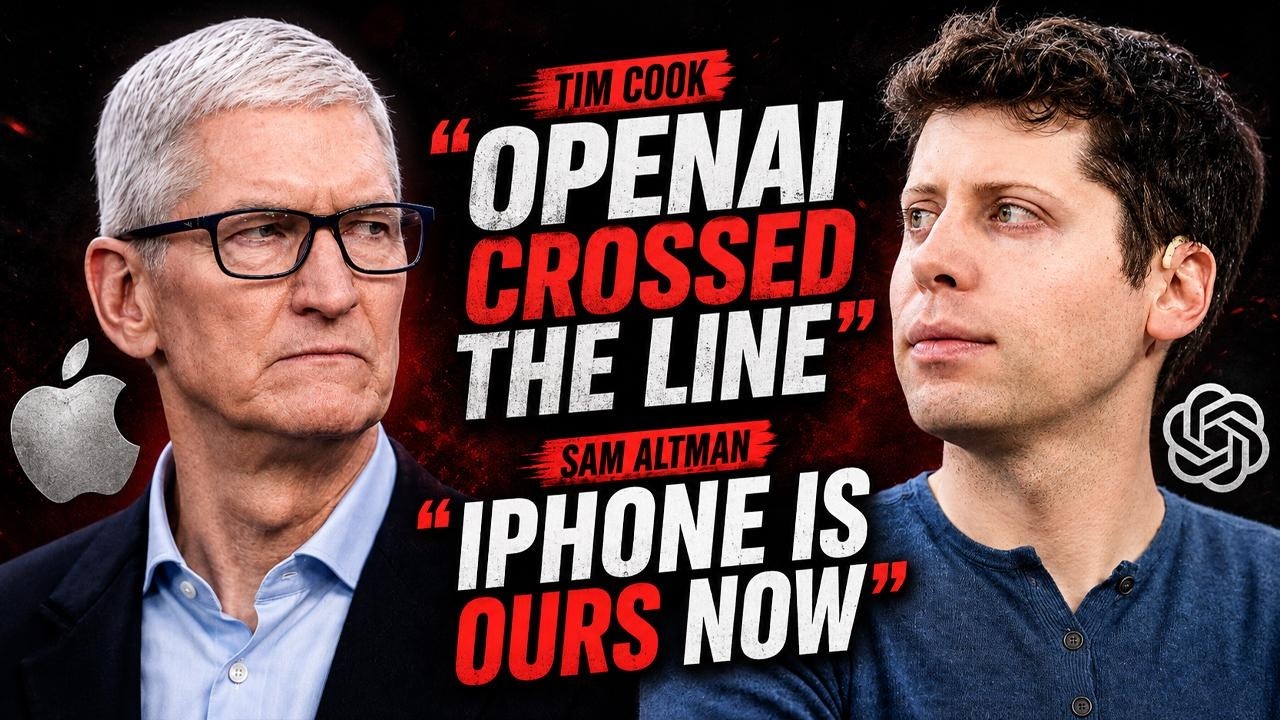
On July 10th, 2025, Apple sued OpenAI in federal court in the Northern District of California, accusing the AI company of systematically stealing trade secrets at every level of its organization. The 41-page complaint uses unusually brutal language, claiming OpenAI's entire hardware business is, in Apple's own words, rotten to its core. The suit names OpenAI, its recently acquired hardware startup IO Products, and two individuals: engineer Chang Lou and former Apple VP Tang Tan, now OpenAI's chief hardware officer. Apple says the theft happened through departing employees, manipulated job interviews, coached evasion of Apple's security teams, and even through a shared manufacturing supplier — no employee required.
This isn't a narrow technical filing. It's a declaration of war from one of the most litigious and well-funded companies on the planet, filed right as OpenAI is racing toward an IPO and betting its hardware future on building the device that replaces the smartphone.
What Did OpenAI Actually Steal from Apple?
The alleged theft covers a wide range of confidential materials: hardware designs, manufacturing details, testing procedures, engineering presentations, technical specifications, proprietary project data, and even Apple's internal code names used during recruiting. Apple says the stolen materials relate to unreleased products — things that have never seen the light of day publicly.
But the most alarming allegation might have nothing to do with employees at all. Apple claims OpenAI convinced a shared manufacturing partner — one that works with Apple on industrial design and metal finishing — to perform Apple's proprietary metal finishing process for OpenAI's benefit, and that the supplier was misled into believing Apple had actually consented. No one had to carry a file out the door. The leak ran straight through the supply chain.
AI governance expert Jean Gan flagged this as the scariest part of the case. Supply chains move trade secrets just as easily as departing employees do, and almost nobody's confidentiality frameworks treat them with the same rigor. That's a systemic vulnerability the whole industry should be reading carefully.
Who Is Tang Tan and Why Is He at the Center of This?
Tang Tan spent roughly 24 to 25 years at Apple. He ran product design on the original iPhone, led the entire iPhone design team by 2011, and later headed Apple Watch design. Colleagues described him as someone famous for taking risks and flying very close to the sun — moving fast, playing fast and loose, breaking things. Inside Apple, he was a legend.
In late 2023, Tan told Apple he was leaving. Apple did something rare: they let him stay through February 2024 to manage the transition. What they apparently didn't know was that behind the scenes, Tan was already working with Jony Ive and Sam Altman on a new AI hardware venture. He co-founded IO Products alongside Ive, Evans Hankey (Ive's successor as Apple's industrial design chief), and Scott Cannon, a former Apple manufacturing manager.
According to the lawsuit, Tan has been methodically funneling Apple's confidential information to OpenAI ever since. He allegedly emailed himself Apple supplier information before leaving. He used confidential Apple code names during OpenAI's recruiting process. And in what might be the most brazen detail in the entire complaint, Apple says Tan turned job interviews into intelligence-gathering sessions — briefing himself on a candidate's current Apple project just hours before the interview, then asking about that exact project. Apple says that became an established, repeating pattern.
There's also allegedly a checklist. Tan reportedly put it together personally and handed it to new hires, walking them through how to slip past Apple's security teams during offboarding and linger for a couple of extra weeks with full internal access still intact.
What Is IO Products and Why Did OpenAI Buy It?
IO Products is the hardware design startup co-founded by Jony Ive — yes, the Jony Ive who designed the iPhone, the iMac, and basically defined what Apple products look like for two decades before leaving in 2019. OpenAI acquired IO in May 2025 for roughly $6.4 billion. Ive himself is not named in the lawsuit.
The irony is sharp. Per people with knowledge of the situation, when OpenAI bought IO, the company had little beyond concepts and early prototypes and was still scrambling to land on a product strategy. They've explored earbuds, smart glasses, AI-enhanced speakers, and ultimately an AI-powered smartphone replacement. The first product, expected sometime next year, might be something more modest. Meanwhile, Apple is cooking up its own home devices, camera-equipped AirPods, glasses, and wearables. Both companies are gunning for exactly the same next-generation device market — which makes the lawsuit feel less like a legal filing and more like a pre-battle salvo.
How Did OpenAI Allegedly Poach Apple Employees?
The scale is staggering. More than 400 former Apple employees now work at OpenAI. This wasn't a trickle — it was a raid. Senior hardware and design leaders, whole chunks of engineering teams, lured away by salaries and stock packages that made Apple's comp look dated.
But Apple's complaint goes further than just aggressive recruiting. It alleges OpenAI encouraged candidates still employed at Apple to study confidential materials before interviewing and to physically bring hardware into OpenAI's offices — batteries, logic boards, CAD files, design artifacts, actual unreleased prototypes. At least one applicant was apparently uneasy about it, saying he was surprised people had brought unreleased hardware to interviews and didn't realize they could take those items off Apple's campus. In many cases, they couldn't.
Once people signed on with OpenAI, Apple says they were told to email themselves useful information before resigning and to notify OpenAI if Apple personnel asked them to sign anything during offboarding. The picture Apple paints is of a coordinated, institutionalized playbook — not a few rogue actors going off-script.
The case of Chang Lou is where the concrete evidence gets sharpest. Lou left Apple for OpenAI in January 2025 but, according to Apple, never returned his company MacBook. He also discovered a software authentication bug that still gave him access to Apple's internal file servers after his employment ended. Rather than report it, he allegedly used it to download dozens of confidential hardware files — and then texted his former colleague Alyssa Pang, "LOL, I found out I can access the network storage." Her reply: "I'm ready." She allegedly helped pull more material through her own laptop before joining OpenAI herself a few months later.
What Happened to the Apple and OpenAI Partnership?
These two companies were partners just a year ago. In 2024, they struck a deal to integrate ChatGPT into Apple Intelligence and the future version of Siri. That relationship deteriorated publicly. OpenAI at one point accused Apple of limiting ChatGPT's functionality on iPhones, effectively sandbagging it. By January 2025, Apple had dropped OpenAI entirely and turned to Google instead.
Apple says it didn't just lawyer up out of nowhere either. Back in February 2025, it reached out to OpenAI directly, raised its concerns, and asked what OpenAI was doing to investigate. OpenAI, per the complaint, never responded. So Apple filed suit.
What Is Apple Actually Asking for in This Lawsuit?
Apple is seeking injunctions to stop the alleged ongoing theft, monetary damages, declaratory judgments, and the return or destruction of any stolen materials. California's legal landscape actually constrained how Apple could structure the case — the state won't enforce non-competes and has largely rejected the inevitable disclosure doctrine, meaning Apple cannot do anything about those 400 employees simply existing at OpenAI. Talent moves freely there by design. So every single allegation rests on specific conduct: retained devices, unauthorized server access, misused documents, coached evasion. Trade secrets law is the only legal perimeter left, and Apple pleaded squarely inside it.
OpenAI's public defense, so far, is a single statement from spokesperson Drew Pazzeri saying they have no interest in other companies' trade secrets. Commentators were not impressed. Claiming no interest in Apple's secrets while literally having hired Jony Ive to build you a competing device is a tough message to land.
Why Did Elon Musk Pile On After Apple Filed Its Suit?
Because of course he did. Musk co-founded OpenAI in 2015, fell out with Sam Altman over control and direction, launched xAI in 2023, and has been in an ongoing legal battle with OpenAI over its shift from nonprofit to for-profit — reportedly seeking $150 billion in damages. A federal jury ruled against him in May 2025. He's appealing.
The moment Apple's suit dropped, Musk spent the weekend calling Altman "Scam Altman" and claiming Altman had stolen all of Apple's phone technology. Altman fired back, citing benchmark results and calling Musk "the actual fraud" for selling xAI data centers to public market investors. Musk countered that SpaceX satellites with 150 kilowatts of computing power each would launch next year, and that Altman could come watch — if his parole officer allows it, because in Musk's telling, Altman is headed to jail.
The real stakes, though, go well beyond the Twitter beef. Apple is a $3.6 trillion company in transition — Tim Cook is handing the CEO role to John Ternus in September, and most of OpenAI's Apple hires came directly from Ternus' hardware division. OpenAI is bleeding money and racing toward an IPO while Anthropic and Google close in. Both companies are building toward the same device. And as VC Livia Sabo put it, this filing just became a due diligence nightmare landing weeks before that IPO — a warning to every founder that IP and talent transition protocols get read line by line before term sheets get signed. This one is going to run for a while.