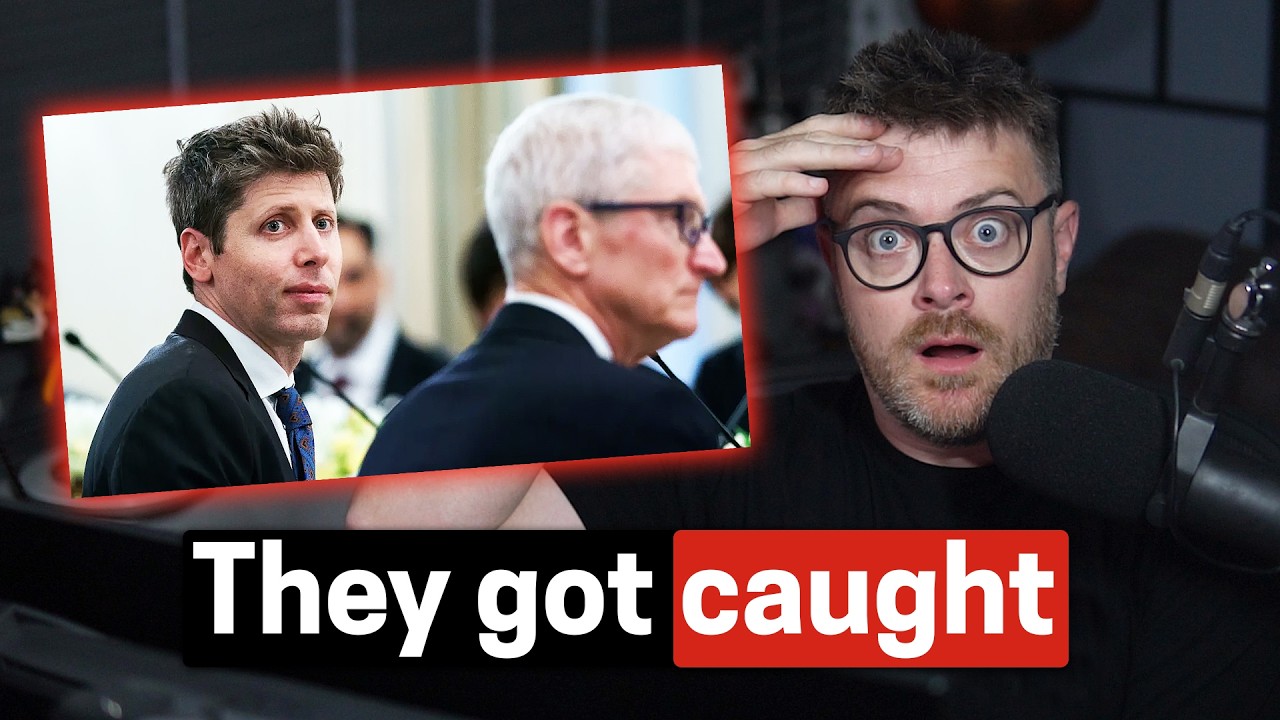

Apple is suing OpenAI for stealing trade secrets — and the details are genuinely shocking. The lawsuit, filed in the Northern District of California, alleges that former Apple employees handed over confidential hardware information, supplier data, and physical parts to OpenAI as part of the AI company's push to build its own consumer devices. This isn't a minor legal spat. If Apple can prove these claims in court, it could be one of the most damaging cases in OpenAI's short but turbulent history.
Why Is Apple Suing OpenAI for Stealing Trade Secrets?
The core of the lawsuit is pretty straightforward: Apple believes OpenAI was actively encouraging candidates interviewing for jobs — candidates who were still working at Apple at the time — to bring confidential information with them as a kind of "show and tell." We're talking about actual physical parts, chip designs, supplier contracts, and hardware files that belong exclusively to Apple.
 00:45
The moment the presenter explains why OpenAI wants Apple's hardware secrets
Watch at 00:45 →
00:45
The moment the presenter explains why OpenAI wants Apple's hardware secrets
Watch at 00:45 →
Why would OpenAI want this? Because OpenAI is trying to build its own hardware device — potentially a phone, a pendant, or some other consumer product — and to do that, they need to understand how Apple, the best hardware company on the planet, actually builds things. Rather than spending decades learning it themselves, it appears someone at OpenAI thought the faster route was just to take it.
This situation has been brewing for a while. In 2024, Apple and OpenAI signed a deal to integrate ChatGPT with Siri on the iPhone. By most accounts, that integration was a disaster. Ask Siri a simple question, and it would spend ten seconds deciding whether to hand you off to ChatGPT — and then ChatGPT would either fail, give the wrong answer, or produce an essay when all you wanted was the weather. A stopgap solution that never really worked. The relationship between the two companies has apparently gone downhill fast ever since.
What Exactly Did OpenAI Allegedly Steal from Apple?
The lawsuit names two specific individuals: Tan Tang, OpenAI's chief hardware officer, and Chang Liao, a member of OpenAI's technical staff. Both are former Apple employees.
03:20
Breakdown of the specific allegations against Tan Tang and Chang Liao
Watch at 03:20 →
Here's what Apple is accusing them of:
- Tan Tang allegedly emailed himself information about Apple's suppliers — think contract details, pricing, component specifications — before leaving the company.
- Tang directed job candidates who were still employed at Apple to physically bring Apple parts and hardware to their OpenAI interviews for a show-and-tell session.
- Chang Liao allegedly used a former colleague's work computer to access Apple's internal network and downloaded dozens of confidential hardware-related files.
- Liao reportedly coached that colleague — someone he was recruiting to OpenAI — on how to copy the files without triggering Apple's security team.
If any of this is proven in court, it's not just embarrassing for OpenAI — it's potentially catastrophic. This isn't someone accidentally taking a document home. This is alleged systematic, coordinated theft of Apple's most sensitive intellectual property.
Who Is Tan Tang, OpenAI's Chief Hardware Officer?
Tan Tang spent 24 years at Apple, rising to become a senior executive on the product design team. He worked directly with Jony Ive, Apple's legendary head of industrial design — the man responsible for the look and feel of essentially every major Apple product of the last two decades.
Tang left Apple to join Ive's AI device startup, IO Products, which later merged with OpenAI. That merger put Tang in charge of OpenAI's hardware ambitions. Notably, the lawsuit does not name Jony Ive directly, though the connection is hard to ignore.
07:10
Presenter explains the New York Times evidence-withholding accusation against OpenAI
Watch at 07:10 →
This also isn't the first time Tang's name has appeared in legal trouble. A separate startup called IO — developing a screenless, voice-controlled earpiece device — previously alleged that a former engineer stole files from their company and handed them over to Tang. OpenAI denied that one too. At some point, a pattern becomes hard to dismiss.
Is OpenAI Really Building a Device to Compete with iPhone?
Yes, and this is the underlying strategic reason all of this is allegedly happening. OpenAI has a fundamental business problem: they have millions of users, but they don't own the hardware those users access their products on. Every interaction goes through Apple's iPhone, Google's Android, or Microsoft's Windows. That means OpenAI is always one contract cancellation away from losing its distribution.
Apple, on the other hand, has the opposite problem. They have billions of devices in people's hands, but their AI is terrible. Their in-house AI offering has been embarrassingly weak in a world where everyone suddenly expects their phone to be intelligent.
If OpenAI could build a device — whether that's a phone, a wearable, an AI pendant, whatever — they could sell directly to consumers and actually start making money. Because right now, despite all the hype, OpenAI doesn't make money. They burn it. And with Google, Meta, Microsoft, and Amazon all either building their own models or offering cheaper alternatives, the pressure on OpenAI's business model is only growing.
Why Are Publishers Accusing OpenAI of Withholding Evidence?
While the Apple lawsuit is grabbing headlines, OpenAI is simultaneously fighting another major legal battle. The New York Times, the New York Daily News, and 15 other media organisations have filed a motion accusing OpenAI of withholding evidence in their ongoing copyright lawsuit.
The publishers originally sued OpenAI in 2023, claiming the company used their articles, stories, and journalism to train ChatGPT without permission or compensation. Now, they're alleging that OpenAI is refusing to hand over training data sets and ChatGPT output logs that would be central to proving their case — and they're calling for legal sanctions over it.
According to the filing, rather than simply producing the evidence and arguing fair use, OpenAI chose obstruction. That's a serious accusation, and if the court agrees, the consequences could range from financial penalties to rulings that go against OpenAI before the case even reaches its merits.
Are All AI Companies Stealing Copyrighted Content?
Here's the uncomfortable truth that the entire industry is dancing around: yes, basically all of them did. Every major AI model — GPT, Gemini, Claude, Llama — was trained on data scraped from the internet, including books, articles, videos, and creative works that were produced by real people who never consented and never saw a penny.
YouTube channels with thousands of hours of content. Authors whose books were digitised and fed into training pipelines. Journalists whose life's work was absorbed into systems that now compete with them. The argument from AI companies has largely been: it's on the public internet, so it's fair game. Courts are now starting to test whether that argument holds up.
The irony isn't lost on anyone. These same companies that built empires on arguably questionable use of other people's data are now suing each other for stealing. Meta is slashing model costs to undercut OpenAI and Anthropic on price. Google and Microsoft have their own models and their own revenue streams to fall back on. OpenAI and Anthropic have nothing except their models — which makes them uniquely vulnerable to being attacked from every direction simultaneously.
Could the Apple Lawsuit Actually Destroy OpenAI?
Destroy might be too strong a word, but this is genuinely serious. Apple is not a company that files lawsuits it doesn't think it can win. They have the resources, the legal firepower, and the evidence to make this extremely painful. If they can prove that OpenAI's chief hardware officer spent years systematically looting Apple's most sensitive IP, the reputational and financial damage could be severe.
More importantly, this case could open a very uncomfortable can of worms. If OpenAI was doing this with Apple, who else was it doing it with? And if the New York Times case results in sanctions or an unfavourable ruling, suddenly you've got existential legal pressure coming from multiple directions at once.
The AI wars are no longer just about who has the smartest model or the cheapest API. They're becoming a full-contact sport, with trade secret theft, copyright battles, and billion-dollar lawsuits. The friendly, collaborative era of AI development — if it ever truly existed — appears to be well and truly over.