
Can donut decorating be automated? Krispy Kreme has already tried — and the short answer is: not really. The company piloted robotic decorating systems, only to discover that glaze clogged the robots' joints, donuts got squished, and quality suffered. For now, the finishing touches on Krispy Kreme's famous donuts still require the hands, eyes, and — as one decorator put it — the love of a human being.
Can Donut Decorating Ever Be Fully Automated?
It's a fair question in an era where automation is disrupting nearly every industry. But inside a Krispy Kreme production facility, the answer becomes surprisingly clear the moment you watch a decorator work. While machines handle the heavy lifting — mixing dough, shaping rings, and applying a standard glaze — the moment a donut needs a seasonal swirl, a drizzle, or a limited-time design, a human has to step in.
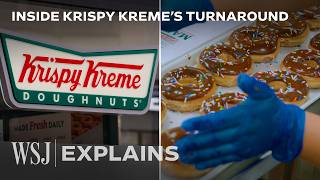 00:45
A Krispy Kreme decorator hand-finishing donuts at speed — the process automation has failed to replicate
Watch at 00:45 →
00:45
A Krispy Kreme decorator hand-finishing donuts at speed — the process automation has failed to replicate
Watch at 00:45 →
Krispy Kreme's leadership confirmed the company has actively explored robotic solutions. The results? Messy. "The glaze got into the joints of the robots," one executive explained. "It's pretty tough to not harm the quality of the donut. And that's the most important thing for us." A robot might be precise in a sterile environment, but a donut production line is warm, sticky, and fast-moving — not exactly robot-friendly terrain.
The decorators themselves aren't losing sleep over it. When asked directly whether her job could be automated, one Krispy Kreme decorator laughed it off: "A machine doesn't do it with love." Her colleague agreed immediately: "Robot can't do that. Not at all." It sounds sentimental, but there's real business logic underneath it. Hand decoration is what allows Krispy Kreme to rapidly roll out limited-time offers and seasonal flavors — a core part of what drives customer excitement and foot traffic.
What Happened with the Krispy Kreme McDonald's Deal?
If you've been following Krispy Kreme's business story, you already know the McDonald's chapter was supposed to be a game-changer. The idea: put Krispy Kreme donuts in thousands of McDonald's locations nationwide, giving the brand a massive new distribution channel and a wave of impulse purchases. It started promisingly. Then it didn't.
03:10
Inside one of Krispy Kreme's largest production lines, capable of making 400 dozen donuts per hour
Watch at 03:10 →
Krispy Kreme's CEO was measured but candid in explaining what went wrong: "We found that the revenue streams weren't necessarily sustainable over time because the conditions weren't as optimum as we have with many of our other customers." Translation: the economics just didn't work out the way they hoped. Selling through McDonald's introduced margin pressures and operational complexities that made the partnership difficult to sustain profitably at scale.
The collapse of that deal forced Krispy Kreme to go back to basics and launch a broader turnaround strategy. The company is now focused on franchising as a larger share of its revenue, shifting toward a more capital-light model that doesn't require as much direct investment to grow. It's a pivot that many struggling consumer brands have made — and one that Wall Street tends to reward when executed well.
How Does Krispy Kreme Actually Make Its Donuts?
Walk into one of Krispy Kreme's production facilities and the scale is immediately striking. The company manufactures much of its own equipment — an unusual move that gives it tight control over consistency and quality. The production process is a blend of serious industrial engineering and old-fashioned craft.
Machines mix the dough, cut and shape the rings, proof them, and run them through a glaze waterfall — that iconic moment where a plain donut becomes a glazed one. The core ring donut, or "coarse shell," is where automation works best. It's a repeatable, high-volume process that machines handle with impressive efficiency.
05:30
Krispy Kreme's CEO discusses the McDonald's partnership collapse and the company's turnaround plan
Watch at 05:30 →
But flavor changes? Seasonal designs? That's where the human element becomes irreplaceable. Changing from one flavor setup to another requires coordination across the team, and the hand-decorated element is what makes Krispy Kreme agile enough to respond to trends quickly. As one executive put it: "The fact that we still have that hand-decorated element allows us to be incredibly agile as a business and offer a huge variety for our guests."
How Many Donuts Can Krispy Kreme Make Per Hour?
The numbers are staggering. Krispy Kreme's largest production lines can produce 400 dozen donuts per hour — that's 4,800 individual donuts every 60 minutes, from a single line. Standard lines run at 200 dozen per hour. The company targets over 93% efficiency on those lines, meaning less than 7% of donuts are rejected for quality issues.
That efficiency target matters because quality control is relentless. Workers monitor each donut as it moves down the line, and any that don't retain the perfect shape are pulled. It's a small but real cost of doing business at this scale. More than 50% of all donuts Krispy Kreme sells are the original glazed — making that particular line the most critical in the entire operation.
How Many People Work at Krispy Kreme in the US?
Krispy Kreme employs more than 6,500 people across the United States, and a notable 10 to 15% of that workforce works specifically as decorators. Each decorator can produce up to 50 dozen donuts per hour — a pace that sounds manageable until you factor in the demand spikes that come with limited-time offers and promotional sales events.
One decorator described the hardest part of her job in one word: "The demand." When a popular new flavor drops or a holiday promotion launches, the volume can spike dramatically. That's the tension at the heart of Krispy Kreme's business model — a brand built on freshness, variety, and seasonal excitement, but dependent on human labor to deliver it at scale.
Is Krispy Kreme Finally Becoming Profitable?
After a period of missed sales targets and the high-profile McDonald's setback, Krispy Kreme launched a formal turnaround in mid-2024. The early results are encouraging. The company is forecasting 2 to 4% systemwide sales growth and has already seen margins improve by 250 basis points since the turnaround began.
The strategy centers on three pillars: growing through franchising rather than direct capital investment, improving operational efficiency across manufacturing and distribution, and leveraging technology for demand planning and supply chain optimization. The CEO is projecting a profitable year — a meaningful milestone for a brand that has struggled to translate its beloved status into consistent financial results.
Will GLP-1 Weight Loss Drugs Kill the Donut Industry?
It's the question hanging over every indulgent food brand right now. GLP-1 drugs like Ozempic and Wegovy are suppressing appetites for millions of Americans — and some analysts have wondered whether brands like Krispy Kreme face a structural headwind as a result.
Krispy Kreme's leadership isn't panicking. The CEO's answer was simple and direct: "When you have your moment of sweet treat sharing, it's got to be worth it. It's got to be amazing." The argument is that donuts were never an everyday staple for most people — they're a treat, an occasion, a shared moment. As long as Krispy Kreme makes the best version of that experience, the demand will hold.
It's a reasonable position. Premium indulgence tends to be more resilient than mid-tier snacking, because consumers who do splurge want the real thing. If GLP-1 drugs reduce overall sugar consumption, the brands most at risk are probably the ones selling cheap, forgettable sweets — not the ones with a cult following and a hot glazed donut that's genuinely hard to resist.
The Bottom Line
Krispy Kreme is a brand at a genuinely interesting crossroads. It's got iconic products, a loyal fanbase, and real manufacturing expertise — but it's fighting to prove that love for the brand can translate into sustainable profits. Automation will keep improving the core production process, but the heart of what makes a Krispy Kreme donut special? That's still — for now — a human story.