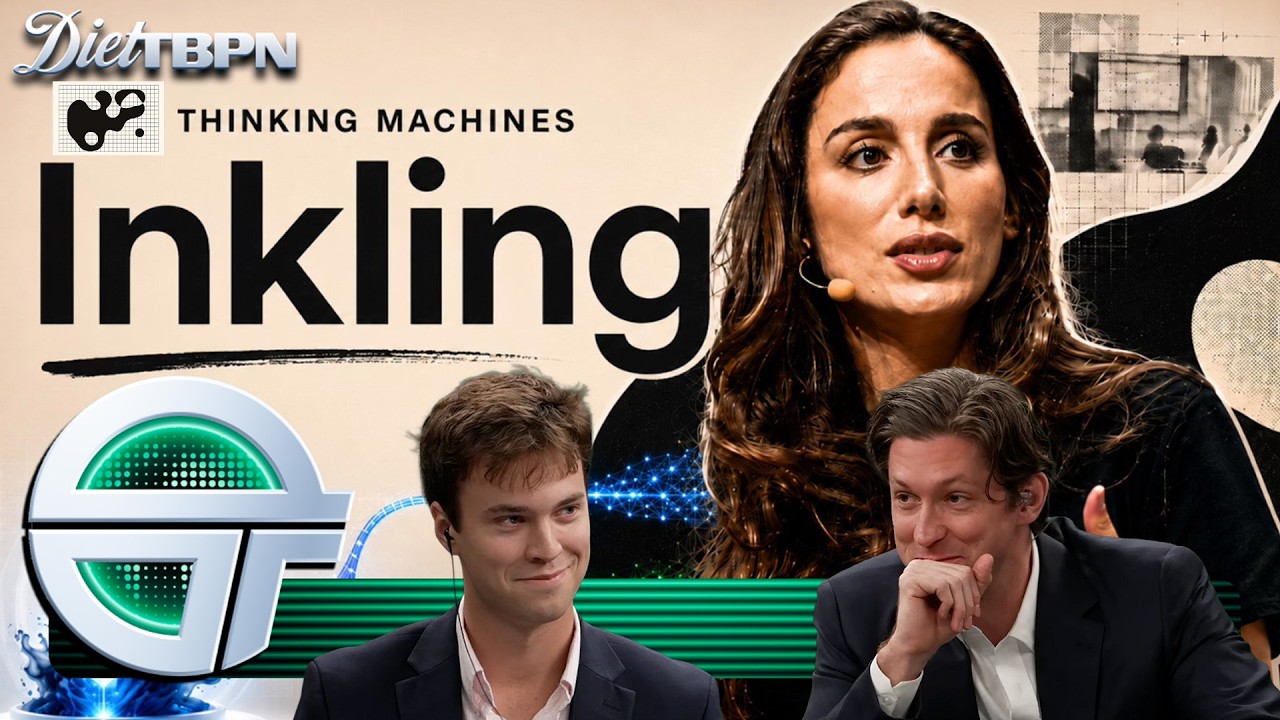

Mira Murati's AI startup Thinking Machines Lab has released its first model — and it's open weight. Called Inkling, the model comes in at 975 billion total parameters, making it one of the largest open-weight models outside of China. If you've been asking what is the Thinking Machines Inkling AI model, the short answer is: it's a broad, foundational model built specifically to be fine-tuned, and it may be the most strategically timed open-source AI release of the year.
What Is Thinking Machines' Inkling AI Model?
Inkling is an open-weights AI model from Thinking Machines Lab (TML), the startup led by former OpenAI CTO Mira Murati. Released this week, it has 975 billion total parameters — but only around 41 billion are active at any given moment, meaning it uses a sparse mixture-of-experts architecture rather than a traditional dense model design.
 02:15
Breaking down Inkling's 975B parameter architecture and what 'open weights' actually means for developers
Watch at 02:15 →
02:15
Breaking down Inkling's 975B parameter architecture and what 'open weights' actually means for developers
Watch at 02:15 →
Murati described it plainly to the Wall Street Journal: "We trained it to be a broad, balanced, foundation model strong across many domains, flexible enough to adapt." Notably, she did not claim it's the best model on the market. That's a deliberate departure from how most AI labs talk about their launches — where everyone is always the best at something. Inkling is pitched as adaptable, not dominant.
The open-weights approach means anyone can download the model weights and fine-tune Inkling on their own data — a crucial detail that ties directly into TML's core business: the Tinker API, a platform for fine-tuning AI models for enterprise customers.
Why Did Mira Murati Go Open Source with Thinking Machines?
The open-source strategy isn't just ideological — it's a smart business move. Thinking Machines already makes money helping companies fine-tune AI models through the Tinker API. Releasing an open-weight model actually strengthens that business rather than cannibalizing it.
Think of it like the Red Hat model: give away the software, sell the service. TML can go to enterprise clients and say, "Look, the model weights are yours to keep. You can leave anytime. But keep working with us because we're the ones making it actually work for your business." That's a compelling pitch — especially for companies nervous about vendor lock-in with closed-source providers like OpenAI or Anthropic.
08:40
The distillation debate: where Inkling's training pipeline gets complicated
Watch at 08:40 →
There's also a geopolitical angle. Just days before TML's release, reports emerged that Beijing is moving to restrict overseas access to China's top AI models. If you're a US-based enterprise and you want a powerful open-weight model you can run and customize freely, your options are suddenly more limited. Inkling arrives at exactly the right moment to fill that gap.
How Does Inkling Compare to OpenAI and Anthropic?
According to benchmark data shared on social media, Inkling beats Nvidia's Nematron 3 Ultra and sits between Kimi K2.5 and Kimi K2.6 in overall performance. Researcher DD Das called it "the best open-weight AI model outside of China."
But here's the nuance: Inkling isn't trying to beat GPT-5 or Claude at everything. It's not built for frontier benchmark chasing. It's built to be fine-tuned — which changes the evaluation entirely. For enterprises using the Tinker API, the question isn't "is it smarter than GPT-5?" It's "does it fine-tune well, run efficiently, and stay under my control?" On those terms, Inkling is a very credible option.
13:05
Anthropic's national security head names Zhipu as a distillation threat at the Aspen Security Forum
Watch at 13:05 →
Jack Morris of Engram Labs called it "the first pure open frontier coding model" trained without distilling from OpenAI or Anthropic — though that claim got complicated fast.
What Is AI Distillation and Why Is Everyone Fighting About It?
AI distillation is when you use a powerful, closed-source model (like GPT-4 or Claude) to generate synthetic training data, and then train a smaller or newer model on that data. The result: your model inherits some of the capabilities of the larger model without you having to generate all that intelligence from scratch.
It's common. It's effective. And it's controversial — especially when labs claim their models are independently trained.
In Inkling's case, TML's own blog post quietly noted that "to bootstrap post training, we ran initial supervised fine-tuning on synthetic data generated by open-weight models including Kimi K2.5." Since Kimi itself has been accused of distilling from closed-source models, you can see how the lineage gets murky fast. It's not a smoking gun — it's a light touch, one small piece of a larger pipeline — but it does complicate the "fully independent" narrative.
The broader debate is whether distillation is cheating or just smart engineering. The honest answer is probably somewhere in between: it accelerates development, but it also means many open-source models are implicitly standing on the shoulders of OpenAI and Anthropic whether they admit it or not.
Are Chinese AI Labs Stealing from OpenAI and Anthropic?
This is where things get heated. Anthropic's head of national security policy publicly accused Chinese AI lab Zhipu (Z.ai) of distilling both Claude and OpenAI models for their GLM-5.2 model — the first time Zhipu has been named specifically. DeepSeek, Alibaba, Moonshot, and MiniMax have all faced similar accusations previously.
The scale is staggering: Anthropic says it is shutting down distillation-related accounts at a rate of millions per week. This isn't a one-off shutdown of a rogue IP address. It's a distributed, industrial-scale operation. Some of it runs through pass-through companies — wrapper businesses that resell API access at scale — making it nearly impossible to watermark or trace once the tokens leave the system.
The strategic implication, according to Anthropic, is real: distillation is actively shrinking the US lead in AI. Their proposed solution involves the US government working with allies to clamp down on Chinese model adoption globally — similar to how the West coordinated around Huawei and ZTE in the telecom space.
- Zhipu's GLM is now described as "probably the most advanced Chinese model on the market," presenting significant cybersecurity challenges.
- Anthropic hinted it will expand access to its internal red-teaming tool Mythos to help cyber defenders keep pace.
- The distillation arms race is accelerating just as Western open-source options like Inkling are becoming viable alternatives.
TSMC Beat Earnings — So Why Did Nasdaq Drop 1%?
TSMC delivered a strong earnings report and raised its capital expenditure guidance, announcing plans to invest an additional $100 billion in US Arizona fabs. For a company that's been through every boom-bust cycle in semiconductors — smartphones, crypto, cloud — to finally go all-in on AI infrastructure is a significant signal.
And yet the Nasdaq dropped 1% on the news. The market's read: TSMC might be overspending. Even when the world's most important chipmaker says "now is the time," investors are nervous about what happens if AI demand softens before those fabs come online. It's the classic tension between long-term infrastructure conviction and short-term earnings discipline.
Why Did Saronic Pick Texas Over California's $3.2B Shipyard Deal?
Defense startup Saronic chose the Port of Brownsville, Texas over Solano County, California for its $3.2 billion automated shipyard — known as Point Alpha. The project is expected to create roughly 10,000 permanent jobs and thousands of union construction jobs.
What went wrong for California? Speed. Texas approved a $211 million tax abatement package in June to lock in the deal. California's permitting and environmental review process — despite labor groups backing fast-track legislation — never advanced far enough to give Saronic the certainty it needed.
As the executive director of the California Alliance for Jobs put it: "While Texas moved quickly and aggressively, California could not provide the clear, expedited approval process needed." For California Forever, the ambitious new city project in Solano County that had pointed to Saronic as a marquee tenant, it's a painful signal — even if the broader project claims to remain on track.
The Brownsville location also puts Point Alpha roughly 20 miles from Starbase, Texas — Elon Musk's SpaceX launch facility — continuing the quiet emergence of South Texas as a hub for ambitious industrial and defense projects.