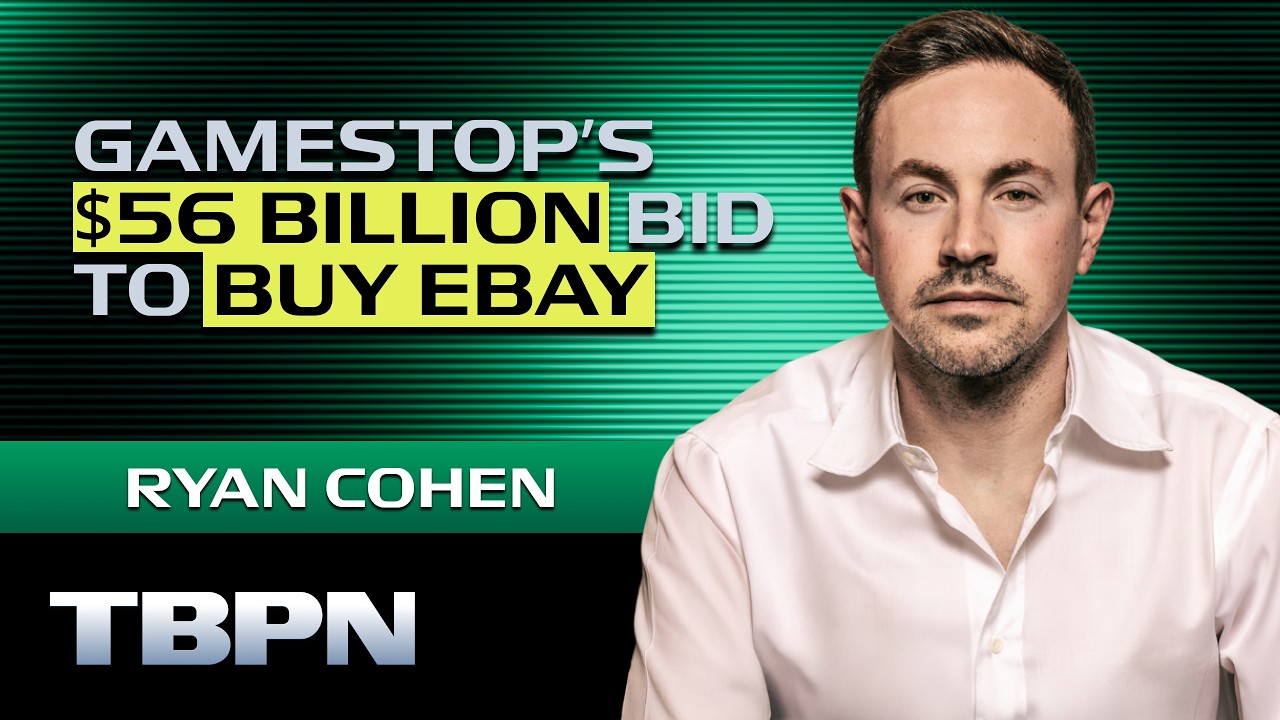

Ryan Cohen wants to buy eBay — and he's not being subtle about it. The GameStop chairman made a formal offer of $125 per share, structured as half cash and half stock, representing a roughly 40% premium from when he started buying shares. His pitch is simple: eBay is a durable, global marketplace that has survived every attempt to kill it, yet it's being run like a sleepy public utility instead of the growth engine it could be. Cohen believes he can change that — fast.
Why Did Ryan Cohen Make a Bid to Buy eBay?
Cohen's case for acquiring eBay starts with one observation: the platform still looks the same as it did in 1995, yet it generates over $2 billion a year in profit and has outlasted hundreds of well-funded competitors that tried to take it apart category by category. To Cohen, that kind of resilience signals an extraordinarily durable business model — one that's been starved of the operational discipline and ownership mentality needed to reach its true potential.
"I want to own eBay forever," Cohen said plainly. "It's run like a public utility. It should have been wiped out, but it hasn't been." He sees a company with 130 million users, $11 billion in revenue, virtually no inventory, and a largely asset-light model — yet it's burning $5.5 billion in operating expenses and employing over 11,500 people. In Cohen's view, that math simply doesn't add up, and the opportunity to fix it is enormous.
Cohen also sees a natural strategic fit with GameStop's existing infrastructure. GameStop's 1,600 retail locations could serve as physical authentication hubs for eBay's collectibles and luxury goods marketplace — a capability no other potential acquirer could bring to the table. Strategically, he argues, the combination is uniquely positioned in a way that pure financial or tech buyers simply aren't.
What Is Ryan Cohen's Plan for eBay?
Cohen's vision for eBay centers on three pillars: ruthless cost-cutting, a deep push into collectibles and authentication, and a major expansion into live commerce.
Collectibles and Physical Authentication
Cohen sees collectibles — trading cards, luxury goods, rare items — as eBay's highest-growth opportunity. The problem today is trust: buyers worry about authenticity, and sellers have no easy way to prove legitimacy. Cohen's solution is GameStop's store network. By routing high-value items through GameStop's 1,600 locations for in-person authentication, the combined company could dramatically increase buyer confidence and drive intake of premium inventory onto the platform.
"The founder of the show was talking about his Mont Blanc pen," Cohen noted. "That's a perfect eBay item — but you're always concerned about whether it's real. With 1,600 stores, we can immediately authenticate that item." He envisions this as a massive intake engine that no digital-only competitor can replicate.
Live Commerce
eBay has 130 million users and an existing platform for live selling — yet it's getting crushed by competitors. Cohen sees this as a fixable problem. His approach: improve the platform's UI to match competitor standards, then build deep partnerships with creators and offer them real financial incentives to drive sales. He acknowledged that the creator incentive structure at eBay is currently too shallow — a referral code here and there, rather than deeply integrated revenue-sharing that could ignite growth on social platforms.
Cutting Bloat and Running Lean
Cohen is blunt: eBay doesn't need 11,500 employees to run what is essentially a marketplace with no inventory. He pointed to billions in sales and marketing spend that, in his view, produces little measurable return — because, as he put it, "everyone knows eBay." He plans to apply the same operational philosophy he used at GameStop: cut hard, cut fast, and use the savings to pay down debt and fuel innovation.
How Is Ryan Cohen Financing the eBay Deal?
The deal structure is half cash, half stock. Cohen confirmed that the cash component — roughly $20 billion — is backed by a "highly confident letter" from his bank, and GameStop brings approximately $9 billion of its own cash to the table. The remaining consideration would come from existing eBay shareholders rolling their equity into the combined GameStop-eBay entity.
Cohen was candid that the rolling equity component was the part of the deal that caused the most confusion — particularly after a viral CNBC clip stripped context from his announcement. His position is straightforward: if he genuinely believes eBay is worth far more than $125 per share under his management, rolling equity is the rational choice. He said he would personally roll 100% of his own equity into the combined company.
When asked about international capital providers and sovereign wealth funds, Cohen acknowledged he is exploring a variety of financing options, leaving the door open for additional backers as the deal progresses.
How Did Ryan Cohen Cut Costs at GameStop?
Cohen's track record at GameStop is the foundation of his credibility here. He dropped selling, general, and administrative expenses (SG&A) by 47% — pulling roughly $800 million out of the cost structure. The primary lever? Nearly eliminating marketing spend. His logic: GameStop is a household name. Paying for marketing that doesn't generate a measurable return on investment, while internal teams fight to protect their budgets and vendor relationships, is a form of institutional waste he refuses to tolerate.
"I'm running the business like a family business," Cohen said. "It's really not that complicated." He extended that same critique to eBay, calling out board directors earning $350,000 to $450,000 per seat with zero insider buying — a signal, in his view, that leadership is not operating with true ownership stakes in the outcome.
Is Ryan Cohen's eBay Move the Next Twitter Takeover?
The comparison to Elon Musk's Twitter acquisition came up directly in the interview, and Cohen embraced the analogy — with caveats. He argued that Twitter's post-acquisition struggles had less to do with Musk's cost cuts and more to do with advertisers organizing against the platform for political reasons. What he took away from the Twitter example is that smaller engineering teams often innovate faster, not slower — and that adding headcount is frequently the enemy of velocity.
"The more people you add, the more you slow things down," Cohen said. "You've got to always be in startup mode." He expressed surprise that more CEOs haven't taken a similar approach with well-known but stagnant businesses — and made clear he intends to be one of the few who does.
What Is eBay's Live Commerce Opportunity?
Live commerce — selling products in real time via streaming video — is one of the fastest-growing categories in global e-commerce, yet eBay has barely scratched the surface. Cohen sees this as a massive gap. With 130 million users already on the platform, the audience is there. What's missing is a polished UI, the right creator partnerships, and incentive structures that actually make it worthwhile for top talent to stream on eBay over competitors.
Cohen's plan is straightforward: fix the technology, recruit the creators, pay them properly, and let the existing user base do the work. Unlike building an audience from scratch, eBay already has the demand — it just needs the supply side to be activated correctly.
What Happens If the eBay Deal Falls Apart?
Cohen made clear that acquiring eBay outright is the goal — but it's not the only play. If the M&A doesn't materialize, he floated the possibility of negotiating a business partnership where GameStop stores authenticate eBay items for a fee. He also noted that if needed, he would pursue a board seat and push for change from the inside.
He disclosed that he reached out to eBay roughly one to two years ago about a potential partnership and was met with what he described as a lack of urgency — slow responses, unavailable contacts, unanswered follow-ups. That experience, in part, is what convinced him that the company needs new leadership rather than a gentler nudge from the outside. As for other targets like Etsy, Cohen was dismissive — eBay is the fit he wants, and he doesn't appear to be shopping for alternatives.