
Jeff Bezos is in talks to raise $100 billion for an AI manufacturing fund — and if you've been on X (formerly Twitter) in the last 48 hours, you already know the internet has opinions. The breaking news set off a wave of reactions ranging from serious investor analysis to bewildered anti-capitalist confusion: "He has $200 billion. Why does he need to raise more money?" The answer, as it turns out, is pretty interesting — and the implications for American manufacturing, job creation, and economic independence could be enormous.
Here's everything you need to know about what Bezos is building, why he's the right person to build it, and which companies could end up in his portfolio.
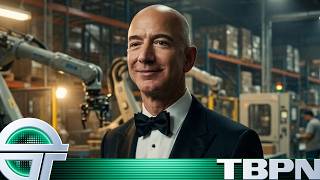 00:45
The hosts break down the viral reaction to Bezos raising money despite having $200B in net worth
Watch at 00:45 →
00:45
The hosts break down the viral reaction to Bezos raising money despite having $200B in net worth
Watch at 00:45 →
What Is Jeff Bezos's $100B AI Manufacturing Fund?
According to breaking reports, Bezos is in active talks to raise a $100 billion private fund focused on AI-driven manufacturing. The structure appears to be a private equity-style rollup — acquiring existing manufacturing companies, assuming their debt, and using artificial intelligence and operational expertise to drive efficiencies and growth across the portfolio.
The fund would reportedly pull money from sovereign wealth funds and institutional investors across the globe, with Bezos acting as the key architect and operator. Think of it less like a traditional VC fund and more like an American version of SoftBank's Vision Fund — but laser-focused on rebuilding the U.S. manufacturing base rather than betting on consumer tech startups.
The goals are multifaceted: job creation, economic independence, national security, and ultimately making physical goods — the cars you drive, the tires on those cars, the washing machine in your home — not just cheaper, but genuinely better through AI-assisted manufacturing.
Why Is Bezos Raising Money When He's Already Worth $200B?
This is the question that broke containment and flooded the anti-capitalist corners of X. If Bezos is worth $200 billion, why raise a cent from anyone else?
04:12
Discussion of how Bezos compares to Masayoshi Son and the SoftBank Vision Fund legacy
Watch at 04:12 →
The short answer: he wants to let other people in on the action, and more importantly, he likely won't be deploying his own capital for every dollar. In classic GP/LP fund structures, a general partner (Bezos in this case) commits a percentage of the fund — often 5–10% — while limited partners (sovereign wealth funds, institutions, family offices) provide the rest. A reasonable guess is that Bezos personally commits $20–30 billion as his GP stake, which is still an extraordinary number but leaves room for the fund to operate at true scale.
There's also a strategic logic here that goes beyond personal wealth. Raising a dedicated fund creates alignment, accountability, and a war chest that doesn't drain any single balance sheet. It also signals seriousness to sellers, regulators, and potential partners in a way that writing checks from a personal account simply doesn't.
Is Bezos Building an American Version of the SoftBank Vision Fund?
The SoftBank comparisons were inevitable the moment the $100 billion figure leaked. Round numbers at that scale carry exactly one association in the investing world: Masayoshi Son's Vision Fund.
Masa Son is a legendary figure — briefly the world's richest man during the dot-com boom, and also the man who holds the record for losing the most money in human history: $76 billion in two years. He made it all back, and then some, largely through transformative bets on Alibaba and ARM. The Vision Fund has had massive winners and a few spectacular black eyes (WeWork, anyone?).
07:30
Bezos's history with Amazon Robotics and one million deployed warehouse robots explained
Watch at 07:30 →
The framing of an American SoftBank isn't a bad one — but the Bezos version appears more operationally grounded and more specifically targeted. This isn't a bet on consumer apps or disruptive startups. It's a bet on physical infrastructure, supply chains, and the factories that make stuff. That's a meaningfully different risk profile, and arguably one better suited to a hundred-billion-dollar fund.
Why Is Bezos Uniquely Qualified to Revitalize US Manufacturing?
This is where the Bezos story gets genuinely compelling. Unlike most pure-play internet founders — think Zuckerberg building Meta on software-only economics with 80%+ gross margins — Bezos has spent his entire career operating in the physical world.
Amazon was never a high-margin software company. It competed with Walmart, Barnes & Noble, and a thousand other real-world retailers. It ran warehouses, managed inventory, hired truck drivers, and negotiated with suppliers. The margins were razor thin for decades, which forced an obsessive focus on operational efficiency at scale.
11:15
Breakdown of specific manufacturing companies Bezos could acquire with the fund
Watch at 11:15 →
That physical-world orientation produced some extraordinary results. In 2012, Amazon acquired Kiva Systems (now Amazon Robotics) for $775 million — a massive bet at the time. That bet paid off with over one million robots now deployed across Amazon's fulfillment network, handling inventory flow, warehouse automation, and last-mile logistics. Bezos didn't just write a check; he integrated hardware and software into a seamless operational system that runs at unprecedented scale.
Anyone who's watched Bezos give a tour of an Amazon warehouse or a Blue Origin facility knows this is personal for him. He lights up. This is a man who genuinely loves machines, systems, and the physical world — and that enthusiasm matters when you're running a hundred-billion-dollar manufacturing turnaround.
What Companies Could Bezos Buy for $100 Billion?
If this fund operates as a private equity rollup, the question becomes: what's actually in the portfolio? Here are some of the most interesting candidates, all sitting at the intersection of high revenues, thin margins, and massive AI upside:
- Lear Corporation — $23 billion in 2025 revenue, $5 billion market cap. Manufactures seats and electronic systems for automakers. Trades at roughly 13x earnings. AI applications across plant scheduling, supplier forecasting, and visual quality inspection could be transformative.
- BorgWarner — $14 billion in revenue, $9.5 billion market cap. A scaled auto supplier pivoting from turbochargers to EV components and battery packs. Already selling turbine generator systems for data centers — squarely inside the AI boom.
- Hexcel — Guiding to $2 billion in revenue with a $5 billion market cap. A leading producer of carbon fiber reinforcements for aerospace. Higher price-to-sales, but strategically critical for next-generation aerospace manufacturing.
- Goodyear Tire — $18 billion in revenue, $1.8 billion market cap. That's a 0.1x revenue multiple — almost criminally cheap. Quality control and downtime optimization are tailor-made AI use cases, and the competitive pressure from low-cost Chinese tire imports makes efficiency gains existential.
- Rockwell Automation — Around $40 billion market cap and already sits at the intersection of factory automation software and industrial controls. Less of a turnaround play and more of a control point for pushing AI into thousands of factories across the supply chain.
There's also speculation around whether Bezos goes even bigger — a Ford Motor Company, for instance, sits at roughly $45 billion. He'd need to lever up, but with a $100 billion fund and sovereign wealth backing, it's not out of the question. More likely, though, is that the focus stays deeper in the supply chain — the companies bending the metal, weaving the carbon fiber, and managing the logistics — where margins are thinner but brand risk is lower and AI upside is highest.
How Did Bezos Survive Losing 85% of His Net Worth in the Dot-Com Crash?
Like Masayoshi Son, Jeff Bezos has been through the fire. At the peak of the dot-com bubble, Bezos was worth roughly $8–9 billion. When Amazon's stock cratered, he lost 85% of his net worth — getting down to his last billion before the recovery began.
What he did during that period is what separates him from most operators. He didn't just keep Amazon alive through one of the most brutal market collapses in tech history — he simultaneously kept Blue Origin funded and operational. That's the part most people don't know.
When Did Bezos Start Blue Origin — and Was It Before SpaceX?
Here's a fact that surprises almost everyone: Jeff Bezos founded Blue Origin in 2000 — before the dot-com crash fully hit, and before Elon Musk founded SpaceX in 2002. Blue Origin is not a reaction to SpaceX. If anything, it's the other way around.
Blue Origin has operated in what might be called turtle mode for most of its existence — methodical, slower to ship, frequently trailing SpaceX in public milestones. But last year, New Glenn successfully launched and landed, and Blue Origin has now delivered humans to space and returned them safely. The rockets went up. The rockets came back. The goal was achieved without losing the company or burning through cash recklessly.
That kind of patient, disciplined execution — keeping a capital-intensive moonshot alive through a financial near-death experience — is exactly the disposition you want managing a $100 billion manufacturing fund. This isn't someone who panics when the numbers get ugly.
What's the Bottom Line on the Bezos Manufacturing Fund?
Whether this fund ends up being a classic PE rollup, a deeper supply-chain play, an Elon-style mega-corp with Blue Origin integrated into a new public entity, or something that tilts toward data centers and compute capacity — the scale and ambition are real, and the operator behind it is uniquely credentialed.
Bezos has spent three decades building systems that interface with the physical world, surviving financial catastrophe, and quietly keeping long-horizon bets alive. An American manufacturing renaissance backed by a hundred billion dollars and run by someone who genuinely loves factories? That's a story worth following very closely.