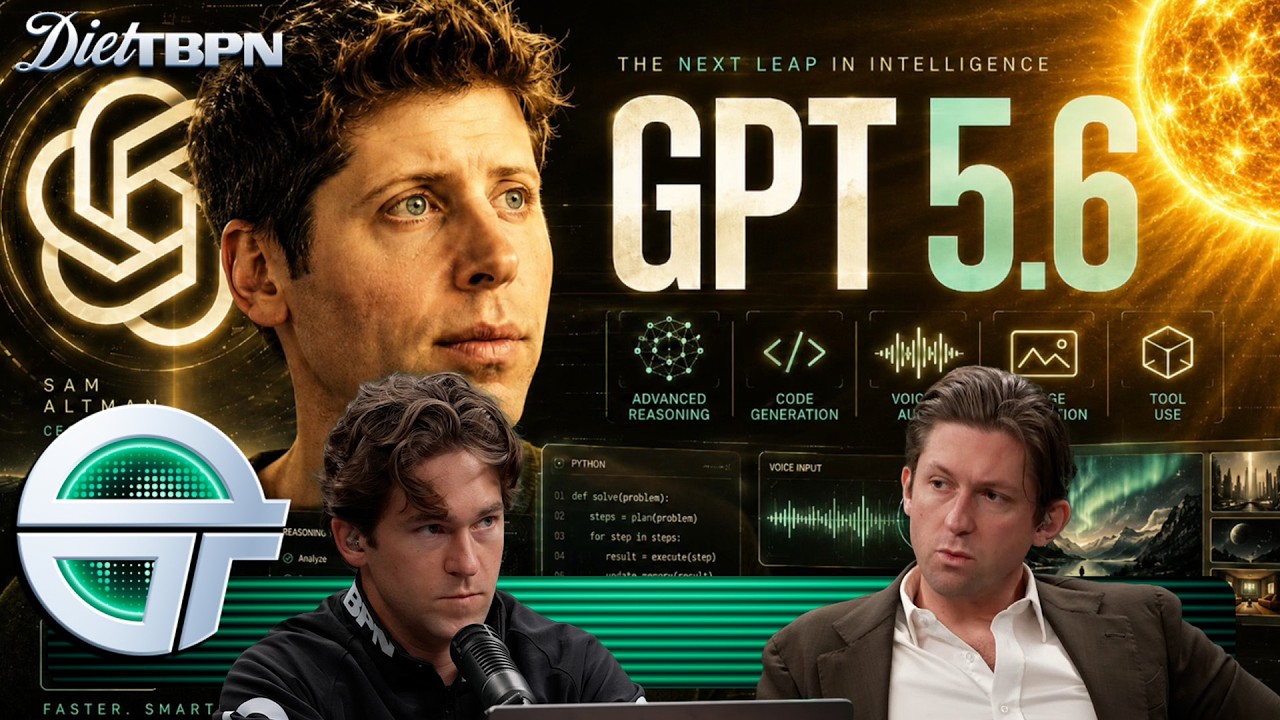

The AI race didn't slow down this summer — it accelerated. In the span of 24 hours, OpenAI released GPT-5.6 Soul, xAI dropped Grok 4.5, and Meta announced Muse Spark 1.1. If you've been trying to figure out the difference between GPT-5.6 and Fable 5, you're not alone. The short answer: they're apples and oranges. One is a collaborative workhorse, the other is a frontier research beast — and knowing which to reach for could save you serious time and money.
GPT-5.6 vs Fable 5: What's the Real Difference?
The most honest framing came from developer CQI Chen, who put it bluntly: Fable 5 is an F1 car. GPT-5.6 Soul Ultra is a Tesla Model X Plaid. Dylan Field, co-founder of Figma, backed this up on X, warning users not to compare the two models directly. "They're apples and oranges," he wrote. "Despite all the research achievements, we are still very early in exploring the tech tree for model training."
 04:12
Hosts break down the Fable 5 vs GPT-5.6 Soul comparison using hip-hop analogies
Watch at 04:12 →
04:12
Hosts break down the Fable 5 vs GPT-5.6 Soul comparison using hip-hop analogies
Watch at 04:12 →
Here's the practical breakdown of how they actually differ in daily use:
- GPT-5.6 Soul is faster, more affordable, and feels like a collaborative co-worker. Developers describe it as warm, communicative, and great at working through problems iteratively.
- Fable 5 is slower but hits harder on the hardest problems. It routinely finds solutions that 5.6 misses — but only some of the time, and at a higher cost.
- For day-to-day coding and planning tasks, Chen reported using GPT-5.6 more than 95% of the time, even with an unlimited token budget.
- For the most demanding frontier problems, Fable 5 still has the edge.
One user on X put it in hip-hop terms: Fable 5 is Kendrick Lamar on good kid, m.A.A.d city — dense, deliberate, and rewarding. GPT-5.6 Soul is Chief Keef on Finally Rich — immediate, energetic, and shockingly effective. Niche reference, but accurate.
What Is GPT-5.6 Soul and Why Does It Matter?
OpenAI launched GPT-5.6 Soul as a new general-purpose model with expanded coding and agentic capabilities. Alongside it came GPT Live, a real-time interactive voice experience that's already drawing strong early reactions from users.
07:45
Live demo of the Saltwind sailing mini-game from the GPT-5.6 launch blog
Watch at 07:45 →
A few standout details from the launch:
- It post-trained itself. OpenAI revealed during the live stream that GPT-5.6 Soul autonomously post-trained GPT-5.6 Luna. That's a significant milestone — and people are having a lot of fun with the implications.
- The launch blog included playable mini-games. One standout was Saltwind, a sailing game where players trim sails to match wind direction. The entire thing was vibe-coded in GPT-5.6 and deployed as a browser game. The best recorded time at broadcast: 25 seconds.
- Real-world validation is rolling in. Stanley Tang, co-founder and CPO of DoorDash, shared that GPT-5.6 solved a magic trick he'd been using as his personal AGI benchmark — a bulletproof trick that stumped 100+ people, including professional magicians, and wasn't anywhere on the internet.
The broader implication of that last point is worth sitting with. When models start solving problems that require genuine first-principles reasoning — not pattern-matching against training data — something real is happening.
What Is ARC-AGI v3 and How Did GPT-5.6 Score?
ARC-AGI (Abstraction and Reasoning Corpus) is widely considered one of the most meaningful benchmarks in AI — precisely because it's designed so that any average human can score close to 100%, but AI models have historically struggled. The puzzles test spatial reasoning, generalization, and pattern abstraction in ways that are hard to brute-force.
Here's where things stand on ARC-AGI v3:
14:30
Discussion of ARC-AGI v3 benchmark scores and what they mean for AGI progress
Watch at 14:30 →
- GPT-5.6 Soul scored 7.78%. That might sound tiny, but the context matters enormously.
- Claude Opus 4.8 scored 1.5% on the same benchmark.
- ARC-AGI v3 is deliberately unsaturated — we're nowhere near 99%, but the jump from 1.5% to 7.78% represents a massive leap in generalization and spatial reasoning.
The ARC-AGI team has done exceptional work building puzzles that filter out the kind of spiky, narrow intelligence that lets models ace math olympiads or hacking challenges. What they're searching for — and what they're beginning to see glimpses of — is something closer to broad, flexible human-like reasoning.
What Is Grok 4.5 and Is It Good for Coding?
xAI unveiled Grok 4.5 this week, marketing it as the first model spec built specifically for coding and AI agents. The model was designed in close collaboration with Cursor, the AI-powered code editor, which gives it a specific optimization target: performing well on real developer workflows.
Early benchmarks show Grok 4.5 outperforming competitors on Cursor Bench, though there's active debate about whether those results reflect genuine capability gains or optimization for the benchmark itself. The model sits at an interesting position on the Pareto frontier — not necessarily the best at everything, but potentially the best for a specific class of coding and agentic tasks.
The Cursor collaboration is notable. Rather than training a model and then seeing how it performs on developer tools, xAI appears to have built the tool relationship into the model's design from the start. Whether that approach generalizes beyond Cursor benchmarks is the key open question.
What Is Meta's Muse Spark 1.1 and How Does It Work?
Meta made a splash this week with Muse Spark 1.1, an agentic coding model that Mark Zuckerberg announced in a rare return to posting on X — his first active post in nearly a decade (lurking, apparently, doesn't count).
The standout capability is agentic reasoning and tool use. Zuckerberg described it as having "state-of-the-art or very close to it" performance on multi-step tasks that agents need to complete on behalf of users. Meta employees are already using it internally to build features across their apps.
Key technical and business details:
- Muse Spark 1.1 is not open source — marking a meaningful departure from Meta's historical open-weights strategy.
- It includes a new paid API tier for developers, Meta's first serious commercial API offering.
- Pricing will be "very aggressive," according to Zuckerberg, which makes sense given Meta's infrastructure efficiency and owned data center capacity.
Is Meta Charging for Its AI API Now?
Yes — and it's a bigger deal than it sounds. Muse Spark 1.1 represents the first time Meta has charged businesses for access to its models. Bloomberg reported Zuckerberg pledging "aggressive pricing" as a key competitive advantage. With owned infrastructure and no need to pay margin to a cloud provider, Meta is structurally positioned to undercut competitors on cost.
The internal dynamic is equally interesting. Meta has reportedly been buying compute from Google, Anthropic, and OpenAI — in some cases, providers couldn't keep up with Meta's demand. Now, with their own frontier model and owned infrastructure, the economic calculus flips. Running Muse Spark 1.1 internally costs essentially the electricity on cards they're already depreciating, versus paying margin on a closed-source model from a competitor.
The risk, as one analyst noted, is a classic resource allocation trap: if Meta's enterprise sales team sells all available compute capacity to external customers, internal teams may find themselves starved for the resources they need to actually ship products. It's a dance every lab is navigating right now — how much compute goes to research, internal use, API customers, and free tiers.
Do AI Model Version Numbers Actually Mean Anything?
Less and less. The version number originally tracked something real — the pre-training run. The decimal tracked post-training improvements. But as reasoning capabilities, agentic post-training, and inference-time scaling have all become separate axes of progress, fitting everything into a single number has become almost meaningless.
The practical result: model numbers are becoming more like car model years. Is this model on the frontier in 2026? It'll probably have a 6 in front of it by year's end. Don't be surprised if Meta skips Muse Spark 2 entirely and jumps straight to Muse Spark 5 or 6 — Samsung already pulled this move with their device lineup, and BMW has been doing it with model years for years.
The more useful question is flavor: which model fits your workflow? Fast and collaborative? Deep and expensive? Coding-optimized? Agentic-first? The version number tells you almost nothing about that. Benchmarks, developer reports, and your own testing tell you everything.
The Bottom Line: The Pareto Frontier Is Alive and Spiky
The AI summer that was supposed to be slow has turned into one of the most active release cycles in recent memory. Multiple companies are growing revenues — some accelerating — even as market share shifts. If you're only growing at 300% while a competitor grows at 400%, you're technically losing share in a market expanding fast enough that both numbers represent extraordinary businesses.
The frontier isn't one model or one company. It's spiky, flavored, and evolving weekly. The right question isn't who's winning — it's which tool fits which job, and how fast you can figure that out.