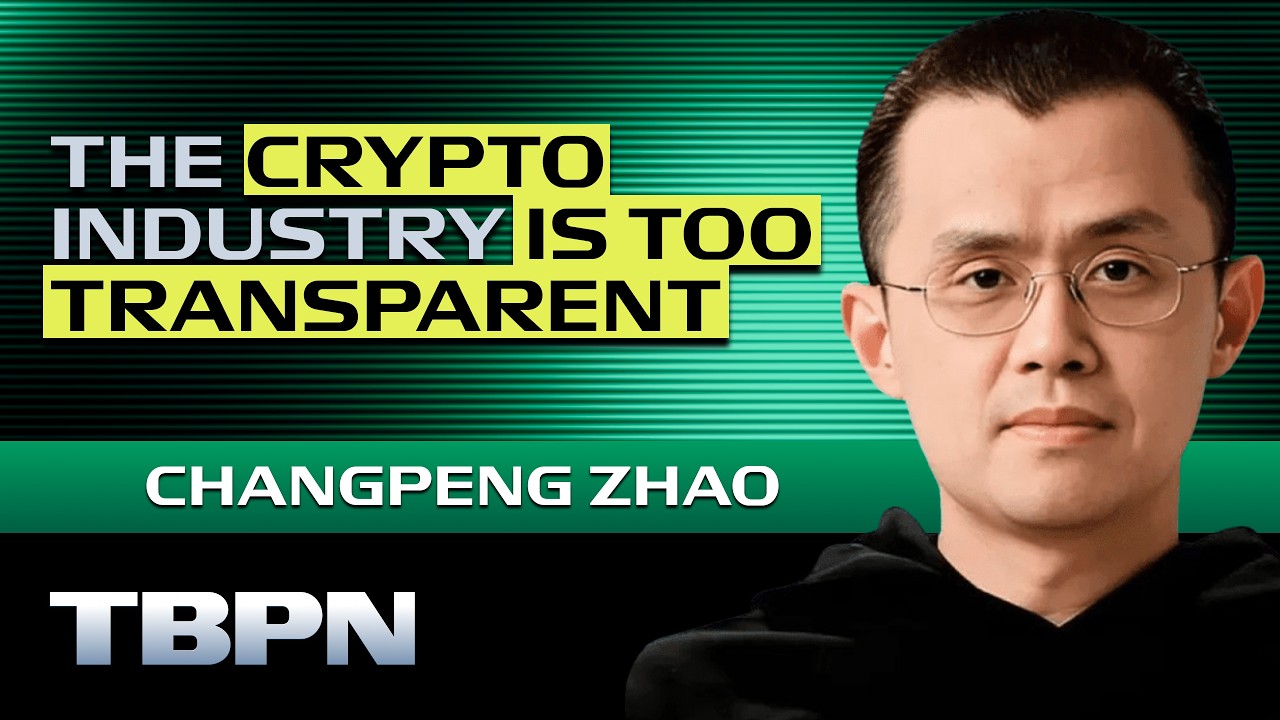

Binance founder CZ — one of the most recognizable and controversial figures in crypto — recently sat down for a candid interview covering everything from US crypto regulation and AI payments to Satoshi Nakamoto and the book he wrote while serving time in prison. If you've ever wondered what CZ actually thinks about the state of the industry, this conversation delivers some of his most direct answers yet.
What Does CZ Think About US Crypto Regulation?
When asked about the current regulatory environment, CZ was cautiously optimistic. He pointed to the Genius Act as a sign that the US is making real progress, but acknowledged there are still significant debates — particularly around stablecoin interest rates.
His core position is straightforward: any regulatory clarity is better than none. He doesn't expect the first iteration of rules to be perfect, but believes collaboration between regulators and the industry over time will produce better outcomes than paralysis.
On the question of privacy versus oversight, CZ made a point that might surprise critics: he thinks crypto is already too transparent. Because the blockchain is a public ledger, and centralized exchanges collect KYC data, it's actually quite easy to trace transactions — often more so than in traditional finance. His concern is that individual financial privacy is being eroded without people realizing it. He gave two concrete examples:
- If your employer pays salaries in crypto, anyone who knows your wallet address can trace every payment and figure out what your colleagues earn.
- If you pay for a hotel in crypto and your address is known, people can tell you're staying there — a genuine security risk for high-profile individuals.
His view is that the industry needs to find a balance that satisfies regulatory requirements while still protecting personal privacy — though he admits he doesn't know exactly where that line should be drawn yet.
Why AI Agents Will Use Crypto Instead of Banks
One of the most forward-looking parts of the conversation was CZ's take on the intersection of AI and crypto. He ranked AI, blockchain, and the internet as the three biggest technologies of his adult lifetime — and he believes the two are on a collision course that most people haven't fully thought through.
His argument is simple: AI agents cannot use traditional banking. They can't do a selfie verification. They don't have a passport. They can't complete a standard KYC process at a bank. Meanwhile, payment infrastructure varies country by country, making it difficult to build globally.
Crypto solves this. Integrate once with a blockchain, and it works globally. It handles microtransactions. It scales. And as AI dramatically increases the volume of automated transactions, traditional payment rails may simply not be able to keep up.
The flip side is also true: CZ believes AI will make crypto easier and safer to use. He pointed to tools like Claude (Anthropic's AI) as examples of technology that could help developers find and fix security vulnerabilities in crypto projects before hackers do. His overall take on AI and crypto security? Security is going to get better, not worse.
Does CZ Know Who Satoshi Nakamoto Is?
The answer is no — and CZ was refreshingly candid about the nuance here. He admitted that even if he did know, he'd probably say no anyway. But he genuinely doesn't.
More interesting than the denial is how CZ has come to peace with not knowing. He said Satoshi is the one person in the world he'd most want to meet — but he's no longer actively trying to figure it out. His reasoning is actually quite principled:
If Satoshi's identity were revealed, it would introduce what CZ calls "founder centralization." Look at Ethereum, where Vitalik Buterin's presence creates a focal point — for better or worse. Bitcoin's unique power comes from the fact that its founder has stepped away completely, possibly permanently. That absence is a feature, not a bug. It makes Bitcoin more decentralized and harder to attack from a governance standpoint.
He also reflected on whether anyone could pull off a Satoshi-style anonymous launch today. His verdict: almost certainly not. The OPSEC required to stay anonymous both digitally and physically in 2025 is nearly impossible. The fact that no one has credibly identified Satoshi after 15+ years suggests the person's operational security is extraordinary — a standard almost no one alive could replicate.
Is Quantum Computing a Real Threat to Crypto?
CZ's take here is measured and optimistic. Yes, quantum computing could theoretically break existing encryption mechanisms. But he sees this as a solvable engineering problem, not an existential threat.
Here's why: quantum-resistant encryption algorithms already exist. The cryptography community has been working on this for years. The solution isn't panic — it's a protocol upgrade. Blockchains would need to migrate to quantum-safe encryption, but that's a technical challenge, not a fundamental flaw in the concept of crypto itself.
He also pointed out the other side of the coin: more computing power generally benefits crypto networks. Quantum computing may actually unlock new encryption mechanisms we haven't even imagined yet — ones that use quantum properties to encrypt in ways that make decryption exponentially harder.
Why Did CZ Write a Book While in Prison?
The backstory here is both practical and human. CZ had a lot of time on his hands during his prison sentence — and he was bored. So he started writing. He finished the book after he got out.
His goal wasn't to mount a legal defense or point fingers. He wanted to share his perspective on a story that he feels has been badly misrepresented — by traditional media, by regulators, and by critics of the crypto industry broadly. He described the book as being written in plain, straightforward language, the way a "simple tech guy" would tell his own story.
The audio version is in production. A human narrator — his friend Michael Santos — will read it for Amazon's Audible platform (Amazon currently prohibits AI-generated voices). But CZ is also experimenting with an AI-cloned version of his own voice for other platforms. His assessment of the AI clone? It reads more smoothly than he does. The main bugs are mispronounced Chinese names and reading "$400" as "dollar four hundred" — errors he says represent maybe 1% of the total output.
Will NFTs and DAOs Ever Make a Real Comeback?
CZ is genuinely optimistic here, but with an important caveat: the second wave of any crypto trend usually looks somewhat different from the first.
He compared early NFTs and DAOs to early video streaming — the concept was always sound, but the technology, timing, and user behavior weren't quite aligned yet. He thinks tokenizing art and digital ownership will return in a significant way. Whether it'll be called "NFTs" or something else entirely, he doesn't know.
On DAOs specifically, he noted they've never really taken off despite years of excitement. But he doesn't think the concept is dead — just early. Many technologies spend a decade maturing before they find their moment.
He's similarly bullish on prediction markets, which he sees as already hitting an inflection point. The fund he's involved with — Easy Labs — has invested in multiple prediction market platforms. His framing of what makes them interesting: they use price to discover truth rather than using information to drive trading. That inversion, he thinks, is genuinely novel and powerful.
What Americans Get Wrong About Global Crypto Adoption
CZ was direct: Americans have been paying some of the highest fees in the world to access crypto, largely because the most competitive exchanges and the deepest liquidity pools are not US-based — a direct consequence of years of regulatory hostility under the previous administration.
The biggest blockchains, the biggest stablecoins, the biggest exchanges — none of them are headquartered in America today. Talent and capital fled. With the Trump administration taking a more favorable stance, CZ sees the tide turning, but says the largest players haven't fully committed to returning yet.
His overall message: America has the entrepreneurial talent, the VC ecosystem, and the traditional market depth to catch up quickly. But it will take time to rebuild what was lost — and consumers will keep paying inflated costs until that liquidity returns.