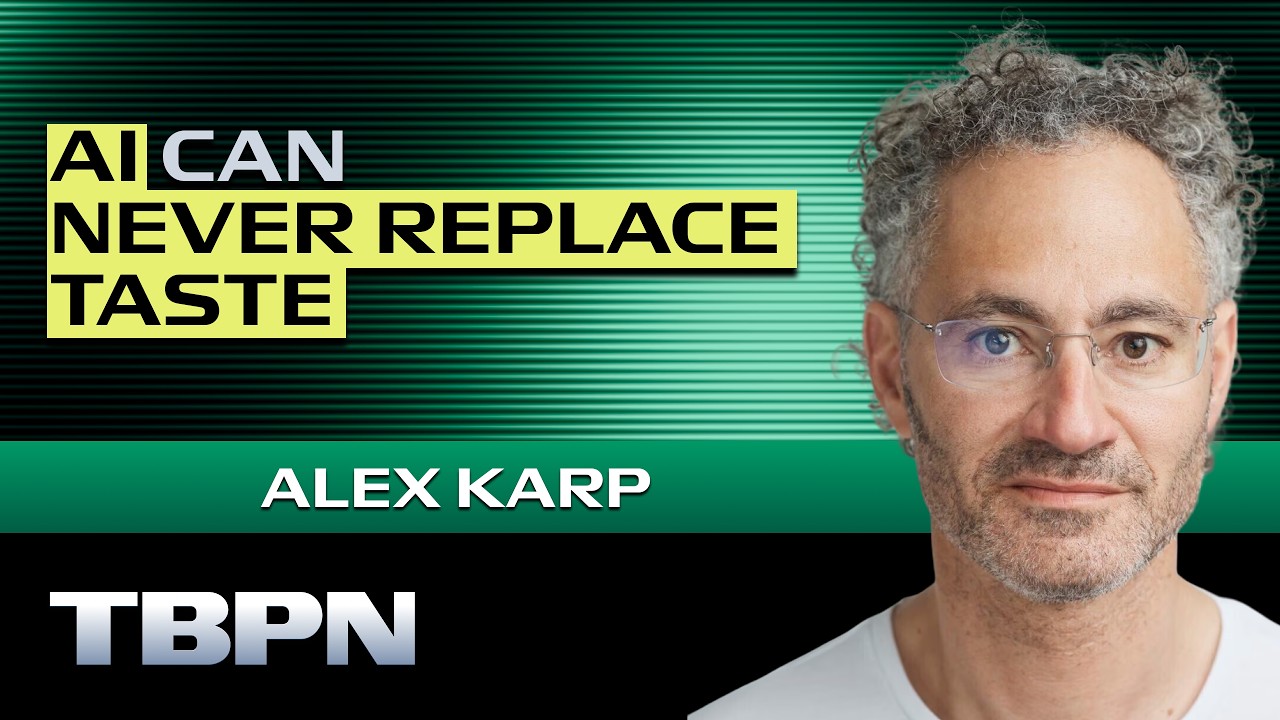

Token maxing in AI — the habit of flooding enterprise workflows with AI-generated outputs that look productive but solve nothing — is one of the biggest problems facing companies trying to actually deploy artificial intelligence today. According to Palantir CEO Alex Karp, it's not just wasteful. It's closer to a corporate addiction. And if you're running a business, it is quietly destroying your ROI while your employees feel extremely busy doing absolutely nothing of substance.
What Is Token Maxing and Why Is It Killing Enterprise AI?
Karp describes token maxing bluntly: it's what happens when employees sit around all day consuming AI outputs — reorganizing emails, generating reports, classifying data — without ever solving a real business problem. Internally at Palantir, there's apparently a colorful internal name for their product that combats this behavior, designed to get enterprises off what Karp calls the "masturbation" cycle of AI consumption.
 02:15
Karp explaining the 'token maxing' problem in enterprise AI — comparing it directly to addiction
Watch at 02:15 →
02:15
Karp explaining the 'token maxing' problem in enterprise AI — comparing it directly to addiction
Watch at 02:15 →
The pattern is uncomfortable to admit but easy to recognize. Employees feel productive. Dashboards get generated. Emails get summarized. And at the end of the quarter, nothing material has changed. Karp compares the psychological pull of this behavior directly to addiction: "It feels so good. It feels productive. One more dashboard. It can't hurt that much." But it does hurt. It costs money, wastes compute, and gives executives a false sense of AI progress while their competitors who are actually solving hard problems pull ahead.
The core issue is that large language models are genuinely magical at certain things — writing code quickly, generating probabilistic analyses, producing dashboards — but that magic doesn't automatically translate into solving the structural problems that actually determine whether a business wins or loses.
How Is AI Actually Being Deployed in Enterprise and Defense?
Karp breaks AI deployment into three distinct layers, using Palantir's own architecture as the model:
- Primitives (Infrastructure Code): Hardcoded systems that deeply understand specific operational environments — what the Ukrainian military uses, what defense departments rely on. This took millions of technical hours to build and cannot be replicated quickly.
- Managed Code (FDE Layer): Code written by Forward Deployed Engineers, managed on top of Palantir's core product. This is where enterprises write to a codebase Palantir actively maintains and improves.
- Free Code: The LLM-generated layer. Fast, almost right, great for dashboards and probabilistic analysis. This is where the magic — and the addiction — lives.
The real competitive moat, Karp argues, isn't in any of these layers alone. It's in the ontology — the deep organizational knowledge structure that sits underneath everything, built over years of actual enterprise deployment. An ontology captures the specialized way a company underwrites risk, drills for oil, manages supply chains, or makes targeting decisions on a battlefield. LLMs enhance these structures. They don't replace them, and they certainly can't conjure them from scratch.
08:40
Karp breaking down Palantir's three-layer code architecture for enterprise AI deployment
Watch at 08:40 →
For defense specifically, Karp notes that soldiers at every level — not just special operators — are now running Palantir's products. High school-educated, vocationally trained personnel are operating systems that would have required specialized analysts a decade ago. That's what real AI deployment looks like in practice: capability multiplication across the entire stack, not replacement of the humans at the bottom.
Is AI Replacing Jobs or Making Workers More Valuable?
This is one of the most politically charged questions in technology right now, and Karp's answer is more nuanced than the headlines suggest. His view: when AI genuinely upskills a worker, that worker becomes more valuable, not redundant. The battery worker, the truck driver, the corporate analyst — if they're learning to work with AI tools that amplify their output, they're worth more to their employer and the economy.
The danger, Karp warns, comes from corporate leaders who publicly celebrate headcount reductions enabled by AI without acknowledging the broader social consequences. He's unusually direct about this: if you run around telling the world that AI let you fire two-thirds of your workforce, you are handing ammunition to the most anti-business political forces in the country. And the executives doing this, he argues, genuinely believe they're insulated from the backlash. They're not.
The working-class perception of AI is already deeply negative in ways that Silicon Valley hasn't fully absorbed. Bus drivers, union workers, small business owners — they are not celebrating the AI moment. They're watching costs go up and wondering who benefits.
18:22
Karp warning about AI nationalization risk and describing his conversations with major tech CEOs
Watch at 18:22 →
Will AI Companies Be Nationalized Before They Can Scale?
This is where Karp gets most urgent, and most uncharacteristically blunt even for him. For the past six months, he says he's been calling major tech leaders — titans of the industry — warning them that AI companies face a real risk of nationalization or suffocating regulation driven by politicians who fundamentally do not understand the technology.
The response he gets? Amusement. Disbelief. "It's never happened in America. We're so likable. We're creating so much value." Karp finds this dangerously naïve. His argument: the AI industry has a significant portion of the public convinced it's either dangerous, predatory, or both. Frontier AI companies are beloved by investors and deeply unpopular with the broader enterprise world and general public. That asymmetry, combined with regulatory pressure from people who don't understand what they're regulating, is a serious structural risk.
His message to anyone in tech who's comfortable: stop sleepwalking. Nationalization or crippling regulation doesn't require malicious intent. It just requires a political class that's angrier than you expect, moving faster than you're watching, with more public support than your investor base suggests.
What's the Real Difference Between LLMs and Enterprise AI?
The simplest version of Karp's distinction: LLMs are a powerful ingredient. Enterprise AI is the recipe, the kitchen, and the 20 years of knowing which dishes your customers actually need.
Frontier LLM companies, he argues, are charismatic with investors and largely not charismatic with enterprise buyers who've been burned by overpromising tech before. Palantir's counterintuitive sales strategy reflects this: rather than competing head-to-head for skeptical enterprise buyers, they encourage those buyers to spend two days with the frontier AI companies first. After that experience, Palantir's door looks a lot more appealing.
The deeper point is about taste — the ability to identify which business problems are actually worth solving, which data should stay on-premise, which processes need precision versus which can tolerate probabilistic outputs, and how to deploy human talent alongside AI systems in ways that compound over time. Taste cannot be tokenized. It cannot be generated by an LLM. And it is the single most important variable separating AI deployments that transform organizations from those that just generate expensive dashboards.
28:55
Dead hang training protocol breakdown — one max effort per week, not daily grinding
Watch at 28:55 →
Why Do Frontier AI Companies Fail at Enterprise Sales?
Karp's diagnosis is sharp: many frontier AI companies are popular within a closed circle — investors, researchers, tech media — and have no real read on how unpopular they are outside that circle. They mistake investor enthusiasm for market validation. They mistake social media engagement for enterprise trust. And they've never had to sit across from a Fortune 500 procurement team, a government contracting officer, or a union rep and explain exactly why their product justifies the risk and the spend.
Palantir's unusual advantage here is that polarization cuts both ways. Yes, Karp estimates Palantir has around five million people who wake up convinced he's a villain. But they also have tens of millions of global fans and, more importantly, deep credibility with the serious enterprise buyers who actually do the work. The companies without that credibility are discovering that being beloved by venture capital is not a substitute for being trusted by the people who actually run operations.
How Do You Train Dead Hangs Without Burning Out?
On a completely different note — Karp has a dead hang time of five minutes thirty seconds, which is genuinely elite-level grip and shoulder endurance. The protocol he uses is surprisingly simple and runs counter to what most people do when they first hear that number and decide to train toward it.
The biggest mistake: hanging every day. Dead hangs require recovery like any other strength training. Doing them daily leads to plateau or injury, not progress.
Karp's actual weekly structure:
- One primary day per week: Hang for your maximum. Don't try to hit your all-time best — aim for around 75-80% of your max and fight to hold it. If your max is two minutes, work to hit one minute thirty and don't force the extra thirty seconds.
- Day two (next day or day after): Two sets of one minute with a long break. Lower intensity, staying loose.
- Days three and four: Progressively shorter sets — four times fifteen seconds, something light.
- One full rest day before your next max attempt.
The hosts on this podcast noted they're currently in the one minute thirty range, which Karp affirmed is genuinely respectable. Two minutes, he said, is super elite. The path there is consistency on this simple weekly structure — not grinding through daily hangs until your tendons revolt.