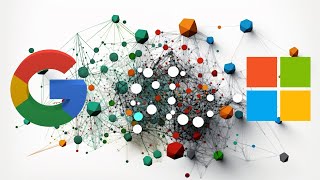
Yes — Google is genuinely threatened by ChatGPT and Microsoft Bing, and anyone who tells you otherwise probably isn't paying attention. For the first time in decades, Google finds itself behind the curve on a technology shift that could fundamentally change how people find information online. The question isn't really whether Google will survive. It's whether Google can adapt fast enough to avoid losing the one thing its entire trillion-dollar empire is built on: search.
Is Google Really Threatened by ChatGPT and Bing?
The short answer is yes, and Google knows it. Reports of an internal "code red" at Google signal just how seriously the company is taking the rise of AI-powered answer engines. Right now, Google controls roughly 85% of global search traffic — an absolutely dominant position. But that share is either stagnant or slowly declining, even though Google is the default search engine on most browsers, phones, and apps.
 03:15
Microsoft's $1B initial investment in OpenAI in 2019 and the Azure compute partnership that came with it
Watch at 03:15 →
03:15
Microsoft's $1B initial investment in OpenAI in 2019 and the Azure compute partnership that came with it
Watch at 03:15 →
Here's the uncomfortable math for Google: at best, they can only hope to maintain their current position. People who search online are already going to Google. A better AI experience isn't going to dramatically grow the total pie of search users. But at worst? Google could lose its core business entirely — and Google's current valuation was sitting around $1.1 trillion at the time this was recorded, after already shedding roughly $100 billion in value in just a few days following the ChatGPT buzz intensifying.
For Microsoft and Bing, the calculus is completely different. At worst, they lose $11 billion. At best, they become the dominant force in search and earn a 100x return on that investment. When the upside and downside are that asymmetric, you can understand why Microsoft is swinging hard.
What Is ChatGPT and Why Did 100M People Sign Up?
ChatGPT is a large language model — essentially a massive transformer-based neural network trained on enormous amounts of text — paired with a technique called Reinforcement Learning from Human Feedback (RLHF). OpenAI released it as a free research preview in late 2022, and what happened next was nothing short of extraordinary.
07:45
ChatGPT hitting 100 million unique users in under two months — the fastest-growing app in history
Watch at 07:45 →
Within two months, ChatGPT reached nearly 600 million total visitors, with 100 million unique users — making it the fastest-growing consumer application in history. For context, it took Instagram years to reach those numbers.
Why did it explode? Because it actually works, and it's genuinely addicting to use. You can ask it almost anything — coding help, essay writing, brainstorming, explaining complex concepts — and it responds in fluent, confident natural language. Yes, it gets things wrong sometimes (often, actually), but the experience of using it feels like talking to an incredibly capable assistant rather than typing keywords into a search box and sifting through ten blue links.
There's also something worth noting that most people overlook: speed matters enormously. One of the reasons Google won the search wars in the first place was its response time. The silent killer of any web application is latency. ChatGPT managed to deliver fast, high-quality responses at massive scale — a genuinely hard engineering problem — and they pulled it off with only minor outages on a free public demo. That's a serious engineering achievement.
Why Did Microsoft Bet $11 Billion on OpenAI?
The Microsoft-OpenAI relationship goes back further than most people realize. In mid-2019, Microsoft invested just over $1 billion into OpenAI, which also came with Azure cloud compute power for training models. That was the opening move. Then in January 2023, news broke that Microsoft was putting in another $10 billion, bringing their total stake to 49% of OpenAI, with Microsoft set to earn 75% of all profits until they recoup their initial investment.
But here's what makes the full picture even more interesting: back in late 2018, Microsoft acquired GitHub for $7.5 billion. At the time, it seemed like a strange move — what does Microsoft, a software giant, really want with an open-source code repository? Fast forward to mid-2021, and GitHub Copilot launches as a technical preview. It's essentially a GPT-style model trained on code — essentially all of GitHub — and for developers, it's genuinely life-changing at $10 per month.
14:20
Google's Bard promotional ad containing the factually incorrect claim about the James Webb Space Telescope
Watch at 14:20 →
GitHub Copilot is a perfect example of a large language model applied brilliantly to a real-world use case. The suggestions are good, the speed is there, and it integrates seamlessly into how developers already work. It was a preview of exactly what Microsoft intended to do with Bing: take powerful AI and wrap it in an application people actually want to use.
What Is Google Bard and Can It Beat ChatGPT?
Google's answer to ChatGPT is called Bard, which is powered by LaMDA (Language Model for Dialogue Applications) — a large language model Google has been developing internally. On February 6, 2023, Google published a blog post announcing their commitment to bringing Bard to users.
The problem? The blog post read less like a confident product announcement and more like a plea to investors to be patient. There was no substantial demo, no concrete release date, and no real evidence that Google had a deployable product ready to compete. The next day, February 7th, Microsoft responded with their own blog post announcing ChatGPT integration into Bing — and given that they're a 49% stakeholder in a product that had already scaled to 600 million users, it wasn't just a press release. It was a statement of fact.
Google's credibility problem here is real. They've been an AI research leader for years — they literally authored the "Attention Is All You Need" paper in 2017 that created the transformer architecture underpinning every one of these models, including ChatGPT. They also produced BERT in 2019. The technology isn't the issue. Deployment is.
Why Did Google's Bard Ad Backfire So Badly?
Also on February 6th, Google shared a promotional ad for Bard. The ad showed Bard answering the question: "What new discoveries from the James Webb Space Telescope can I tell my 9-year-old about?"
Bard's response, delivered with full confidence in the ad, stated that the JWST was the first telescope to take photos of exoplanets outside our solar system. That's factually wrong. That distinction belongs to other telescopes that came before it.
What made this so damaging wasn't just the error itself — ChatGPT makes errors like this constantly, and everyone knows that. What made it catastrophic is that this was Google's own cherry-picked example. This wasn't a random user catching a bug in the wild. This was the specific moment Google chose to show the world what Bard could do. And they didn't even fact-check it before publishing.
The fallout was immediate — Google's stock dropped, contributing to that ~$100 billion in market cap loss mentioned earlier. It perfectly illustrated the impossible position Google is in: they need to move fast to stay competitive, but they cannot afford to move recklessly because their entire brand is built on being the trusted, authoritative source of information.
Will AI Answer Engines Replace Google Search?
We are likely approaching the end of the "type a query, click through ten links, deal with ads, maybe find your answer" era of search. The shift toward direct answer engines — where you ask a question and get a conversational, synthesized response — is already happening. The real question is who owns that experience.
Google's advantage has always been trust and speed. Bing's advantage right now is that it has almost nothing to lose. Even if Bing drives away every single current Bing user with a buggy AI experience, the 85% of the market currently on Google is still out there waiting to be won. Bing can afford to be the scrappy, quirky, sometimes-wrong answer engine while it improves. Google cannot.
That said, it's way too early to write Google's obituary. Google has enormous resources, incredible research talent, and infrastructure that took decades to build. The next 12 months are going to be genuinely fascinating to watch as both companies — and potentially new challengers — race to define what search looks like in the AI era.
What Are the Best ChatGPT Alternatives Right Now?
Beyond Google Bard and Bing's ChatGPT integration, a few other players are emerging in this space worth keeping an eye on:
- You.com — A search and chat hybrid where you can converse with an AI similar to ChatGPT while also seeing traditional search results blended in. Users can upvote and downvote answers to help improve results over time. It's genuinely enjoyable to use.
- OpenAssistant.io — An ambitious effort to fully open-source and crowdsource a ChatGPT-like AI that could be self-hosted or even run locally on your own machine.
These alternatives point to something important: the real disruption might not come from Google or Microsoft at all. It might come from a more open, less restricted answer engine that doesn't constantly remind you it's "an AI language model" and refuse to engage. The winning product in this space will likely be the one that's most useful, fast, and enjoyable — not necessarily the one backed by the biggest company.
These are genuinely exciting times to be alive if you're into AI and technology. Google's stumble, Microsoft's massive bet, and the explosion of ChatGPT are all happening simultaneously, and we're only at the very beginning of figuring out what this all means. Stay tuned — it's only going to get more interesting from here.