A rare convergence of signals is unsettling markets: Bank of America has triggered what it calls the "dragon" warning, a historically bearish indicator, while two of the market's most prominent capital raises — SpaceX and Google — are simultaneously draining liquidity from the system. Layered on top is a Federal Reserve chair who appears to be deliberately buying time before cutting rates, even as inflation threatens to overtake unemployment. The result is a market under meaningful pressure, and the risks are not evenly distributed.
The Liquidity Drain: SpaceX and Google Hit the Market at the Same Time
SpaceX is refinancing approximately $20 billion in debt maturing within the next year — a rational move, but one that follows an already enormous capital raise of $75 billion plus a $10 billion green shoe. Returning to the market yet again for more is a meaningful suck of liquidity at a moment when capital is neither cheap nor abundant.
The market dynamics around SpaceX's stock have turned sharply negative. With only roughly 4% of shares available to trade at IPO, momentum drove the stock above $217 per share. That scarcity premium has now completely unwound. The stock fell over 16% in a single session. Because SpaceX is expected to be added to the NASDAQ 100 within 15 days of trading, its decline is already pulling index funds down with it — indiscriminate selling that drags unrelated names lower.
 05:30
SpaceX stock price decline chart showing drop from $217 to current levels
Watch at 05:30 →
05:30
SpaceX stock price decline chart showing drop from $217 to current levels
Watch at 05:30 →
Google's situation adds another layer. The company is conducting an $80 billion stock sale to fund its AI ambitions. Berkshire Hathaway underwrote roughly $10 billion of that via a private placement at a 7% discount — a discount that has already been largely erased by market movement. The remaining $70 billion is more concerning: approximately $30 billion in shares is expected to hit the open market by the end of June, with an additional $40 billion in at-the-money offerings beginning in Q3. That means July, August, and September could see overlapping selling pressure from both tranches simultaneously.
Google is still up over 33% year-to-date and remains a high-quality business. But the timing of this capital raise, colliding with SpaceX's refinancing, creates a supply glut that the market must absorb against a backdrop of already rising yields.
The Dragon Warning Explained
Bank of America's "dragon" warning is triggered when the CPI inflation rate rises above the unemployment rate. The unemployment rate currently sits around 4.3%. CPI for the 12 months ending May 2026 printed at 4.2% — nearly identical, and trending in the wrong direction. If inflation crosses above unemployment, the Fed is effectively forced to keep rates elevated for longer, compressing the capital available for AI investment and corporate expansion.
The warning is reinforced by the behavior of the yield curve. The spread between the 2-year and 10-year Treasury yields — a standard measure of curve shape — has fallen to its lowest level of Donald Trump's second term, matching levels last seen in December 2024. This is a bear flattener: both short and long yields are rising together, signaling that markets are pricing in stagflation rather than growth. Cash becomes more attractive. Risk assets become less so.
18:45
2-year vs 10-year Treasury yield spread chart showing bear flattening trend
Watch at 18:45 →
Bank of America's Bull-Bear Indicator is currently sitting at 9.2 — extreme bullish positioning. Their sell signal triggered last month. Looking at the prior 17 sell signals since 2002, global stocks averaged a 2–3% loss over the following two to three months, with a 60% hit rate and a maximum drawdown of 20%. That is not a signal to panic, but it is a signal to stop aggressively adding risk in the near term.
Kevin Warsh and the Fed's Waiting Game
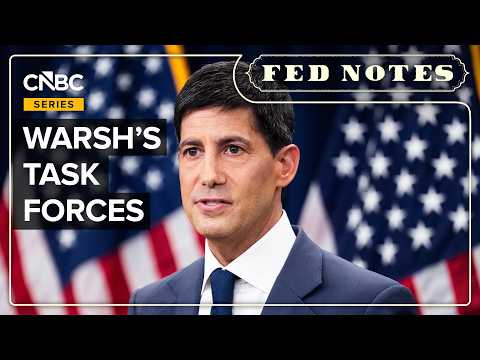
Federal Reserve Chair Kevin Warsh appears to be deliberately distancing himself from political pressure to cut rates. His approach: commission multiple task forces and wait for their findings, which conveniently may not arrive until year-end. This buys time to let oil prices fall further, allow AI disinflation to take hold, and watch whether the frenetic pace of AI capex spending slows on its own. If those conditions materialize, Warsh has political cover to cut rates without appearing to capitulate to the White House.
The risk of this strategy is duration. The longer rates stay high while CPI hovers at or above the unemployment rate, the more pressure accumulates on the real economy. Hawkish voices at institutions like TS Lombard argue inflation could persist for years and that rate hikes may even be warranted. The counterargument — and the more likely outcome, in this analysis — is that AI disinflation, more efficient models, and a plateau in token demand growth will produce significant deflationary pressure. The danger then flips: if a cautious Fed is too slow to respond, a reinverted yield curve could signal recession before rate cuts arrive.
AI Spending: Commoditization Risk Is Becoming Real
Microsoft CEO Satya Nadella has begun publicly discussing the commoditization of artificial intelligence — a significant signal. Token usage grew approximately 50x from 2024 to 2025 over a comparable one-month period. From 2025 to 2026, that growth rate has slowed to roughly 6.7x. The second derivative of growth is negative. Meanwhile, models are becoming more efficient, chips are becoming more efficient, and the value per token is declining.
This is showing up in competitive dynamics. Google's Gemini was dominant in late 2024. Anthropic surged ahead in spring 2025. Now there are early signs of a ChatGPT resurgence. One of Gemini's co-leads, a VP of engineering, recently departed Google for OpenAI after just two years. The race is tightening, and the returns on massive capex spending are becoming harder to justify.
The near-term implication for companies like Microsoft and Meta is continued earnings pressure as capex remains elevated. The longer-term thesis — that these companies eventually pivot from spending to harvesting, showing dramatically improved profitability through advertising and productized AI services — remains intact but will take time to materialize.
What Would Change the Outlook
The clearest path back to bullishness runs through disinflation. Oil prices, while down from recent highs, remain roughly 30% above their early-year levels around $60 per barrel on Brent. A further meaningful decline in oil would help. AI-driven disinflation — cheaper inference, more efficient models reducing enterprise costs — would help. A tariff rollback would help. Any combination that brings CPI meaningfully below the unemployment rate would defang the dragon warning and give the Fed room to cut without reigniting inflation fears.
The immediate near-term test is Micron's earnings. The stock has significant optimism priced in. A single miss — on revenue guidance, margin trajectory, or HBM demand commentary — could produce a 16–30% single-session decline. The upside case, detailed separately, rests on Micron trading at approximately 1.1x PEG, which is genuinely cheap, but only if the AI memory demand cycle continues uninterrupted. Given everything described above, that assumption deserves scrutiny.