
If you want to know what the best open-source AI projects are right now, the answer is scattered across GitHub — but this list cuts through the noise. From a 200,000-star agent harness that self-heals its own broken skills, to a free Mac video editor you can control with plain language, these are the tools that developers and builders are actually using. Here's every project worth bookmarking, ordered by how much they'll change the way you work.
What Are the Best Open-Source AI Projects Right Now?
Over a single weekend, a wave of high-quality open-source AI tools surfaced — many from major companies like ByteDance, Nvidia, Baidu, and Haygen, and others from influential developers like Matt Pocock and Y Combinator's Garry Tan. The combined GitHub stars across these projects run into the hundreds of thousands, which tells you this isn't hype — developers are voting with their attention. Let's go through each one.
 00:45
Open Montage generating a full cinematic sci-fi trailer from a text prompt
Watch at 00:45 →
00:45
Open Montage generating a full cinematic sci-fi trailer from a text prompt
Watch at 00:45 →
Open Montage — Your AI Video Production Studio (~15,000 Stars)
Open Montage turns your AI coding assistant into a full video production team. Describe what you want in plain English, and the agent handles research, scripting, asset generation, editing, and final composition. It ships with 12 production pipelines covering cinematic trailers, explainer videos, talking heads, screen demos, podcast localization, documentary montages, and more. It also packs 400 different agent skills. You can even hand it a clip you love and ask it to build something similar. Think of it as replacing an entire production crew with a single prompt.
What Is the Best Open-Source AI Agent Harness?
Two projects dominate the conversation here, and they represent very different philosophies.
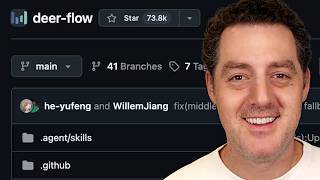
DeerFlow by ByteDance (~74,000 Stars)
DeerFlow — which stands for Deep Exploration and Efficient Research Flow — is ByteDance's open-source super-agent harness. What makes it different is its focus on long-horizon tasks: you hand it a complex goal and it works for hours, even days, orchestrating sub-agents, memory, and sandboxes to get it done. Use cases include building data pipelines, generating slide decks, spinning up dashboards, and automating full content workflows. If you've experimented with OpenClaw or Hermes, DeerFlow is the next logical stop.
03:20
Hyperframes rendering an HTML/CSS animation sequence as a finished MP4
Watch at 03:20 →
Hermes Agent (~200,000 Stars)
The Hermes Agent just crossed 200,000 GitHub stars, making it one of the most popular repositories on all of GitHub. Its standout feature is self-healing and self-improving behavior: if a skill fails during a run, Hermes automatically fixes it and improves performance for the next time. It has all the functionality you'd expect from a top-tier agent harness — and then some. It's a legitimate alternative to OpenClaw with a massive community behind it.
G Stack by Garry Tan (~114,000 Stars)
G Stack is president of Y Combinator Garry Tan's codified approach to building products. It's less a collection of tools and more a process: Think → Plan → Build → Review → Test → Ship → Reflect. It includes commands like /office-hours (mimicking a real YC partner session), plan reviews, design reviews, QA, canary deploys, and release documentation — all end-to-end. If you're building a startup and want your agent to think like a YC-backed founder, this is it. Installation is just a URL paste.
Matt Pocock's Agent Skills (~143,000 Stars)
Developer educator and Total TypeScript author Matt Pocock packaged everything he's learned about writing great code into a set of agent skills. We're talking about real engineering practices — not vibe coding. Features include Ask Matt (a router that picks the right skill for your situation) and Grill with Docs (a session that builds your project's domain model and keeps your context.md sharp). Over 143,000 stars means a lot of engineers have already decided this is worth their time.
08:10
Palmier Pro's AI-native video editor interface being controlled via natural language
Watch at 08:10 →
How Do You Turn HTML Animations Into MP4 Videos?
Hyperframes, from the company Haygen, is an open-source framework sitting at just above 30,000 stars. It converts HTML, CSS, media, and seekable animations into deterministic MP4 videos. Your agent writes the animation in HTML and CSS, and Hyperframes renders it to video using Chrome and FFmpeg. It's excellent for product demos, motion graphics, and presentation slides, and it supports animation libraries including Three.js. If you've ever wanted to programmatically generate polished video content, this is the cleanest path to get there.
How Do You Give Your AI Agent Cybersecurity Skills?
Anthropic's Cybersecurity Skills package (just under 20,000 stars) gives your agent a deep understanding of security defense frameworks. It ships with six cyber frameworks including MITRE ATT&CK, NIST, and the MITRE FiGHT Fraud Framework — co-developed by JP Morgan Chase, Citigroup, Lloyds Banking Group, CrowdStrike, and Verizon Business. It works with Claude Code, GitHub Copilot, Codex CLI, Cursor, and Gemini CLI. Any agent that supports skills can use it. Installation is a single URL copy-paste. Point it at your codebase and tell it to improve your defenses — that's it.
10:45
Voicebox interface showing voice generation with the Kokoro 1.7B model
Watch at 10:45 →
What Is the Best Open-Source AI Video Editor for Mac?
Palmier Pro (8,000 stars) is a fully AI-native video editor you can download for macOS right now — and it's completely free. The standout feature is its built-in MCP server, which means you can control the video editor directly through your AI agent. Connect it to Claude, Codex, or Cursor and describe your edits in plain language. The editor executes them. For anyone who wants to automate video editing workflows without giving up a real timeline-based interface, Palmier Pro is ahead of anything else in the open-source space right now. Windows and Linux support hasn't arrived yet, but it's worth watching.
How Do You Index a Massive Codebase for AI Agents?
Codebase Memory MCP by Deus Data (just above 12,000 stars) describes itself as the fastest code intelligence engine for AI coding agents. It indexes an average repository in milliseconds and can index the full Linux kernel — 28 million lines of code — in just 3 minutes. Structural queries resolve in under 1 millisecond. It supports 158 programming languages, uses 120 times fewer tokens than traditional approaches, and integrates with 11 agentic harnesses. It also includes a built-in 3D visualization so you can explore your codebase as an interactive graph. Installation is one line.
What Open-Source Tool Handles Voice Cloning and Transcription?
Voicebox (33,000 stars) aims to be both ElevenLabs and WhisperFlow in a single open-source package. It handles voice output (AI-generated speech) and voice input (transcription), running entirely locally on your machine if you choose. Features include near-perfect voice cloning, a stories editor for timeline-based audio editing, an audio effects pipeline, and unlimited generation. The interface is clean and the output quality is genuinely impressive — especially when you factor in that you can plug in local models and keep everything offline.
Baidu also dropped a brand-new open-weights vision language model (under 3,000 stars, released just days ago) built specifically for lightning-fast OCR. At only 6.5GB, it can read, analyze, and even highlight specific sections of PDF documents with precision — a surprisingly hard problem that this model handles quickly. Grab it from Hugging Face.
How Do You Scan AI Agent Skills for Security Risks?
Before you install any third-party agent skill, run it through Skill Specter from Nvidia (under 10,000 stars). It's a dedicated security scanner for AI agent skills that detects 65 vulnerability patterns across 16 categories, including prompt injection, data exfiltration, privilege escalation, and supply chain attacks. It accepts Git repos, URLs, zip files, directories, or single files. Given that agent skill ecosystems are growing fast and not every skill comes from a trusted source, having a Nvidia-backed scanner in your workflow is a no-brainer.
The Bottom Line
The open-source AI ecosystem just leveled up dramatically. Whether you need to automate video production, run long-horizon research agents, protect your codebase, or clone a voice — there's a free, high-quality tool for it right now. All project links are in the description. If you found this useful, the like button and a subscription go a long way toward keeping this kind of curation coming.