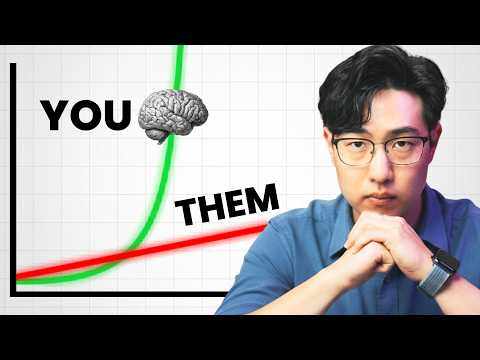

If you've always been smart, breezed through school, and understood things faster than your peers — but lately you feel like you're falling behind despite putting in real effort — you're not getting dumber. According to learning science, smart people stop performing well over time not because they've lost their edge, but because they've hit the invisible ceiling of a skill they never had to develop: learning strategy. This phenomenon is called deep processing tanking, and it affects a surprisingly large number of high-achieving people.
Less than 10% of the population are natural deep thinkers. If you're one of them, school probably felt almost effortless. You likely ranked in the top 20% without grinding for it. But here's the trap — that natural ability can actually work against you in the long run, and understanding why is the first step to getting back on top.
What Is a Deep Processor and Are You One?
Before diving into the problem, it's worth understanding what a deep processor actually is. In learning science, deep processing means taking new information and doing more than just memorizing it. A deep processor doesn't stop at surface-level understanding. Instead, they instinctively ask: Why does this matter? How does this connect to what I already know? Is this more or less important than that other concept?
This kind of thinking creates what researchers call a schema — a rich mental model of a topic where ideas are interconnected, prioritized, and contextualised. It's why deep processors can often recall and apply knowledge more flexibly than their peers, even after studying less.
Signs You Are a Natural Deep Processor
- You consistently outperformed peers with noticeably less effort throughout school.
- When learning something new, you automatically evaluate how important a piece of information is.
- You habitually compare new concepts to things you already know, looking for similarities and differences.
- You ask yourself questions like why did the author include this? or how would I actually use this?
- You've always been naturally curious, often described as someone who asks a lot of questions.
- Your standard for "understanding" something is high — it only makes sense to you once you've connected it to existing knowledge.
If most of those resonate, there's a strong chance you're a natural deep processor. And that's genuinely rare. But it also sets the stage for a very specific and frustrating problem.
What Is Deep Processing Tanking?
Deep processing tanking is what happens when a naturally gifted deep thinker hits a ceiling — not because their intelligence has declined, but because the difficulty level of what they're doing has outpaced the learning strategies they actually use.
Think of it like this: if you can bench press 150kg with ease, you don't need perfect form to lift 30kg. You'll make it look effortless regardless. But the moment you walk into a competition where everyone is lifting 200kg, your lack of technique suddenly matters — a lot. Your raw strength got you this far, but it's not enough anymore.
That's exactly what happens with natural deep processors. Their raw cognitive ability — their instinct to think deeply about information — carries them through school and often into early university or their first job. They never had to develop deliberate learning strategies because they simply didn't need them. Their brain was already doing the heavy lifting automatically.
The problem surfaces when the level of challenge increases sharply — through harder exams, greater volumes of content, more complex workplace demands — and suddenly the strategies they've been relying on (which, for many deep processors, amounts to little more than read it and think about it) are no longer enough.
Why High Achievers Plateau at University or Work
There are three levers that drive academic or professional performance: time and effort, learning strategy, and natural processing ability. For most people, when difficulty increases, they start by putting in more hours. At some point, they max out on time and are forced to improve their strategy to keep progressing. They get better at active recall, spaced repetition, structured note-taking, and so on.
Natural deep processors often skip this middle stage entirely. Their processing ability is so strong that pure effort carries them past the same difficulty levels that forced their peers to sharpen their strategies. The problem? When they finally hit a challenge that demands both strong processing and strong strategy, they're only bringing one of the two.
This is the pattern that plays out at key transitions:
- High school to university: Suddenly surrounded by peers of similar ability, facing much higher content volumes.
- University to workplace: New complexity, faster timelines, less structured guidance.
- A promotion or new role: Expectations jump, but the same old approach to learning stays the same.
During each of these transitions, deep processing tanking shows up as a disproportionate increase in effort required to maintain the same level of results. You're working harder than you ever have, and somehow getting less back for it. That's the signature.
Why Do Smart People Stop Performing Well Over Time?
The honest answer is that most high-performing people were never taught — and never needed — to build deliberate learning systems. Their brain's natural habits did the work for them. So when those natural habits aren't enough on their own anymore, they don't have a toolkit to fall back on.
Meanwhile, the average learner, who struggled through school and had to grind for results, actually developed something valuable: a habit of refining their approach. They tried flashcards, spaced repetition, taught concepts to others, drew diagrams. They experimented because they had to. By the time a naturally gifted deep processor hits a wall, the average learner may have already built years of strategic experience.
This is the irony at the heart of deep processing tanking. The very thing that made you good — your natural deep thinking — also meant you never had to develop the complementary skills that would have made you great.
How to Tell If You Are a Natural Deep Thinker
If you're still unsure whether this applies to you, there's a simple internal check you can run. When you're learning something new — forget whatever technique or method you're using — just pay attention to what's happening inside your head.
- Are you automatically making judgments about how important each piece of information is?
- Are you drawing comparisons between what you're reading and things you already know?
- Does something only feel truly understood when you've simplified it, connected it, or found an analogy for it?
- Have you always been the curious one — the person who asks why more than others?
If yes to most of these, you're likely a natural deep processor. And if you also have a history of strong early performance followed by a frustrating plateau, then deep processing tanking is probably what's holding you back.
How Deep Thinkers Can Improve Their Learning Strategy
Here's the genuinely good news: if you're already a natural deep processor, improving your strategy yields results much faster than it does for someone starting from scratch. For a person with low natural deep processing, building that cognitive habit takes months or even years of deliberate practice. For you, the processing foundation is already solid. You're not rebuilding your brain — you're just adding the right tools on top of it.
The goal is to find strategies that align with how your brain naturally wants to think. Strategies built around connection, comparison, evaluation, and meaning — not rote repetition or passive reading. A great starting point is a method called thinking on paper, which involves externalising your thought process as you learn, turning your internal deep processing into a visible, structured output. Deep processors tend to pick this up very quickly because it maps directly onto what their brain is already trying to do.
How to Stop Peaking Early and Start Improving Again
Deep processing tanking is not a permanent condition. It's a gap — specifically, the gap between the level of challenge you're facing and the level of strategy you've developed to meet it. The fix is straightforward in principle: close the gap by deliberately improving your approach to learning.
Ask yourself honestly: when the difficulty in your life went from level three to level seven, did your strategy go from level three to level seven too? Or did it stay at level four while you just worked harder?
If you're a natural deep thinker who's been coasting on raw ability, the ceiling you've hit isn't your intelligence. It's your strategy. And unlike intelligence, strategy is entirely learnable — and for deep processors, often learnable fast. The same instincts that made you naturally good can, with the right methods, take you from the top 20% all the way to the top 1%.
You haven't peaked. You've just been running without the right shoes.