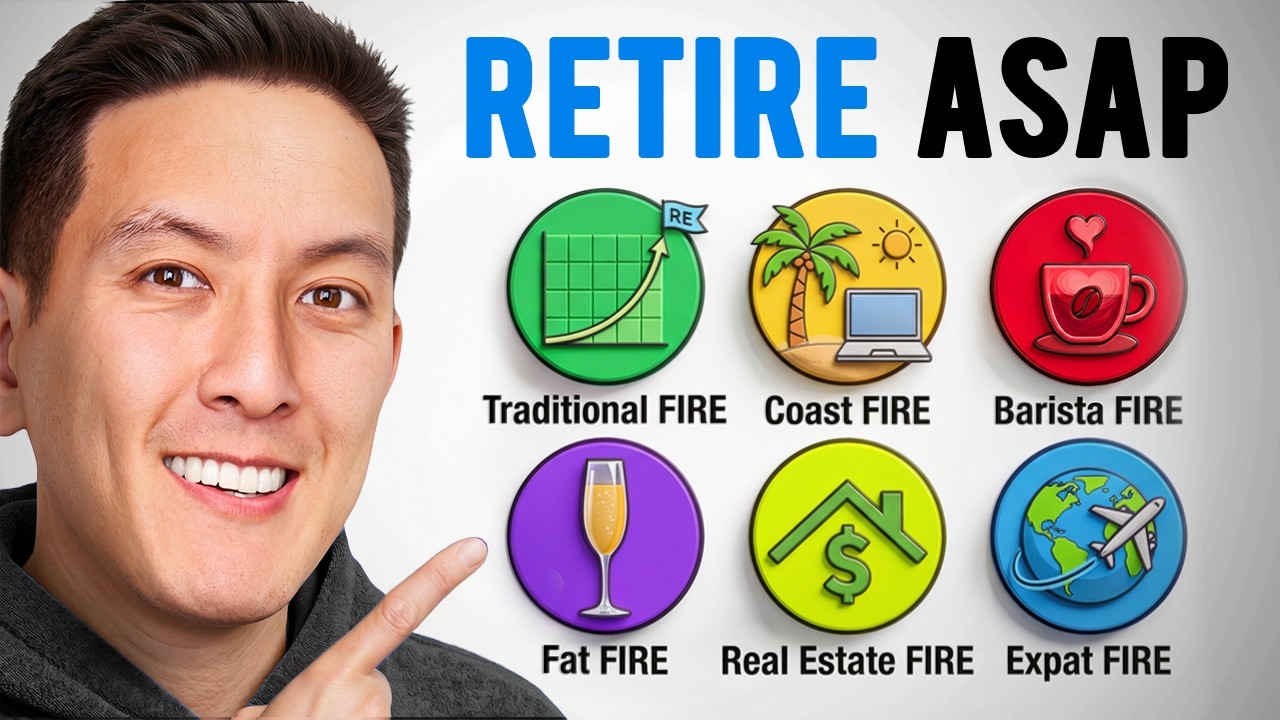

Most people who've heard of FIRE know one version: save aggressively, invest in index funds, and retire in your 40s. But there are at least 15 distinct strategies for reaching financial independence, and they vary wildly — from a theoretical three-year exit to a methodical 30-year journey. Using a hypothetical earner making $100,000 per year, here's every major path mapped against a single timeline so you can find where you actually fit.
 00:45
Timeline graphic showing all 15 FIRE strategies placed between Year 0 and Year 30
Watch at 00:45 →
00:45
Timeline graphic showing all 15 FIRE strategies placed between Year 0 and Year 30
Watch at 00:45 →
The Fast Lanes (Years 3–10)
Entrepreneur FIRE — Year 3 (with a big asterisk)
The fastest theoretical path is building and selling a business. A $100K earner who spends nights and weekends building an e-commerce brand, SaaS product, or content agency could potentially sell it for $1.5–2 million within three to five years — enough to satisfy the 4% rule outright. The catch: it's the most volatile strategy on the list. Some people catch lightning in a bottle; others never get the business off the ground. If you go this route, shelter as much income as possible through a Solo 401(k) (up to $72,000 per year in contributions) or a SEP-IRA. Timeline placement: Year 3 — but treat this as a best-case scenario, not a plan.
Coast FIRE — Year 7
Coast FIRE is a checkpoint, not a finish line. The strategy: save aggressively for the first several years until your portfolio is large enough to compound to your full retirement number on its own — then stop contributing and switch to any job that just covers your living expenses. A 23-year-old who saves $40,000 per year for five years accumulates roughly $253,000. Left untouched for 39 years, that grows to over $5 million by traditional retirement age. A Roth IRA is ideal here because tax-free compounding amplifies the front-loading effect dramatically. Timeline placement: Year 7 to reach the coast point.
Digital Nomad FIRE — Year 8
This strategy combines a smaller investment portfolio with remote freelance or consulting income, while dramatically reducing living costs by working from lower cost-of-living countries. You're not retired in the traditional sense, but you're working on your own terms from wherever you choose. A Solo 401(k) and a taxable brokerage account with global access are the key tools here. Unlike Coast FIRE — which demands sacrifice upfront — Digital Nomad FIRE trades some savings speed for lifestyle freedom along the way. Timeline placement: Year 8.
Extreme Frugality FIRE — Year 9
This path runs on one engine: slash spending to the bone. Living on 25–30% of a $100K income means annual expenses of roughly $25,000–$30,000, which puts the target portfolio at $750,000 (25x annual spend per the 4% rule). Saving $50,000 per year after tax with 8% market returns gets you there in about nine to ten years. The hard truth: you have to maintain that lifestyle in retirement too, indefinitely. Timeline placement: Year 9.
The Middle Ground (Years 10–16)
Barista FIRE — Year 10–11
Leave your high-stress career early and replace it with flexible part-time work — a barista role, a golf course attendant, seasonal resort work. The math works by subtracting your part-time income from your annual expenses to find your portfolio gap. If you want $50,000 per year and earn $20,000 part-time, your portfolio only needs to cover $30,000 — meaning a $750,000 nest egg suffices. A notable bonus: employers like Starbucks offer health insurance to part-time workers, which meaningfully lowers your financial exposure. Timeline placement: Year 10–11.
Hybrid FIRE — Year 12–14
The expanded cousin of Barista FIRE. Instead of a customer-facing part-time job, you blend investment income with knowledge-based side income — consulting a few months per year, freelancing, or running a small business generating $25,000 annually. The income is less predictable than a W-2 part-time role, which is why it lands slightly later on the timeline. Timeline placement: Year 12–14.
Geo Arbitrage FIRE and Expat FIRE — Year 11–13
Geo arbitrage means earning a high-cost-city salary while living somewhere significantly cheaper — relocating from San Francisco to Boise, or internationally to Portugal, Mexico, or Thailand. If your lifestyle costs drop from $60,000 per year to $35,000, your required portfolio falls from $1.5 million to $875,000. Expat FIRE is the permanent version: full relocation, residency visa, local banking, and navigating a foreign healthcare system. Both strategies shrink your target number without requiring you to earn or save more. Timeline placement: Year 11–13.
Lean FIRE — Year 13–15
Lean FIRE is Extreme Frugality FIRE with the edges sanded down. Annual spending of $35,000–$40,000 means a target portfolio of around $1 million — a few years slower to reach, but you can eat out occasionally, take a budget trip, and keep a gym membership. For a $100K earner saving roughly $35,000 per year after taxes, the finish line arrives around years 13 to 15. The four-to-six year difference compared to extreme frugality buys a meaningfully better quality of life during the accumulation years. Timeline placement: Year 13–15.
Real Estate FIRE — Year 15
Rather than building a stock portfolio, Real Estate FIRE generates cash flow through rental properties. The typical entry point is house hacking: buy a duplex, live in one unit, rent the other. An FHA loan requires as little as 3.5% down since you're an owner-occupant. Over time, three to five properties might generate $4,000–$6,000 per month in net rental income. The downside is real: you become a landlord, dealing with 2 a.m. maintenance calls and vacancy risk. High interest rates have also made the numbers harder to work in recent years. Timeline placement: Year 15.
The Long Game (Years 16–30+)
Traditional FIRE — Year 16
The original model and the baseline for this entire list. Save 30–50% of income, invest in low-cost index funds, and target a portfolio of 25 times your annual spending. The 4% rule — developed by financial researcher William Bengen from historical market data — suggests you can withdraw that percentage annually without depleting your portfolio, even through severe market downturns. For a $100K earner, this takes roughly 15 to 18 years. Timeline placement: Year 16.
Dividend FIRE — Year 22
Build a portfolio of dividend-paying stocks large enough that the income covers your expenses without ever selling a single share. At a 4% dividend yield, generating $50,000 per year requires $1.25 million in dividend stocks. This is actually slower than traditional FIRE for the same income level — but the psychological payoff is substantial. Your portfolio principal stays intact, the income arrives automatically, and dividend stocks tend to be less volatile, which means calmer retirement years. Timeline placement: Year 22.
Pension FIRE — Year 25
Work long enough in a government, military, or union role to earn a defined benefit pension — a guaranteed monthly check for life, completely independent of market performance. A long-tenured $100K earner might receive $50,000–$70,000 per year in pension income. The trade-off is a multi-decade commitment to a specific employer or career track. Timeline placement: Year 25.
Slow FIRE — Year 27
The opposite philosophy from extreme frugality. Save 15–20% of income, live your life fully during the accumulation years, and retire at 57 or 58 rather than 67. It's not dramatic, but it's realistic and sustainable for the vast majority of people. Timeline placement: Year 27.
Fat FIRE — Year 28–35+
Financial independence at a level where you can spend $100,000, $200,000, or more per year in retirement — luxury travel, multi-million dollar homes, no discretionary budget whatsoever. Most Fat FIRE portfolios sit at $5–10 million or higher. Reaching this on a $100K salary alone is unlikely; it generally requires a high-income profession, equity from a startup exit, or an IPO windfall. Timeline placement: Year 28–35, often off the chart entirely.
35:00
Final completed timeline showing all 15 strategies placed from Year 3 to Year 30+
Watch at 35:00 →
Choosing Your Path
The right strategy depends less on which timeline looks most appealing and more on what you're willing to trade. Extreme Frugality FIRE gets you out in nine years but demands a stripped-down life indefinitely. Slow FIRE lets you live fully but asks for 27 years of patience. Entrepreneur FIRE could compress the timeline to three years or stretch it to never. Most people will find their answer somewhere in the middle — a hybrid of intentional savings, lifestyle design, and realistic income expectations. The key is simply picking a strategy and starting.