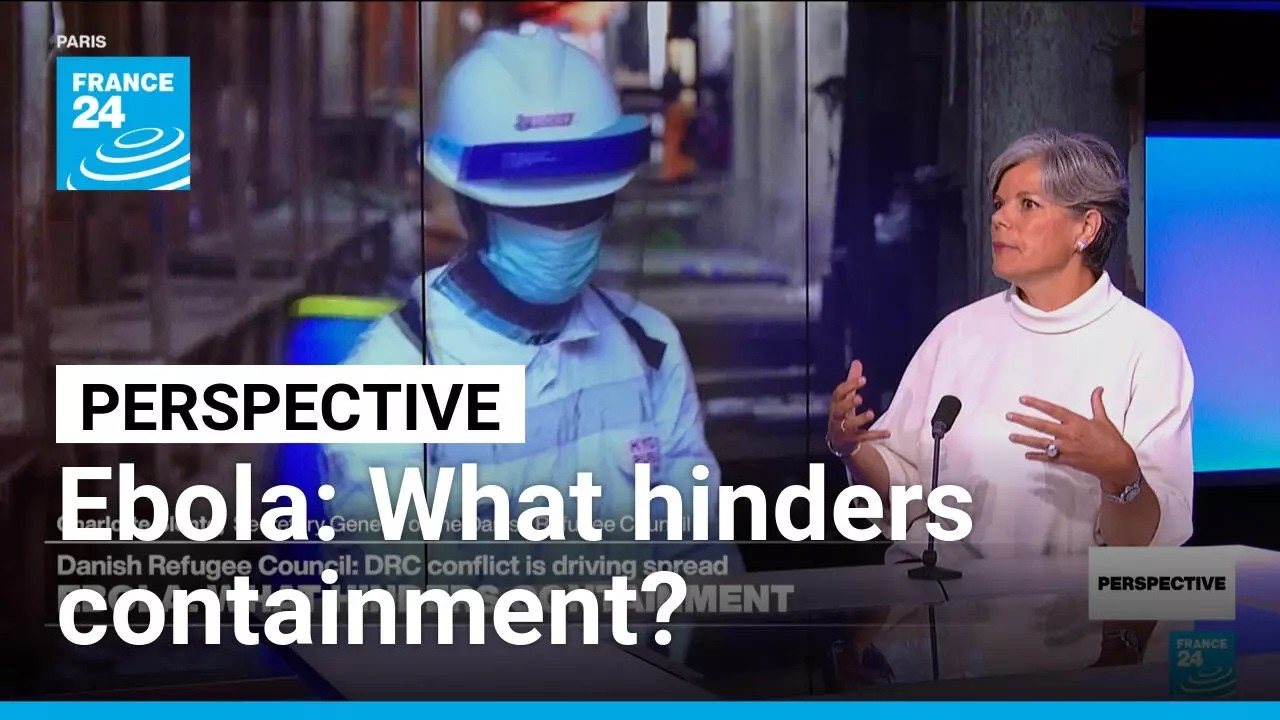

The Ebola outbreak in the Democratic Republic of Congo is one of the deadliest in the country's history — but why is the DRC Ebola outbreak so difficult to contain? According to Charlotte Slente, Secretary General of the Danish Refugee Council, the answer has very little to do with medicine alone. The virus is spreading through communities already shattered by decades of armed conflict, mass displacement, and dramatic cuts to humanitarian funding. Treating Ebola in isolation, she warns, will not work — and may actually make things worse.
Why Is the DRC Ebola Outbreak So Hard to Contain?
With more than 1,400 infections and over 430 deaths recorded, the outbreak centered in Ituri province has confounded health authorities for one core reason: the virus is not spreading through a stable population. It is moving through one of the most volatile, under-resourced, and heavily displaced communities on earth.
Armed groups actively infiltrate displacement camps. Women and girls face systematic sexual violence. Young men and boys are coerced into joining militias. Access to clean water, food, sanitation, and income is severely limited even in the best of times. This is the environment the virus is now exploiting — and standard outbreak-response playbooks were not written for conditions like these.
When health authorities attempt to quarantine displacement sites, they risk trapping hundreds of thousands of people in overcrowded spaces with no safe access to food or water. People then seek alternative, informal routes to survive — routes that medical teams cannot monitor, and where the virus can spread completely undetected. As Slente put it bluntly: "The virus goes undercover."
How Many People Are Displaced in Eastern Congo?
The scale of displacement in eastern Congo is staggering and often underreported in global media. According to the Danish Refugee Council, more than 5 million people have already been displaced across eastern DRC. In Ituri province alone — the epicenter of the current Ebola outbreak — over 1 million people are living as internally displaced persons (IDPs).
These are not temporary tent cities with robust infrastructure. Displaced families live under plastic sheeting, often in dangerously overcrowded sites with minimal access to sanitation or healthcare. The conditions are precisely what infectious disease experts describe as ideal for rapid transmission. Add armed group infiltration to that picture, and it becomes clear why standard quarantine measures can cause more harm than good.
What Is a 'Protection Crisis' and Why Does It Matter?
The Danish Refugee Council describes the situation in the DRC not merely as a health emergency, but as a protection crisis — a term that carries specific meaning in humanitarian contexts. A protection crisis occurs when the basic physical safety, dignity, and rights of civilians are under systematic threat, often compounded by the failure or absence of state protection.
In practical terms, this means women and girls living in displacement camps face ongoing sexual violence. Young boys face forced recruitment into armed militias. Entire families live under constant fear, with no functioning legal system or security force to turn to. These conditions do not pause for a disease outbreak — and any Ebola response that ignores them is building on sand.
Slente's core argument is straightforward: you cannot separate a medical emergency from the human environment it is unfolding in. Treating Ebola without addressing protection failures will undermine trust, drive people away from medical services, and ultimately allow the virus to spread further.
How Does Armed Violence Make the Ebola Response Worse?
One of the most striking testimonies shared in the interview illustrates just how deeply conflict and disease are intertwined. A young girl who died from Ebola had her body carried back into a displacement camp by eight people — all of whom touched her remains, potentially exposing themselves and others to the virus. Why did this happen? Because in communities ravaged by violence and grief, cultural practices around death and mourning do not simply disappear in the face of a health protocol.
Armed groups further complicate medical access. Health workers and aid organizations operating near front lines face direct security threats. Movement of medical staff is restricted. Monitoring becomes impossible in areas controlled by militias. The result is a patchwork of visibility — Ebola response teams can only see part of the picture, while the virus moves freely through the gaps.
Why Do Local Communities Distrust Ebola Aid Workers?
Perhaps the most politically uncomfortable finding from the Danish Refugee Council's report is the depth of mistrust that exists between displaced communities and the authorities responding to the Ebola outbreak. This mistrust has real consequences: there have been documented cases of communities refusing to cooperate with medical teams, and even incidents of medical evacuation tents being burned down.
To understand why, you have to look at the history. For decades, the civilian population of eastern Congo has been neglected — by their own government, by the international community, and by the very systems that were supposed to protect them. No one has successfully stopped the violence. Basic services have been absent for years. And now, suddenly, authorities are showing up in camps and displacement sites with urgent demands for cooperation on a disease response.
From the community's perspective, the question is entirely rational: where were you before? Slente describes this as a "natural distrust" — one that humanitarian organizations must actively work to overcome, not dismiss. The only way to earn cooperation, she argues, is to visibly attend to people's basic needs at the same time as the medical response unfolds.
Has Funding for DRC Aid Collapsed During the Outbreak?
The funding picture behind this crisis is deeply alarming. According to Slente, humanitarian support for eastern Congo has collapsed dramatically in recent years. In 2014, the response received approximately $1.4 billion USD in international support. By the time the Ebola outbreak intensified, that figure had fallen to just $400 million USD — less than a third of what it once was.
This funding collapse means that aid organizations were already being forced to make impossible choices before the virus arrived. Now, with Ebola commanding global attention and resources, there is a real danger that whatever funding does arrive gets redirected entirely into the medical response — leaving protection programming, water and sanitation, schools, and livelihood support to wither. That, Slente warns, is a false economy. Hollowing out basic aid in order to fund the health response will destroy the community trust and resilience that effective disease containment actually depends on.
What Is the Danish Refugee Council Doing on the Ground?
Rather than choosing between health response and protection programming, the Danish Refugee Council is working to integrate both. On the ground in DRC, this looks like several concrete interventions running simultaneously:
- Cash assistance: Mobile money transfers to people who can no longer safely access their normal livelihoods due to the outbreak or conflict.
- Water, sanitation, and hygiene (WASH): Continued investment in clean water access and hygiene infrastructure within displacement sites.
- Keeping schools open: Schools serve as safe spaces where children are protected from forced labor and armed recruitment — and where hygiene kits and prevention education can be distributed efficiently.
- Medical protocol integration: Applying WHO Ebola protocols directly within existing protection programming, so that health measures reinforce rather than replace community support.
The overarching philosophy is one of parallel tracks — never sacrificing one form of support for another, because in this environment, everything is connected. Food security affects disease spread. Protection from violence affects cooperation with health workers. Trust in aid organizations affects whether people report symptoms or hide them.
The DRC Ebola crisis is a reminder that the hardest outbreaks to fight are not always the ones with the most dangerous viruses — they are the ones where the communities at risk have the least reason to trust the people trying to help them. Rebuilding that trust, while simultaneously containing a deadly disease in a war zone, is the challenge humanitarian organizations like the Danish Refugee Council are facing right now.