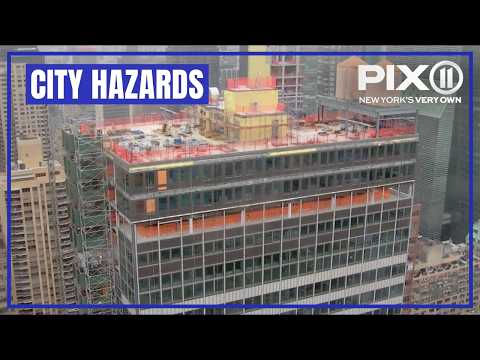
What Happened at 235 East 42nd Street?
Two structural columns buckled on the 21st and 22nd floors of the former Pfizer headquarters building at 235 East 42nd Street in Midtown Manhattan, triggering a major construction emergency. Construction workers discovered the buckled columns — accompanied by multiple cracks causing floors to sag between the 21st and 26th floors — just before 8:00 a.m. The discovery immediately set off a chain reaction: the building was declared unsafe, nearby streets were shut down, and multiple surrounding buildings were evacuated as a precaution. No injuries were reported, and all workers were accounted for.
The steel tower, which is the former home of pharmaceutical giant Pfizer, is currently undergoing what would be the largest commercial-to-residential conversion in New York City history. Developer Metro Loft is transforming the building into more than 1,600 rental apartments. But on this morning, that ambitious project came to a sudden and alarming halt.
Why Were 7 Midtown Buildings Evacuated?
Because of the structural instability detected at 235 East 42nd Street, officials moved quickly and evacuated seven nearby buildings out of an abundance of caution. The evacuations included a school housing approximately 400 children, at least one hotel, and several commercial buildings. Police went door to door — and in some cases, room to room — alerting occupants to leave immediately.
Hotel guests, including out-of-town visitors, were told to leave with no initial timeline for when they could return. One guest from Connecticut, visiting New York on vacation with his wife and friends, described police knocking on his hotel room door while he was in the shower. He was eventually allowed back in to retrieve his luggage thanks to the hotel's guest relations team.
Workers at nearby hotels and businesses were also sent home. Restaurants and small businesses in the area were forced to close for the day, creating a significant economic ripple effect across the neighborhood.
Is the 42nd Street Building Going to Collapse?
Officials say a total collapse is not expected — and the building's own construction actually works in their favor. Because of how the steel tower is built, structural engineers and city officials expressed confidence that a full collapse was unlikely. That said, they were not taking any chances.
Throughout the day, engineers entered the building for the first time since it was deemed unsafe and conducted a floor-by-floor assessment. By the time they had reached above the 30th floor, the building had not shown any additional movement — a significant and encouraging sign. The FDNY had earlier reported that the building was moving after the initial discovery, making the stabilization all the more reassuring.
The engineering team continued working their way up toward the 37th floor to complete the full structural review. Once the building is officially deemed safe, crews plan to shore up the 21st floor and inspect for any additional weak points. FDNY crews remained on site watching for any further shift in the structure throughout the evening.
What Safety Violations Were Found at the Site?
Today's structural emergency was not the first warning sign at 235 East 42nd Street. An investigation by Fox Five revealed a troubling history of construction safety violations dating back to 2025. The Department of Buildings has issued six violations against the site's general contractor — a company associated with Metro Loft — totaling $32,530 in fines.
- Deviating from approved plans: One citation noted that work on site did not follow the approved construction documents.
- Falling metal panel: In August 2025, two citations worth $12,500 were issued after a metal panel fell from the 33rd floor and landed on the sidewalk below.
- Falling window glass: A piece of window glass fell from the eighth floor during an active demolition job.
- Worker fall: In December 2025, a worker fell six feet from a platform ladder because it was not on a flat, level surface and was not fully opened.
- Failure to report injury: The contractor was cited again for failing to report that December injury to authorities.
Beyond official violations, complaints filed with the Department of Buildings from people in the surrounding area alleged additional safety concerns — including one report of a worker blowing material off the roof using a leaf blower. Multiple complaints also alleged that workers on site were unlicensed.
Did the Contractor Use Unlicensed or Nonunion Workers?
Those complaints about unlicensed workers were echoed loudly by a union representative who arrived at the scene. The union rep alleged that Metro Loft chose to use nonunion ironworkers on the project — and argued that decision directly contributed to the structural failure.
"They should have used those New York City union iron workers to begin with," the rep told reporters. "And I guarantee you, you wouldn't have had this problem." He went on to allege that the developer went nonunion across nearly every trade on the project, with the exception of steamfitters handling the sprinkler system and elevator constructors. "It's all for profit," he said.
Fox Five reached out to Metro Loft for comment on both the violations and the allegations regarding unlicensed or nonunion workers. As of the time of reporting, the investigation into the construction site's safety enforcement practices was ongoing and active.
What Is the Former Pfizer HQ Being Converted Into?
The building at 235 East 42nd Street is the former headquarters of pharmaceutical company Pfizer. Developer Metro Loft purchased the property and launched what would be a record-breaking conversion project: transforming the adjoining commercial towers into more than 1,600 residential rental apartments — making it the largest office-to-residential conversion in New York City history.
The planned development includes a rooftop pool, 100,000 square feet of amenities, ground-floor retail space, and some office space. Notably, 400 of the planned units are designated as affordable housing. The scale and ambition of the project made it one of the most talked-about real estate developments in the city — but the events of today have put that reputation under a very different kind of spotlight.
What Streets Are Closed in the Frozen Zone?
City officials established what they called a "frozen zone" in response to the emergency, spanning from East 40th Street north to East 45th Street, between First Avenue and Third Avenue. All nearby streets within that perimeter were closed to both pedestrians and vehicle traffic.
The closures caused significant transportation disruptions across Midtown. Bus routes that typically run along Third Avenue were rerouted to Lexington Avenue, creating traffic jams stretching 20 blocks. Near Grand Central Terminal — already a congestion hub during rush hour — traffic came to a complete standstill multiple times as dozens of buses were funneled onto a single alternate route.
Mayor Mamdani thanked New Yorkers for their patience and emphasized that public safety was the top priority. Residents of evacuated buildings were still awaiting word on when they would be allowed to return home, and businesses throughout the frozen zone remained closed as the investigation continued into the evening.