
What Is the Muon g-2 Experiment Trying to Discover?
The Muon g-2 experiment is trying to answer one of the most fundamental questions in all of science: do we truly understand particle physics? Specifically, it's probing whether there are new particles and new forces in the universe that we haven't yet discovered. By measuring the magnetic moment of the muon with extraordinary precision, physicists can compare their measurement to the predictions of the Standard Model — the reigning theory of particle physics. If those two numbers don't match, it's a direct signal of unknown physics lurking just beyond our current understanding.
Think of it as a pass/fail test for all of human knowledge about the subatomic world. As one scientist on the collaboration put it, "When we make a measurement and compare it to the prediction, it's kind of like a go no go for all the knowledge we have. It's do we understand particle physics, yes or no?" That's an extraordinary amount of weight to hang on a single experiment — and it's exactly why Muon g-2 has captivated the physics world for decades.
Could Muon g-2 Prove Physics Beyond the Standard Model?
The short answer is: possibly, and that possibility is what makes this experiment so exciting. The Standard Model is the best framework physicists have for describing the fundamental particles and forces of nature. But scientists have long suspected it's incomplete. It doesn't account for dark matter, dark energy, or gravity at the quantum level. Muon g-2 is looking for cracks in the model's foundation.
The experiment searches for interactions between the muon and hypothetical unknown particles — particles that would represent entirely new physics. The Brookhaven experiment that preceded Fermilab's effort ended with a tantalizing hint: a discrepancy between the measured value and the Standard Model prediction just large enough to make the entire field wonder if something new was being detected. That mystery was compelling enough to justify building an even more precise version of the experiment, and moving it across the country to Fermilab to find out.
What Is the Magnetic Moment of the Muon and Why Does It Matter?
Every muon behaves like a tiny bar magnet — it has a north pole and a south pole, just like the magnets you played with as a kid. This property is called the magnetic moment. What Muon g-2 measures is exactly how strong that internal bar magnet is, and what happens to it when the muon is placed in an external magnetic field.
Here's where quantum mechanics makes things strange and fascinating. According to quantum field theory, the vacuum of space isn't actually empty. It's a roiling sea of virtual particles — a "quantum foam" — that blink in and out of existence constantly. These fleeting particles interact with the muon and subtly alter its magnetic moment. By measuring that alteration with incredible precision, physicists can essentially take a census of everything the muon interacted with. If the result doesn't match the predicted value, it means the muon bumped into something the Standard Model doesn't know about.
Why use muons instead of electrons? Muons are about 200 times heavier than electrons, which makes them roughly 40,000 times more sensitive to this quantum foam. They sit in a scientific sweet spot: heavy enough to be enormously sensitive to new physics, yet light enough to be produced in large quantities and measured with extreme precision.
Why Did Muon g-2 Move from Brookhaven to Fermilab?
The history of this experiment stretches back to the 1950s, when physicist Leon Lederman — later the director of Fermilab — was part of the first measurement of the muon's magnetic moment. A series of increasingly precise experiments followed at CERN throughout the 1960s and 70s, culminating in 1979 with the CERN 3 experiment, which achieved a precision of seven parts per million.
The baton then passed to Brookhaven National Laboratory, where a new experiment pushed precision 14 times beyond what CERN had achieved. But Brookhaven had limits — limits on the number of muons it could produce and the precision it could reach. Fermilab, with its powerful accelerator complex, could do far better. The facility had previously housed the Tevatron collider, which smashed protons and antiprotons together. Scientists converted what was once an antiproton source into a muon source, and the results were dramatic: Fermilab could produce 20 times more muons than Brookhaven ever could. As one researcher described it, "It felt like a firehose — we just start filling up with muons like gangbusters."
How Did They Move a Massive Magnet Across the Country?
Moving the experiment from Brookhaven to Fermilab wasn't just a scientific challenge — it was a logistical spectacle. The centerpiece of the experiment is a massive superconducting storage ring magnet housed in a cryostat so large it would span four lanes of highway. The team had strict instructions: don't take it apart. It had to travel essentially intact.
The journey required shutting down two different interstates in the Chicago area on two separate nights. Word got out, and people lined the roads to watch the enormous, glowing ring roll by in the dark. The scientists who organized the move — many of them young researchers who joked they "needed a grown-up on the team" — were stunned by the public response. What had been a daunting project management challenge became an unexpected moment of connection between science and the wider world. Reusing the existing magnet also saved enormous time and money compared to building a new one from scratch.
What Did the Final Muon g-2 Results Actually Show?
The Fermilab team set their precision goals back in 2007, making what they called "best guesses" about how well the experiment could actually perform. Years later, the final results confirmed they had met — and in some respects exceeded — those initial ambitions. The measurement achieved a precision that dwarfed anything done before it.
The results continued to show a discrepancy between the measured value of the muon's magnetic moment and the Standard Model's prediction. While the physics community continues to scrutinize both the experimental results and the theoretical calculations, the persistent gap keeps the possibility of new physics firmly on the table. For the physicists who dedicated years or even entire careers to this experiment, that lingering mystery is not a frustration — it's an invitation to keep pushing.
Why Did Muon g-2 Win the Breakthrough Prize?
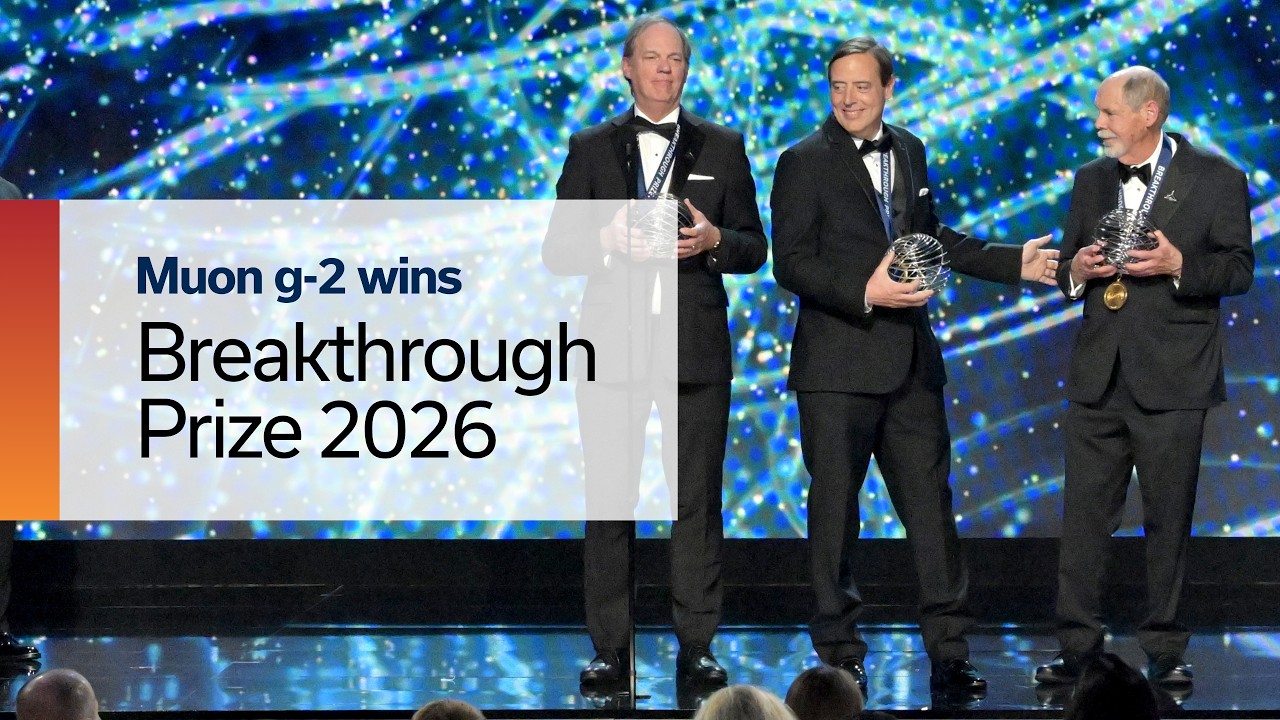
The Breakthrough Prize is widely considered one of the most prestigious awards in science, and the Muon g-2 collaboration's receipt of the award reflects both the technical achievement and the broader significance of the work. Members of the collaboration described the recognition as deeply moving — not just for the senior scientists, but for the graduate students, postdocs, engineers, and technicians who made it possible.
Beyond the measurement itself, the experiment's legacy includes its power to inspire. As one collaborator put it, "I would say by far one of our most important byproducts is our ability to inspire future scientists. It all sounds like science fiction until you realize it's reality." For many on the team, Muon g-2 wasn't just an experiment — it was a defining chapter of their scientific lives, a shared endeavor that combined cutting-edge physics with genuine human connection.
The question the experiment posed — do we truly understand particle physics? — remains one of the most compelling open questions in science. And thanks to Muon g-2, we are closer than ever to knowing the answer.