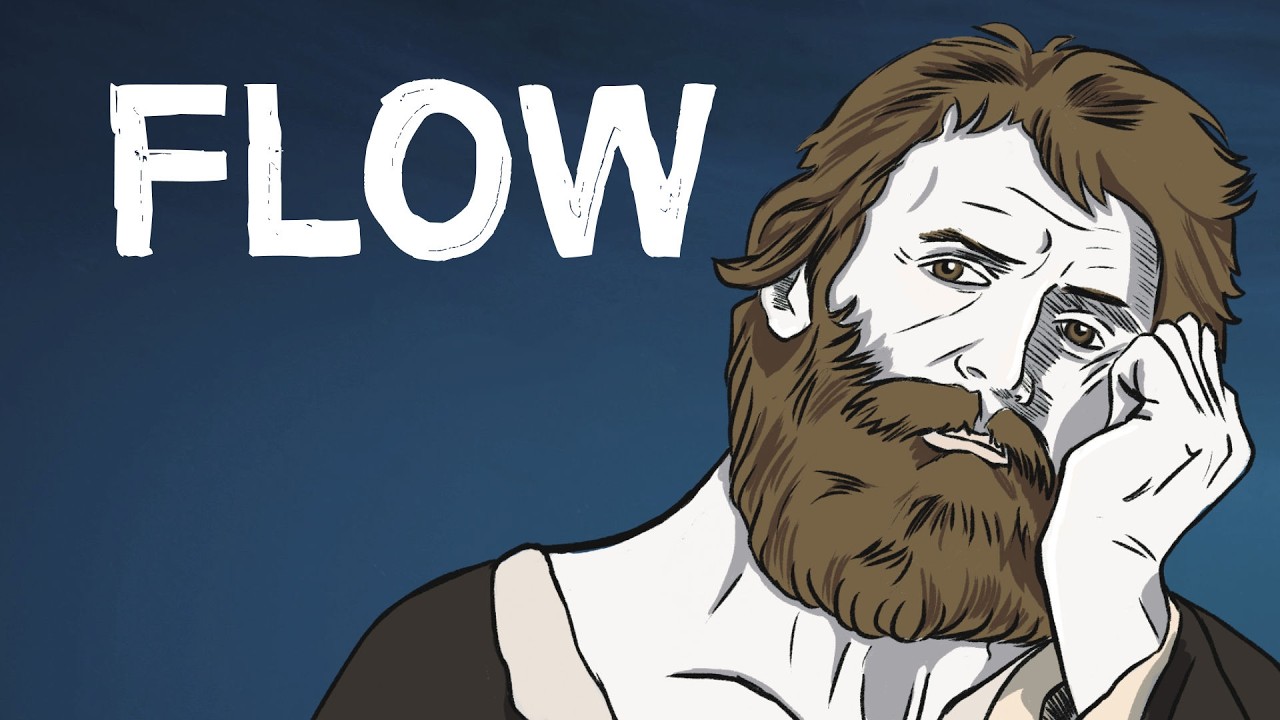

When Heraclitus said "everything flows" — panta rhei in ancient Greek — he wasn't just making a poetic observation about rivers. He was describing the fundamental nature of reality itself. Everything you see, everyone you love, and even who you are right now is in a constant, irreversible process of change. Nothing is fixed. Nothing is permanent. And once you truly grasp that, it becomes one of the most clarifying ideas you'll ever encounter.
 00:30
Heraclitus's river metaphor introduced — the river that flows continuously as a symbol of reality
Watch at 00:30 →
00:30
Heraclitus's river metaphor introduced — the river that flows continuously as a symbol of reality
Watch at 00:30 →
What Did Heraclitus Mean by 'Everything Flows'?
Heraclitus was a pre-Socratic philosopher who looked at the cosmos and saw not a stable, ordered system, but an endless, dynamic interplay of forces, elements, and matter. His central claim — summarized by Plato as panta rhei, or "everything flows" — was that change is not an occasional disruption to reality. Change is reality.
He believed that fire was the fundamental principle of this change, though scholars still debate whether he meant literal fire or used it metaphorically. What's clear is that fire, for Heraclitus, represented transformation — the way a blacksmith uses heat to turn raw metal into something entirely new. Nothing escapes this transformative force. Mountains, marriages, skyscrapers, people — all of it is always becoming something else.
This idea clashes hard with how we naturally perceive the world. Things look solid. People seem consistent. Institutions feel permanent. But Heraclitus would argue that this appearance of stability is an illusion — a trick of human perception layered over a reality that never actually stops moving.
02:15
The Autograph Tower in Jakarta used as an example of how even massive, seemingly solid structures are always in flux
Watch at 02:15 →
What Does 'You Never Step in the Same River Twice' Mean?
The river metaphor is probably Heraclitus's most famous idea, and it works on two levels that most people miss. The obvious reading: the river is always changing. The water flowing past you right now is not the same water that was there a moment ago. So the river you step into today is, in a very real sense, a different river from the one you stepped into yesterday.
But here's where it gets genuinely interesting. Even if the river were somehow identical — same water, same current, same temperature — you wouldn't be. The person stepping in now is not the same person who stepped in before. Your body has changed at the cellular level. Your mood has shifted. Your experiences between those two moments have quietly reshaped how you perceive everything around you.
So the river is a metaphor for external reality understood as a process of continual becoming. And that process doesn't stop at the riverbank — it runs straight through you.
What Is the Core Philosophy of Heraclitus?
Heraclitus wrote in riddles, and much of his work has been lost to time. But the fragments that survive point to a consistent worldview built on a few key ideas:
06:40
Personal reflection on how mood and fatigue shift perception — the subjective side of the river metaphor
Watch at 06:40 →
- Flux is fundamental: Nothing in reality is fixed or static. Everything — from rocks to relationships — is always in the process of becoming something else.
- Opposites are unified: Heraclitus saw existence as an ongoing tension between opposites — hot and cold, health and sickness, war and peace. These aren't separate things; they define each other.
- Change creates identity: Paradoxically, it's not despite change that things have an identity — it's because of it. A river is a river because it flows. A human is a human because they are born, grow, age, and die.
- The logos: Heraclitus believed there was an underlying rational principle — the logos — governing the flux of the universe, even if most people were too distracted to perceive it.
One philosopher who pushed back hard on all of this was Parmenides, who argued that change itself is an illusion and that true reality is eternal and unchanging. It's a mind-bending counter-argument worth exploring — but for now, Heraclitus's view remains far more aligned with what modern science tells us about the physical world.
If Everything Changes, Do You Even Have a Stable Identity?
This is where things get philosophically uncomfortable. If you are always changing — your body, your beliefs, your personality, your desires — is there really a consistent "you" at all? What does identity even mean in a world of constant flux?
Heraclitus's answer is elegant: identity exists through change, not despite it. Consider a marriage. It's meant to be a permanent commitment, and in a formal sense it is. But the lived content of that marriage is always in motion — new homes, new jobs, children, crises, beautiful moments, long silences. The marriage isn't defined by any single frozen moment. It's defined by the entire flowing process of it.
The same goes for a human being. We are born, grow up, learn, adapt, fall ill, recover, age, and eventually die. That entire arc — that process — is what it means to be human. Strip away the change, and you don't get a purer version of a person. You get nothing at all.
So the next time you feel unsettled by how much you've changed over the years — your old goals no longer motivating you, your old friendships fading, your old self feeling like a stranger — consider that this is not a sign of something going wrong. It may be the most human thing about you.
How Do Your Moods Change the Way You See Reality?
Heraclitus made a sharp observation that's easy to overlook: "It is sickness that makes health pleasant and good; hunger, plenty; weariness, rest." In other words, our internal states don't just affect how we feel — they fundamentally alter how we perceive the world around us.
When you're sick, health becomes the most precious thing imaginable. When you're hungry, the entire world narrows to a potential source of food. When you're exhausted, everything feels heavier and more threatening than it actually is. These aren't just minor emotional fluctuations. They can reshape your judgment, your priorities, and your sense of what matters.
This has a practical implication worth sitting with: be suspicious of your perceptions, especially during low states. If you're running on three hours of sleep and suddenly convinced your life is heading in the wrong direction, ask yourself whether the circumstances have actually changed — or whether it's your mood and bodily state that have shifted. Often, it's the latter.
The river not only flows continuously. Your perception of that river is also always in flux. You are never seeing reality from a fixed, neutral vantage point. You are always seeing it through the lens of who you are in this particular moment.
Why Did Heraclitus Believe Strife Is Necessary?
When the ancient poet Homer wished that strife would simply vanish from the world, Heraclitus pushed back — hard. Not because he was a warmonger, but because he saw conflict as an unavoidable feature of a universe built on the tension of opposites.
For Heraclitus, strife wasn't just an unfortunate side effect of existence. It was a generative force. Tension, friction, and opposition are what drive change — and since change is the basis of all identity and all life, strife is, in a strange way, what keeps things alive.
That doesn't mean we should welcome devastating wars or unnecessary suffering. But it does mean we might stop treating every form of difficulty as something to be eliminated. Failure builds character in ways that success rarely does. Painful feedback can unlock real improvement. Physical strain strengthens the body. A difficult conversation between two people who care about each other can save a relationship that comfortable silence would slowly destroy.
Think of these moments as the fire Heraclitus described — the force that transforms raw material into something shaped, refined, and purposeful.
How Do You Stop Resisting Change and Use It Instead?
Heraclitus didn't leave us a tidy self-help system. He wrote in fragments and riddles, and much of what he wrote is gone. But the practical wisdom embedded in his philosophy is hard to miss once you see it.
We resist change constantly — clinging to people who have moved on, defending beliefs that no longer serve us, mourning versions of ourselves that had to be outgrown. And underneath all of that resistance is a fantasy: that something, somewhere, should be fixed and permanent.
But if Heraclitus is right — if everything flows, including us — then resistance isn't just painful. It's a fight against the very nature of reality. The question isn't whether change will come. It will. The question is whether you'll be dragged by it or whether you'll learn to move with it.
As Heraclitus might have put it: the truly wise learn to have change on their side. Not by surrendering to chaos, but by understanding that flux is the medium in which all growth, all meaning, and all identity are formed. The river keeps flowing. So do you. The only real choice is whether to swim.