
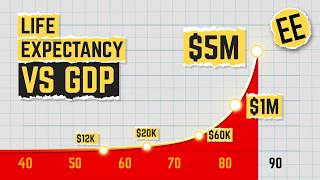
Wealthy people live longer than poor people — and the gap is far larger than most people realize. In the United States, the richest 1% of men outlive the poorest 1% by 14.6 years. That's roughly the same difference in life expectancy as between Japan, the country with the longest lifespan on Earth, and Yemen. Except this isn't a comparison between two different countries with different histories and different levels of development. This is the same country. Sometimes the same city. Occasionally, statistically speaking, the same street.
 00:45
The 14.6-year life expectancy gap between the richest and poorest 1% of American men — compared to the difference between Japan and Yemen
Watch at 00:45 →
00:45
The 14.6-year life expectancy gap between the richest and poorest 1% of American men — compared to the difference between Japan and Yemen
Watch at 00:45 →
And the situation is getting worse. The single most powerful predictor of how long you'll live in America turns out not to be your genetics, your diet, or your access to healthcare. It's your bank account.
How Big Is the Life Expectancy Gap Between Rich and Poor?
A 40-year-old man living in poverty in the United States has a life expectancy roughly equivalent to a man living in Pakistan or Sudan. Let that sink in for a moment. The United States spends more on healthcare per person than any other nation on Earth — and yet the poorest Americans are dying at rates comparable to some of the world's least developed countries.
The gap isn't just large. It's widening. At the very bottom of the income distribution, life expectancy has actually fallen. The wealthiest Americans are on track to live around 8 additional years compared to their parents' generation. For the poorest Americans, the gain is practically zero. In fact, the next generation of poorer women is projected to die younger than their mothers did.
That projection was modeled before COVID-19, which disproportionately devastated lower-income communities. So even the pessimistic estimates are probably optimistic.
Why Do Wealthy People Live Longer Than Poor People?
The obvious answers are, well, obvious. Wealthier people eat better, live in safer neighborhoods, and work jobs that don't slowly destroy their bodies over 20 or 30 years. In the UK, the poorest fifth of the population would need to spend 50% of their disposable income just to meet the government's recommended healthy diet. Poor nutrition isn't really a lifestyle choice when you're spending half your income just to survive.
05:10
The Whitehall Study finding: civil servants at the bottom of the hierarchy died at three times the rate of those at the top
Watch at 05:10 →
Tobacco use runs at nearly three times the rate in low-income households compared to wealthy ones. Lower-income workers are far more likely to live near industrial plants and busy roads — not because they chose to, but because property near pollution is cheaper. The result is measurably worse air and significantly higher rates of respiratory and cardiovascular disease.
Wealth even scrambles the biological advantages you were born with. Women live longer than men almost everywhere on Earth. But at the very bottom of the income distribution in the United States, women live around 6 years longer than men. At the very top, that gap shrinks to about one and a half years. A lot of what kills men early — dangerous jobs, chronic stress, destructive coping mechanisms — are things that money can directly fix.
The Hidden Role of Control Over Your Own Time
Beyond the material factors, there's something deeper at work. In the late 1960s, British epidemiologist Michael Marmot began following roughly 18,000 civil servants working in Whitehall — the heart of the British government. These weren't people living in poverty. They had stable employment, regular pay, and access to the NHS. They worked for the same employer in the same city.
07:30
S&P 500 vs. housing returns since 1970 — $100 in housing becomes $1,600; $100 in equities becomes $33,420
Watch at 07:30 →
And yet Marmot found something that should have been impossible: people at the bottom of the office hierarchy were dying at three times the rate of those at the top. He traced the cause back to one thing: control. Senior civil servants could restructure their afternoon, take a long lunch, manage their own time. People at the bottom had their days monitored, managed, and dictated by others.
That chronic, unrelenting experience of having no agency over your own time turns out to be extraordinarily damaging to the human body. It quietly raises blood pressure, weakens the immune system, and increases the risk of heart disease over years — without the person even necessarily recognizing it as stress. The conclusion was surprisingly simple: the more control you have over your working life, the longer that life turns out to be.
How Do Extra Years of Life Make the Wealthy Even Richer?
Here's where the story gets genuinely dark. Wealth doesn't just buy a longer life — a longer life generates more wealth. And that feedback loop, once it starts, is almost impossibly hard to interrupt.
The mechanism is compound interest. At a standard long-run market return of around 7% per year, money roughly doubles every 10 years. Warren Buffett made 99% of his wealth after the age of 50. His real secret isn't just investing skill — it's time. For someone with $5 million in assets, those extra 14 years of life that wealth buys translates into roughly $13 million in additional compound growth.
But this advantage is brutally uneven in how it's distributed. Wealthy households tend to own appreciating assets — equities, businesses, investment portfolios — that continue compounding over decades. Most middle-income retirees don't. Their financial security is usually tied up in home equity and pension entitlements. Since 1995, home prices in the US have risen by about 310%. The S&P 500 is up over 2,300% in the same period. A hundred dollars invested in housing in 1970 would be worth $1,600 today. The same amount in the S&P 500? $33,420.
For lower-income households, every extra year of life isn't accumulation — it's depletion. Someone retiring today can expect to spend around 5 years longer in retirement than their grandparents did. Most people still plan based on how long they watched the previous generation live. That calculation error doesn't get fixed until it's too late, which is why 64% of Americans say they are more afraid of running out of money in retirement than they are of dying.
Why Does the Pension System Favor the Rich Over the Poor?
Collective pension systems were designed on one key assumption: that people live roughly similar lengths of time after retiring. But when some people now live more than a decade longer than others, the system quietly starts redistributing money in the wrong direction.
If wealthier workers consistently collect pension benefits for more years, the collective pot flows disproportionately toward the people who need it least. Across developed economies, three fewer years of life expectancy at retirement is enough to cut a low earner's total pension by 13% relative to a wealthier retiree — roughly equivalent to losing 2 full years of pension payments. In Germany and the United States, this shortfall is large enough to cancel out all the redistribution the pension system was built to create in the first place.
Projected forward, poverty rates among retirees could double when millennials retire. That means a much larger share of a very large generation drawing heavily on public healthcare, housing support, and pension top-ups — all systems already under significant strain.
Is Raising the Retirement Age Fair — or Does It Punish the Poor?
Most governments have settled on the most politically expedient solution available: raise the retirement age and apply it to everyone equally. France tried this in 2023, moving the age from 62 to 64. The proposal was so deeply unpopular it couldn't pass parliament — so the government invoked a constitutional mechanism to bypass a vote entirely. More than a million people took to the streets. By November 2025, the National Assembly voted to suspend the whole thing.
The protesters understood something important: the same retirement age for everyone only makes sense if everyone ages the same way. In England, only men living in the wealthiest 10% of areas have a healthy life expectancy that actually reaches the state pension age of 67. For everyone else, the government is asking people to keep working past the point their bodies can sustain it.
A senior manager at 64 still has their health and cognitive function. A construction worker, a nurse, or a warehouse operative does not have the same luxury. Raising the retirement age uniformly hits people in physically demanding, lower-income jobs the hardest — while the people most likely to comfortably work into their late 60s are the ones who were already going to live the longest anyway.
What Are Baby Bonds and Could They Fix Wealth Inequality?
One of the most promising long-term interventions is baby bonds — government-funded investment accounts seeded at birth and locked until adulthood. The most prominent US proposal would give every newborn $1,000 at birth, growing at a fixed interest rate until age 18. Lower-income families would receive up to an additional $2,000 per year in top-ups, meaning the account could reach around $46,000 by adulthood — enough for university tuition, a business deposit, or a down payment on a home.
Projections suggest a national baby bonds program could reduce the wealth ratio between the richest and poorest families from 14-to-1 down to roughly 5-to-1. Because wealth buys time, some models suggest the policy would extend average lifespan by one year across the whole population and by 6 years for people currently at the bottom.
Connecticut has already launched a state-level version, giving $3,200 at birth to every child born to a mother on Medicaid. The oldest enrolled children are barely 3 years old. We'll know if it worked around 2041.
The honest limitation of baby bonds is that they are a generational solution. A child born today won't meaningfully benefit for decades — and that does nothing for governments facing pension and retirement crises right now. The gap between what people globally will need in retirement and what has been saved to pay for it is already estimated at $400 trillion — roughly four times the size of the entire global economy, and growing.
The unsettling truth is that we know exactly what's happening and roughly what would fix it. The problem isn't a lack of diagnosis. It's a shortage of political will to treat the disease rather than describe it in increasingly sophisticated terms while waiting for someone else to act first.