If you're genuinely trying to figure out how to stop procrastinating, here's the uncomfortable truth: most tips and tricks won't save you if your entire lifestyle is built around avoidance. Procrastination isn't just something you do — for a lot of people, it's something they are. But the six strategies below aren't fluffy advice. They're practical, sometimes counterintuitive, and they work. Let's get into it.
How to Stop Procrastinating (What Actually Works)
The first strategy sounds almost insane: fully commit to doing the thing you're avoiding doing. Not the work. The procrastination itself.
 00:45
The internal conflict loop that keeps chronic procrastinators stuck — doing the bad thing while feeling guilty about it
Watch at 00:45 →
00:45
The internal conflict loop that keeps chronic procrastinators stuck — doing the bad thing while feeling guilty about it
Watch at 00:45 →
Here's why this works. Most chronic procrastinators live in a constant state of internal conflict. They're scrolling TikTok, but they know they should be working. They're on Reddit, but they feel guilty about it. That guilt doesn't actually help them get work done — it just adds stress, raises cortisol, and makes them want to escape even more. It's a loop.
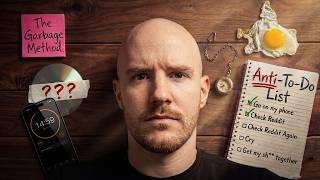
So break the loop entirely. Instead of half-heartedly goofing off while feeling bad about it, go all in. Commit to the escape. Own it. And if you really want to hack your brain, try writing an anti-to-do list — a detailed plan for how you're going to procrastinate. Which subreddits are you visiting? For how long? What kind of TikToks are you hoping to find? What's the plan?
What Is an Anti-To-Do List and Why Does It Help?
The anti-to-do list turns an unconscious compulsion into a conscious decision. When you write down your plan to goof off, you're shining a light on behavior that usually runs on autopilot. You convert mindless escape into a deliberate activity — and that shift in awareness is surprisingly powerful.
What tends to happen is that about 10 to 15 minutes into intentional procrastination, something clicks. You realize you're the one in control. You're wearing the pants in your own brain. And from that position of agency, a lot of people find they'd actually rather be productive. They just needed a reminder that it was their choice to begin with.
03:10
How the 2-minute rule creates momentum from a standing start
Watch at 03:10 →
What Is the 2-Minute Rule and Does It Work?
Once you've reclaimed the driver's seat, the 2-minute rule is one of the best ways to build momentum from zero. The idea is simple: scan your to-do list and ask yourself, will this take two minutes or less? If yes, do it right now.
It might not be the highest-value task on your list. It might feel almost pointless. But if procrastination has been your default mode, then literally anything productive is a massive upgrade over your current baseline. The goal isn't to optimize — it's to move.
You can even simplify further. Forget the 2-minute rule. Use the 1-second rule: just pick up the three mugs sitting next to your computer and put them in the dishwasher. That's it. It won't change your life, but it gets the ball rolling. Small wins create momentum. Momentum creates bigger wins. That's the whole game.
05:22
The lifestyle habits silently destroying your focus before the day even starts
Watch at 05:22 →
- Scan your task list for anything that takes 2 minutes or less
- Do it immediately — don't think, just act
- Feel the shift — being even slightly productive releases different brain chemicals than doomscrolling does
- Snowball — use that energy to tackle something slightly bigger
Your phone is essentially a dopamine machine. You're already used to that feeling. But making real progress in your life? That runs on serotonin, endocannabinoids — chemicals that feel good in a deeper, longer-lasting way. The 2-minute rule gets you there.
How Does Sleep Affect Your Productivity?
No honest conversation about how to stop procrastinating is complete without talking about sleep, diet, and exercise — the holy trinity of cognitive performance that everyone knows about and almost nobody takes seriously enough.
Here's a harsh reality check: if you're running on five hours of sleep, eating fast food for lunch, and blasting your brain with blue light and dopamine for two hours before bed, no productivity tip in the world will save you. You are actively sabotaging your own brain chemistry and then wondering why you can't focus.
Try this experiment tonight:
09:05
The 15-minute suffer window timer trick in action
Watch at 09:05 →
- No phone for at least an hour before bed (or use a red light filter in your settings if you must)
- Aim for 7–9 hours of actual, restful sleep
- In the morning, don't touch your phone — no TikTok, no YouTube Shorts
- Eat a breakfast with protein and fat — eggs are genuinely great here
Then notice how different your day feels. Brain fog, energy levels, willingness to start hard tasks — all of it improves dramatically when your body isn't in a state of chronic inflammation and sleep debt.
You don't have to nail all three pillars perfectly. Think of it like a Venn diagram. Fantastic sleep plus a decent diet means you can get away with less exercise. An impeccable diet and consistent workouts can compensate for slightly shorter sleep. But don't let sleep drop below six hours — that's the one threshold that's genuinely hard to compensate for. Aim for eight.
How to Get Into a Flow State in 15 Minutes
Here's something most productivity advice misses: the hardest part of almost any task is the first 15 minutes. Not the whole task. Just the first 15 minutes.
11:40
The Sims View — zooming out to see your life as a skill-building system
Watch at 11:40 →
Whether it's filing your taxes, debugging code, writing a cover letter, or drafting a painful email — the opening stretch is where all the resistance lives. But push through those first 15 minutes and something shifts. You ease into the work. You stop dreading it. You enter a flow state where the task starts to feel manageable, even natural.
The move here is simple: set a timer for 15 minutes and give yourself permission to stop when it goes off. Tell yourself this is all you have to do. Just 15 minutes. That reframe makes starting feel dramatically less intimidating.
The kicker? Once you're in it, you almost never want to stop. Subconsciously, you know that sitting down is the hard part — so your brain starts milking the momentum. The 15-minute suffer window isn't a trick. It's just an honest acknowledgment of where the real friction lives.
How to Overcome Perfectionism and Just Start
This one might be the most practically useful tip of all: just do the garbage version.
Perfectionism is one of procrastination's favorite disguises. You tell yourself you're not ready, that you don't have the right words yet, that conditions aren't ideal. Meanwhile, nothing gets made, nothing gets done, and the gap between your standards and your output just keeps growing.
The fix is to deliberately lower the bar — all the way to the floor. Give yourself explicit permission to do a terrible job. Write the garbage essay. Make the cringe video. Send the awkward email. Ask someone out badly. Because a garbage version of the thing is infinitely better than a perfect version that doesn't exist.
This works because it removes the psychological weight of the task. When there's no bar to clear, everything is a win. And once you start creating — even badly — you often find that the work is better than you feared, and editing or improving something is always easier than starting from nothing.
Perfectionism is just fear wearing a productivity costume. The antidote is action, even imperfect action.
How to Build Long-Term Motivation to Be Productive
The final strategy is less of a tip and more of a perspective shift — and it might be the most powerful one on this list. It's called the Sims View.
Imagine zooming all the way out and viewing your life like you're playing The Sims. You're watching a little character on a screen. That character has a set number of hours in each day. Every hour they spend doing something, their skill in that area increases — just like a skill bar in a video game. Spend time writing, and the writing skill goes up. Spend time scrolling, and... nothing goes up.
From that bird's-eye view, the math is obvious. Certain skills, when developed, lead to more money, better relationships, more opportunities. Others lead to nothing. It's not complicated. It's almost mechanical.
The problem is we don't live at the bird's-eye view. We zoom in, enter our bodies, and suddenly all the noise rushes in: Do I feel like it? What if I look stupid? What's the point? These thoughts are real and human, but they're also the things that hijack our time and keep us stuck.
The Sims View is a reminder to zoom out. To ask: what skills am I actually upgrading right now, and where is that taking me? When you can see your life as a system — not just a feeling — the decision to do the work becomes a lot simpler.
You already know how to stop procrastinating. You've probably known for a while. The question is whether you'll zoom out enough to actually do it.