
If you want to use organic marketing to get more leads for your business, the single most important shift you can make is this: stop treating early content as acquisition and start treating it as lead nurture. Your first videos, posts, and shorts aren't going to flood your pipeline overnight — but they will warm up every single person who sees your paid ads, books a call, or stumbles across your brand. That compounding effect is where the real money lives. Here's the full breakdown from an 8-hour session with a room full of business owners.
How Do You Use Organic Marketing to Get More Leads?
There are two types of businesses that fail in predictable ways. The first has all the money and no traffic. The second has all the traffic and no money. The magic happens when you learn to marry the two. Think Logan Paul with Prime, Mr. Beast with chocolate, or Alex Hormozi pointing his massive audience toward Skool. They all had distribution — they just needed the right product attached to it.
 00:45
Explaining how organic content warms up paid ad leads and increases show rates and close rates
Watch at 00:45 →
00:45
Explaining how organic content warms up paid ad leads and increases show rates and close rates
Watch at 00:45 →
If you already have paid ads running, starting organic immediately makes those ads more profitable. Here's why: someone sees your ad, then they look you up organically, then they book a call — and they actually show up. And when they show up, they close at a higher rate. You don't need a huge audience for this to work. You just need enough organic presence that when someone goes looking, they find something that builds trust.
In the early days, think of your content as nurture. As your audience grows, it becomes acquisition. Make that mental shift and the whole game becomes less stressful and a lot more scalable.
How Do You Actually Grow a YouTube Channel With Business Content?
The honest answer: just keep making it, and make it exceptional. That's not a cop-out — it's the pattern that holds across every creator who breaks through. One framework that surfaced from reviewing 35 top-performing video intros is what you might call the 3 Ps: Promise, Proof, Path.
- Promise: Tell viewers exactly what they're going to get out of watching.
- Proof: Give them an immediate reason to trust you. "I sold my company for $46.2 million, and a big part of that was our guarantee strategy" — done in one sentence.
- Path: Show them there's structure. Set expectations and then meet them. This is what drives watch time.
Most educators obsess over matching the thumbnail text to the first few seconds of the video. That matters for entertainment content. But for education, the real "Lamborghini" — the flashy hook — is proof. Answer "why should I listen to you" as fast as humanly possible, and people will stay.
08:20
Breaking down the Promise, Proof, Path framework for the first 30 seconds of any video
Watch at 08:20 →
One more counterintuitive truth: bigger creators post less frequently, not more. That's not laziness — it's power laws. Spending 10x more time on one video doesn't get you 10x the views. It can get you 100x the views. Quality has disproportionate returns. Create volume early to figure out what quality looks like for you. Then slow down and go deep.
Should You Put CTAs Inside Your Videos?
Short answer: don't. CTAs inside your content kill reach, feel awkward, and frankly — nobody likes them. The better model is to only give in content, and use ads for the ask.
Think about the give-to-ask ratio from the perspective of someone's news feed. They see three pieces of your organic content — all value, no pitch — and then they see a paid ad from you. The ad is the ask. The content built the goodwill. They exist in completely separate mental spaces, and that separation is what protects the brand.
15:10
Whiteboard diagram of the give-only content model with ads as the sole CTA mechanism
Watch at 15:10 →
If you're right-hooking every video — "go here, buy this, click that" — people tune out and unsubscribe. But if you keep depositing value, they stay. And later, when the ad hits them, they're warm. Put your links in the description and your link in bio. That's it. People will take the next step naturally when they're ready.
What Is a Brand and How Do You Build One Online?
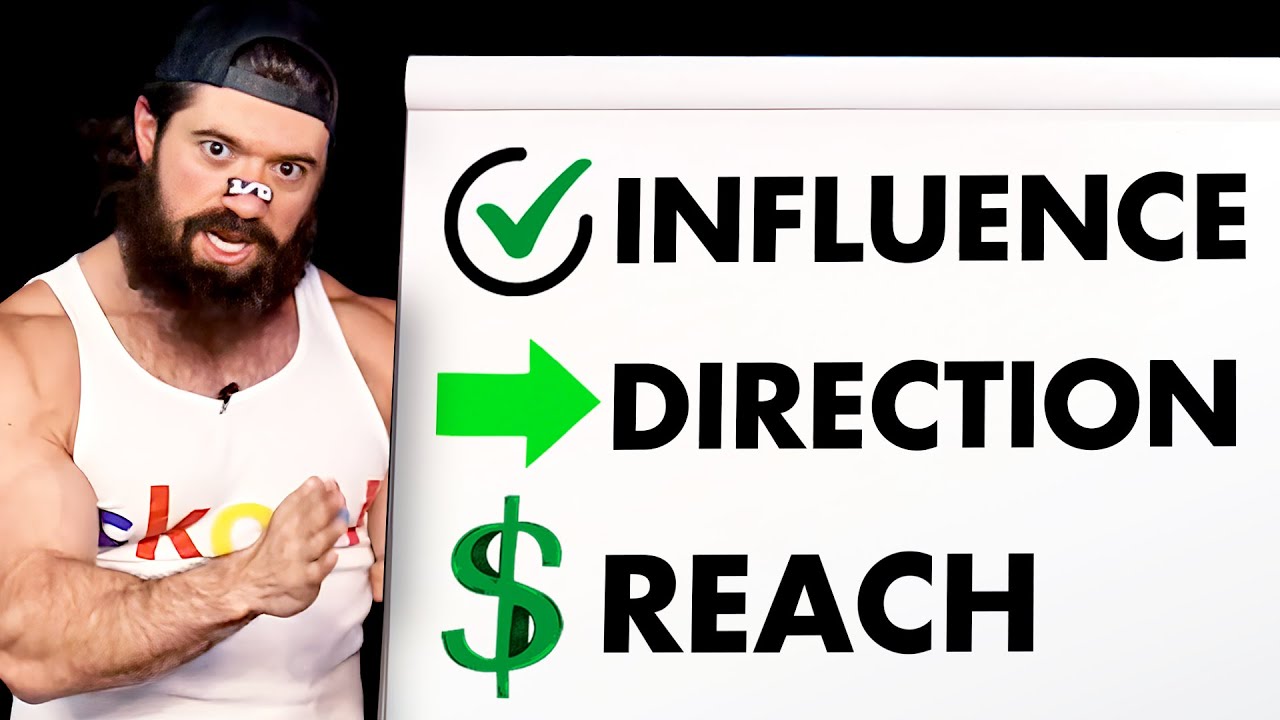
A brand is an association between two things — something people don't know yet, and something they already do. Branding is really just teaching at scale. If you wear a hat in every video, people associate the hat with you. Eventually the hat alone triggers the association. That's the mechanics of it.
There are three dimensions to a strong brand:
22:35
Three-part brand framework: Influence, Directionality, and Reach explained with examples
Watch at 22:35 →
- Influence: Does seeing your brand change someone's behavior? A strong brand does — it makes people act differently than they would have otherwise.
- Directionality: Are people moving toward you or away from you? You want as many people as possible moving toward you.
- Reach: How many people total have the association with you? More reach means more people whose behavior you can influence.
"All publicity is good publicity" is a half-truth. All publicity increases reach. It doesn't automatically improve influence or directionality. Be intentional about who you appear alongside — on stages, podcasts, and in collaborations — because audiences associate you with the company you keep. The purest version of your brand is you. Lean into that.
How Do You Never Run Out of Content Ideas?
There are four content buckets that, together, make topics feel endless:
- Real-time capture: Whenever an idea hits, capture it immediately — a tweet, a note, a voice memo. The highest-leverage content habit is making this frictionless.
- Recent past (your calendar): Look at every meeting and conversation from the past week. What problems came up? What did you solve? That's content.
- Far past: What are the big belief-shifting lessons from your career that would change how someone thinks? These make some of the best videos.
- Manufactured: Challenges, experiments, case studies — "I built a community from scratch, here's what happened." Use this sparingly, but it's a legitimate bucket.
If you're ever stuck, just open your calendar. Every client issue, team meeting, and decision you made this week is a content idea waiting to be extracted.
Shorts vs Long-Form Video: Which Should You Focus On?
Think of a long-form video as multiple shorts strung together. Structure both the same way. Your "path" in a long video is really just seven or eight short-form concepts connected by a thread. The container is bigger, but the building blocks are the same.
For long-form, there are only three content formats: lists, steps, and stories. You can mix them — a list of strategies, with steps inside each one, and a story to illustrate every step. That combination is what keeps viewers engaged through longer videos. Don't overthink the format. Just pick one and execute.
How Do You Turn Your Expertise Into Repeatable Frameworks?
The framework for making frameworks is straightforward. First, drink in a ton of data — watch your best-performing content, interview your best customers, collect every example you can find. Write down everything. Then look for what's common across all of them. Delete everything that isn't shared. What remains is your framework.
Once you have the core elements, make them memorable: same first letter, an acronym, a metaphor. That's the polish. The real work is in the pattern recognition. When you find a problem you have to solve repeatedly, that's your signal to build a framework — so you never have to solve it from scratch again.
Agency or In-House Team: What's the Right Move for Content?
Start with an agency, especially when entering a new platform. You're buying lessons and compressing your timeline — not outsourcing forever. The real value of an agency in the early days isn't even their skill. It's accountability. Having someone to hand content off to forces you to make it consistently.
When you're ready to go serious, hire an in-house creative director and have them manage the agency. Run them in parallel until your internal team beats the agency's output. When it does, let the agency go. The best agencies, by the way, don't run ads — they're already full. Find them through referrals, talk to at least ten options, and you'll quickly see who actually has their systems together.