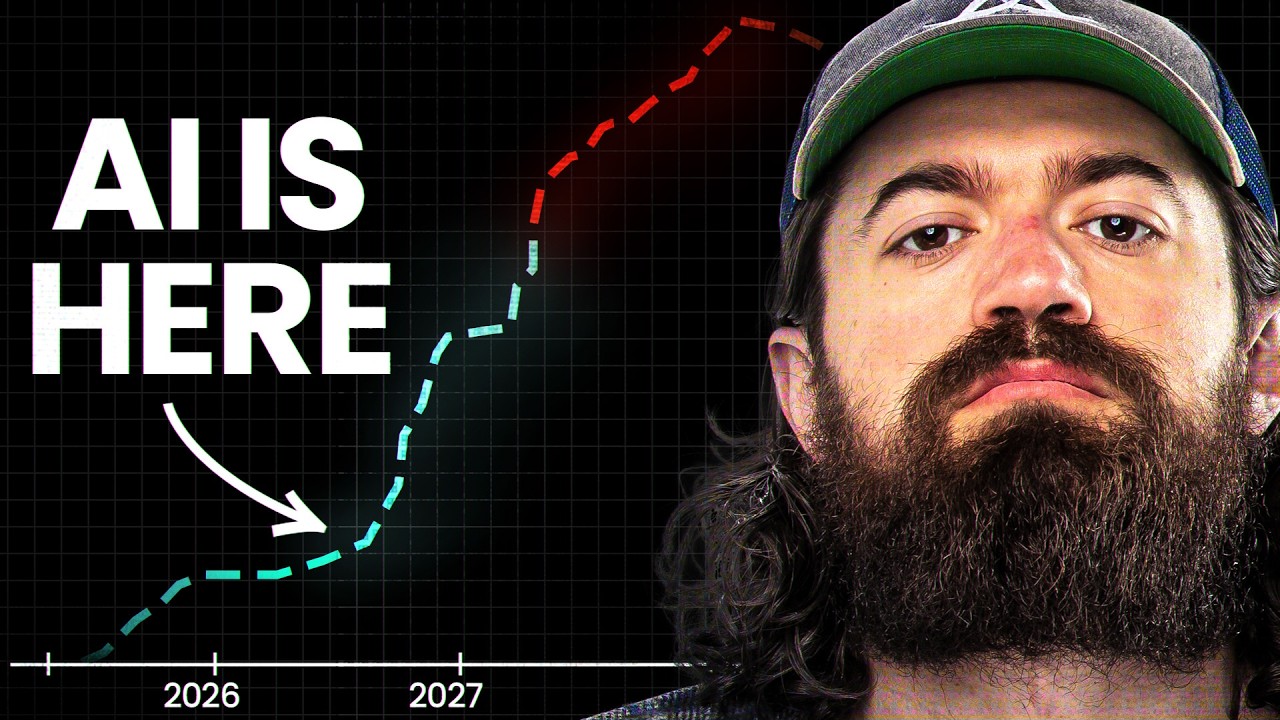

AI is not a future trend to monitor — it is a present reality that is already restructuring labor markets, business models, and competitive dynamics. Jerome Powell recently noted there has been effectively zero net job creation in the private sector. That is not a recession signal. That is an automation signal. The businesses and individuals who recognize this shift now and act on it will capture extraordinary leverage. Those who wait will find the window has closed.
The Core Premise: AI Only Gets Better From Here
The single most important mental model to internalize is this: AI will never be worse than it is right now. Whatever limitations or frustrations you have experienced with current tools, they represent the floor — not the ceiling. Any reasonable rate of improvement over any reasonable time horizon means that learning to use AI should be your first, second, and third priority.
The barrier to adoption is rarely technical. It is psychological. There is a short-term learning cost that most people are unwilling to pay. But consider the analogy of training a new employee: the time spent onboarding feels expensive in the moment, but the compounding return makes it obviously worth it. People who think too short-term lose to people who think even slightly longer-term.
Research on skill acquisition consistently shows it takes roughly 20 hours to become proficient at something new — yet most people delay starting for years. One focused weekend of hands-on experimentation with an AI agent will teach you more than months of reading articles about AI. Tear the wrapper off. Get your hands in it.
Stop Thinking in Roles. Start Thinking in Workflows.
The most actionable shift you can make right now — whether you own a business, lead a team, or work within one — is to stop organizing around job titles and start organizing around workflows.
Traditional org charts exist to manage communication and decision-making between humans. But at the most fundamental level, every business takes raw inputs, applies some process, and produces a more valuable output. That process can be mapped, documented, and increasingly automated — regardless of what title sits above it.
 12:45
Diagram showing a traditional org chart with roles at the top and tasks listed underneath each role
Watch at 12:45 →
12:45
Diagram showing a traditional org chart with roles at the top and tasks listed underneath each role
Watch at 12:45 →
For every role you are considering hiring for, write down the four to ten discrete things that person actually does — not their title, not their function, but their literal daily tasks. Then ask, honestly, whether each of those tasks could live inside a workflow instead of a headcount line.
The old paradigm: I need to hire an editor.
The new paradigm: What are the five specific things an editor does to produce a finished video, and which of those can be a workflow?
This reframing is not about eliminating people for its own sake. It is about raising the bar for what human contribution means. The people who can operate at that higher level stay. The roles that are purely task execution get automated. That is a hard conversation, but it is the honest one.
Training AI Like You Should Train People
One of the most common failure modes with AI is treating a bad initial output as proof that the tool does not work. If you handed a new employee a vague assignment and they returned something mediocre, you would not fire them on the spot — you would train them better. The same logic applies to AI.
Humans learn through reinforcement: do a thing, observe the outcome, adjust. Good taste, in any domain, is just deeply internalized pattern recognition. The difference is that AI can run that feedback loop at a scale and speed that no human can match. One hundred training iterations with a person might take eighteen months. The same one hundred iterations with AI might take one hundred minutes.
The practical implication: the quality of your AI output is almost entirely a function of the quality of your input. If you ask an AI to write email copy and receive generic, flat prose, the problem is almost certainly that you gave it no constraints, no examples, and no definition of what good looks like. Provide twelve non-negotiable rules. Provide sixteen writing samples. Define the output explicitly. The result will be dramatically better — and it will improve further with each iteration.
The people who will be most effective at working with AI are not necessarily the most technical. They are the people who have developed the discipline to define observable outcomes, strip out vague language, and describe exactly what they want. If you have ever been good at writing clear briefs or standard operating procedures, you already have the foundational skill.
The BYOA Economy: Bring Your Own Agent
The medium-term future of work will be defined by individuals who arrive at a business — as an employee, contractor, or consultant — and bring their own suite of trained agents with them. Anthropic has famously operated with a single person in their marketing function. Whether that number is precisely accurate, the principle holds: one person with well-trained agents can produce the output that previously required a full department.
If you can walk into a business and credibly say, "I am your entire marketing department," the economics are extraordinary. The business is accustomed to paying for a department's worth of output. You can deliver that output because your agents — trained on your methods and the company's voice — are doing the execution. The margin you capture, or the equity you can negotiate, or the salary premium you can command, reflects that gap.
This model is available to you right now. It has never been available before. But capturing it requires that you stop thinking in job titles and start thinking in outputs and workflows.
A Framework for the Future: The Barbell Strategy
No one knows precisely how AI will reshape the economy over the next decade. The honest position is to make bets on both ends of the risk spectrum rather than trying to predict the middle.
On the high-risk, high-reward side: go fully AI-native. Automate aggressively. Have the hard conversations. Build companies where revenue per employee is measured in millions, not thousands, because you started that way from day one. Be willing to do what incumbent businesses cannot, because they have too many existing relationships, roles, and cultural inertia to move fast enough.
On the stable, durable side: identify what will not change. Humans will still have bodies, so health, fitness, food, and supplements will persist. Humans with more automated labor will have more leisure time, so entertainment will expand — and the cost of production is collapsing at the same time demand is rising. The arbitrage opportunity in entertainment alone — producing high-quality content at a fraction of historical cost while prices have not yet adjusted — is significant.
The broader point is to be an all-weather operator. Prepare for disruption while building on durable foundations. The specific winners are unknowable. The sectors that will exist are not.
What to Do This Weekend
If you want to translate this from abstract to action, here is the exercise: write down everything you do at the most granular level. Not "I run ads" — but the ten specific tasks underneath that: building campaigns, setting budgets, writing copy, analyzing results, testing headlines. Break every bucket down to its component tasks.
Then take the first task on the list. Put it into an AI tool and say: Help me automate this. What steps would you take? It will give you a list. Take the first item on that list and do it. If you get stuck, screenshot your screen and ask: What do I do now? Then do the next thing.
Every person reading this has an AI tutor available at all times that will answer any question, walk through any problem, and never lose patience. The only variable is whether you choose to use it.
The businesses that will look back on this period as their greatest inflection point are the ones that started this weekend.