
Real-time physics simulation of deformable objects — think squishy cloth, elastic ships, or wobbling letters — has long been the holy grail of computer graphics. The core challenge is brutal: every tiny point in a squishy object affects every other point, and with millions of them in a scene, one small error cascades into chaos. A new technique finally cracks this open, enabling stable, accurate, real-time simulation of deformable objects at speeds previously thought impossible. We're talking 30 to 170 times faster than the previous state of the art.
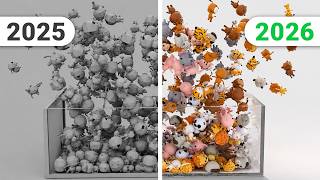 00:32
Jack-o'-lanterns thrown at a tree — demonstrating real-time deformable collision simulation
Watch at 00:32 →
00:32
Jack-o'-lanterns thrown at a tree — demonstrating real-time deformable collision simulation
Watch at 00:32 →
How Does Real-Time Deformable Physics Simulation Work?
To understand why this new method is such a big deal, you need to appreciate what came before. Traditional simulation approaches break a complex object into thousands of small pieces and solve the physics of each piece separately. It sounds smart — divide and conquer, right? But there's a catastrophic flaw hiding in that strategy.
When you solve each piece in isolation, the pieces don't know what the others are doing. You apply a small correction in one area, and it inadvertently makes things worse somewhere else. The simulation wobbles. It slows down. Sometimes it outright explodes. This is the simulation equivalent of playing whack-a-mole with a time bomb.
The new method changes the rules entirely. Instead of solving each slice independently and hoping for the best, it precomputes how every local change will ripple through the entire object — before the simulation even starts moving. This is the key insight that unlocks real-time performance without sacrificing accuracy.
What Is the Overshoot Problem in Physics Simulation?
The technical name for that cascade-of-errors problem is overshoot. When a simulation splits an object into independent chunks and processes them separately, each chunk applies its own local correction without awareness of its neighbors. Those corrections compound, amplify, and create instability across the whole system.
02:15
Overshoot instability causing a simulation to wobble and explode under the old approach
Watch at 02:15 →
Overshoot is why fast simulations tend to be wrong, and accurate simulations tend to be painfully slow. You either accept the instability and go fast, or you iterate carefully and slowly enough that the errors stay manageable. For decades, that was the tradeoff. GPUs made the problem even more tantalizing — they're built to process thousands of operations simultaneously, perfect for handling all those slices at once. But overshoot meant you couldn't just hand all the slices to a GPU and expect a stable result.
Until now, that is.
What Is a Co-Rotated Local Perturbation Subspace?
Here's where things get beautifully technical. The secret weapon in this new method is something called a precomputed co-rotated local perturbation subspace. That phrase sounds intimidating, but the concept is actually elegant.
In plain language: each small slice of the object is given the ability to predict how its own movement — its stretching, pulling, and rotating — will affect the rest of the object. It doesn't wait to find out. It knows ahead of time.
03:40
Five barbarian ships with 2.5 million elements simulating at 3 frames per second in real time
Watch at 03:40 →
This is achieved by precomputing a mathematical structure that captures the relationship between local deformations and global consequences. Armed with this knowledge, every slice can apply its correction in a way that's already accounted for its neighbors. The overshoot problem doesn't disappear — it's preemptively neutralized. That's what makes the GPU parallelism finally viable. You can give all 1,000 slices to the GPU simultaneously, and instead of chaos, you get a stable, accurate simulation screaming along in real time.
How Much Faster Is This Method Than Vertex Block Descent?
The previous cutting-edge technique for fast deformable simulation was called Vertex Block Descent (VBD). It was already impressive — capable of handling large scenes without waiting overnight for results. So how does this new method stack up?
- 30 to 170 times faster than VBD across tested scenarios
- A dragon scene with 100,000 elements runs in real time
- Five barbarian ships with 2.5 million elements runs at 3 frames per second — visible in motion as it computes
- A house of cards simulation with 400,000 elements runs at 30 frames per second
And then there's the most dramatic comparison of all: there are specific scenarios where VBD simply fails to converge. It never finishes. It runs forever without producing a valid result. In those same scenarios, this new technique produces beautiful, stable simulations. That's not 170 times faster — that's infinitely faster, in the most literal sense.
Can Realistic Physics Simulations Actually Run in Real Time?
Yes — and this paper is a significant step toward making that a practical reality for game developers and visual effects studios. The idea of running a physics simulation with millions of deformable elements at interactive frame rates has historically been science fiction. Pre-baked animations, simplified proxy geometry, and heavily approximated physics have been the standard workarounds in games and real-time applications.
What this research demonstrates is that the gap between offline simulation quality (the kind used in movies, rendered over hours or days) and real-time simulation quality is closing fast. A dragon with 100,000 simulated elements running in real time isn't a tech demo trick — it's a genuine glimpse at what physics in next-generation games and interactive experiences could look like.
The implications stretch beyond games: virtual reality, surgical simulation, digital twins, and any domain where physically accurate deformable objects matter could benefit from this class of technique.
What Are the Limitations of This Simulation Technique?
No breakthrough comes without caveats, and this one is no exception. The real-time performance is real — but it comes with a prerequisite: precomputation.
Before the simulation can run at blazing speed, the system needs to compute the rest-shape Hessian matrix for each deformable asset in the scene. This is a one-time upfront cost, but it's not trivial:
- A quick dragon scene: approximately 7 minutes of precomputation
- A large, complex scene: up to 67 minutes of precomputation
For interactive applications or live editing, that's a meaningful constraint. You can't tweak a character's geometry and immediately see it simulate — you'd need to wait for the precomputation to finish first.
However, for shipping a game or a film asset pipeline, this limitation is far less painful than it sounds. The precomputation happens once, offline, before the product is delivered to the user. Players never see the 67-minute wait — they just experience the buttery-smooth real-time simulation. In that context, the tradeoff is very favorable.
What Is a Precomputed Hessian Matrix and Why Does It Matter?
The Hessian matrix, in this context, encodes second-order information about how an object's energy changes as it deforms. Think of it as a detailed map of the object's physical behavior under stress — a mathematical fingerprint of how it wants to move, stretch, and resist deformation.
By computing this matrix for each asset at rest (before the simulation begins), the method gives every local element the global awareness it needs to avoid overshoot. It's the precomputed knowledge that makes GPU parallelism safe and stable.
The good news: this matrix only needs to be computed once per asset, not once per frame. It's a fixed property of the object's geometry and material. That's why it fits neatly into a game development pipeline — compute it during asset creation, ship it with the game, and never think about it again.
Why This Research Matters
This work represents a genuine step-change in what's possible for real-time simulation of squishy, deformable objects. The combination of GPU-parallel processing, precomputed global awareness, and rock-solid stability addresses the core tension that has haunted physics simulation research for 30 years. Fast and accurate has always been the dream. This method gets meaningfully closer to making it a reality — and it's open science, meaning the tools and insights are freely available for the research community to build upon.
The simulation of elastic ships, detailed cloth, and complex organic forms running in real time isn't just impressive eye candy. It's a signal that interactive physics is about to get a serious upgrade.