The way AI agents communicate with each other today is surprisingly inefficient — they write out full sentences in plain English, one token at a time, and then the next agent reads and re-encodes the entire thing from scratch. A new research paper asks a genuinely radical question: why should AI agents talk to each other in human language at all? The answer they arrive at is fascinating — skip the words entirely, and link up their internal representations directly. The results are hard to argue with: accuracy on competition-level math problems jumps from 73% to 86%, and token usage drops by a staggering 75%.
How Do AI Agents Actually Talk to Each Other?
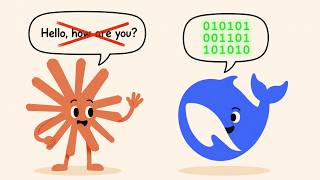
Right now, the dominant approach to multi-agent AI systems looks a lot like a relay race with too much paperwork. Agent one does some work, writes up its findings in plain text, and hands it off. Agent two reads that text, re-encodes it into its own internal representation, does its work, writes more text, and passes it along. Agent three does the same. Every handoff involves decoding thoughts into words and then re-encoding words back into thoughts.
 01:15
Visualization of how current text-based agent handoffs work — each agent decodes and re-encodes information through plain language at every step
Watch at 01:15 →
01:15
Visualization of how current text-based agent handoffs work — each agent decodes and re-encodes information through plain language at every step
Watch at 01:15 →
This is the bottleneck. Language is a compression format optimized for humans, not for machines talking to machines. When you force an AI to express its internal state as English sentences, you inevitably lose information — nuance gets flattened, precision gets rounded off, and the next agent has to do expensive reconstruction work just to understand what the previous one was trying to say.
The researchers behind this paper point to something instructive from the world of brain-computer interfaces. When researchers built neural interfaces for brain-to-text communication, people could think of a letter and have it appear on screen. But after enough practice, a natural question emerges: the alphabet was designed for writing, not for thinking. What if you used a notation optimized for the actual cognitive process? That same logic applies here.
What Is Cross-Agent Latent State Transfer?
The paper introduces what it calls cross-agent latent state transfer. Instead of converting internal representations into language at each handoff, agents pass raw, undecoded numerical vectors — their latent states — directly to the next agent. Think of it as sending brain signals rather than translated speech.
02:40
Diagram showing cross-agent latent state transfer: raw numerical vectors passed directly between agents across multiple refinement rounds
Watch at 02:40 →
In a three-agent setup, the first agent writes a plan, the second critiques it, and the third solves the problem. That structure is nothing new — it mirrors what many multi-agent frameworks already do. What is new is the communication channel between them. Rather than serializing thoughts into tokens, each agent passes its hidden state directly. The receiving agent picks up exactly where the previous one left off, without any lossy translation step in between.
The system runs multiple rounds of this — round one, round two, round three — refining the answer progressively. With each cycle, the agents build on each other's latent representations rather than their written summaries. The result is a tighter feedback loop and a more coherent collective reasoning process.
Why Do Multi-Agent AI Systems Break Down?
To appreciate why this matters, it helps to understand just how badly coordinated multi-agent systems can fail. Consider two agents planning a holiday. The flight agent hallucinates a cheaper airport located 400 miles from your actual destination. The hotel agent, working from that bad information, books the nearest cheap option — non-refundable, naturally. You now own a hotel room you will never visit.
These failures are not just about individual agents making mistakes. They are about how errors compound across agents when each one is working from an imperfect, language-mediated summary of what the previous agent was thinking. Every translation introduces noise. Every handoff is an opportunity for misunderstanding to snowball.
04:10
Benchmark comparison showing accuracy jump from 73% to 86% on competition-level math, alongside 75% reduction in token usage
Watch at 04:10 →
Agent coordination is genuinely hard, and the difficulty scales with the number of agents involved. The more translation steps you add, the more signal you lose. Latent state transfer addresses this at the architectural level, not just by making individual agents smarter, but by making the communication channel between them lossless.
Does Latent Communication Actually Improve AI Math?
The benchmark results are striking. On competition-level math problems — the kind designed to challenge the best human mathematicians — the latent communication approach pushes accuracy from 73% to 86%. These are not frontier-scale models with enormous parameter counts. These are sub-10 billion parameter models, the kind you can actually run without a data center budget.
One important methodological note: the training prompts for each agent's role are generated by a large AI model. A skeptic might reasonably ask whether the gains come from the latent architecture itself or simply from having a high-quality teacher distill knowledge into the smaller agents. The researchers anticipated this and ran a controlled comparison — giving the same teacher-generated training data to other architectures. The latent communication system still won. The architecture is doing real work, not just riding on good training data.
There is also a hint of a new scaling law here. More rounds of latent exchange produce better results, at least up to a point. That curve is interesting because it suggests a different axis along which to improve performance — not just bigger models, but smarter communication protocols between smaller ones.
Can Small AI Models Beat Expensive Large Ones?
This is where things get practically exciting. The AI landscape has largely been defined by a single scaling story: bigger models, more compute, better results. What this research suggests is that smarter coordination between small models can close a significant portion of that gap.
A sub-10 billion parameter model using latent state transfer reaching 86% on competition math is not just an academic curiosity. It means the performance ceiling for small, cheap, deployable models is higher than we thought — provided you rethink how they communicate. For anyone building applications where frontier model costs are prohibitive, this is a meaningful finding.
The practical implications extend beyond math. If latent coordination proves effective across domains, it opens up architectures where you deploy several small specialists rather than one giant generalist — and have them collaborate at a level of fidelity that text-based communication simply cannot match.
How Much Does It Cost to Train These AI Agents?
Here is the detail that makes this research almost unreasonably compelling: the training cost is approximately four dollars. Not four thousand. Not four hundred. Four dollars — roughly the price of a coffee.
That number reframes the entire conversation. When frontier model training runs cost millions of dollars, a four-dollar experiment that produces measurable gains in multi-agent coordination is not just efficient — it is a signal that the low-hanging fruit here has barely been touched. The researchers are essentially arguing that the communication layer between agents has been dramatically underinvested, and the payoff for fixing it is immediate and cheap.
It is worth noting that the code and models are publicly available. This is still early-stage research — rough around the edges, not something you plug into production and expect perfection. But the accessibility matters. When the barrier to experimenting with a genuinely novel idea is four dollars and an afternoon, the research community tends to move fast.
What Are the Real Limits of AI Agent Coordination?
The paper is honest about its limitations, which is one of the things that makes it worth taking seriously. First, all tests were run on smaller models. Whether the latent transfer gains hold as you scale up to much larger systems is an open question. If they do, the implications are enormous. If they do not, the technique still puts small models on a significantly higher performance ceiling — which is valuable in its own right.
Second, there is an optimal latent thought length of around 80 steps. Beyond that, additional thinking steps do not add much value. This is a soft constraint on per-round reasoning depth, but given that these agents are already solving Mathematical Olympiad-level problems, it is hard to view 80 steps as a crippling limitation.
The broader takeaway is that we are still in the early innings of figuring out how AI agents should be built, how they should be structured, and most importantly, how they should talk to each other. The assumption that human language is the right medium for machine-to-machine communication was never really examined — it was just the default. Papers like this one are what happens when researchers start questioning the defaults.