
Most people using AI to write are not saving time — they are skipping the most valuable part of their work. The process of writing is where thinking happens. When you outsource the writing, you outsource the thinking, and what you get back is polished, plausible, and largely empty. People can tell. And if your boss or your team starts asking follow-up questions, you will have no answers, because you never actually worked through the problem.
Mistake #1: Letting AI Think Instead of Organizing Your Thinking
When someone submits a prompt like "write me an email to my boss about my team not working together," they get a generic email — and miss the entire point. What forced you to get clear on the situation, what you have already tried, what you actually need from the other person, and what outcome you want? None of that happened. The thinking never occurred.
A concrete example: a team member recently submitted an eight-page memo — clearly AI-generated — proposing a new departmental philosophy. Two problems. First, it could have been half a page; the rest was filler. Second, it proposed no specific solution. It identified that a philosophy was needed, without actually providing one. That happens because AI, when given thin context, chunks up to the abstract. It cannot chunk down to your specific problem if you have not given it the raw material to do so.
The value of writing was never the writing itself. It was the process required to produce it. Writing a book forces a depth of understanding that no amount of AI-generated prose can replicate — because when you go on interviews and podcasts, you need to actually understand what you wrote. If you outsource the thinking, you give away the exact part that makes you valuable.
Before you open a chat window, ask yourself: Have I actually thought through this problem myself? Am I using AI to organize my thinking, or to replace it? Start with organizing. Never with replacing.
Mistake #2: Publishing AI Slop Without Reading It Out Loud
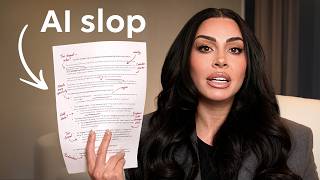
Bad AI writing is not subtle. There is a recognizable pattern, and experienced readers spot it immediately. Phrases like "in today's rapidly changing landscape," "as we navigate the complexities of," "moreover," "furthermore," and "synergies" are instant signals. Nobody talks like this. Nobody should write like this either.
 12:30
List of common AI writing phrases that signal AI-generated content
Watch at 12:30 →
12:30
List of common AI writing phrases that signal AI-generated content
Watch at 12:30 →
Even when you write something yourself and then ask AI only to organize it into sections, it will inject these filler phrases anyway. You ask it not to edit — it edits. You get back a document stuffed with transitional fluff and a concluding line that sounds like a motivational poster. That is AI slop: words that look like work but communicate nothing.
The deeper problem is not stylistic. Bad phrasing reveals that nobody made a clear decision about what they were trying to say. Good communication is being clear. Most AI-generated writing is not clear — it is verbose and vague, which are opposites of the same failure.
The fix: Decide what you want the reader to do, feel, or believe after reading your message. Then read your draft out loud. If you would not say it, do not write it. This is one of the most reliable editing tools available — your ear catches what your eye misses.
Mistake #3: Using AI to Fake Judgment You Have Not Exercised
AI can mimic language, patterns, and even the structure of decisions. That is dangerous. If someone brings you a problem, you solve it using AI, and then they review your solution using AI, no human being has actually engaged with the problem at any point in the chain. The problem does not get solved. It gets processed.
The rule: if you cannot argue for why a paragraph exists, delete it. Every sentence needs to earn its place. If something is so unclear that even you cannot explain it, it is not ready to send, publish, or post. This is the discipline that AI use tends to erode — the habit of defending your own thinking before putting it in front of someone else.
What to Do Instead: A Four-Step Process
Step 1 — Think first, without AI
Work through the problem yourself. Write down what happened, what matters, what you have tried, and what you want to happen next. This does not need to be polished. Bullets, rough notes, or voice memos all work. The goal is genuine engagement with the problem.
Step 2 — Use voice-to-text to capture your thinking
Tools like Whisper Flow allow you to speak your thoughts and have them transcribed accurately, including punctuation and sentence structure. Speaking forces you to think in real time — you can hear when you are overexplaining, when something does not land, when you are going in circles. The output sounds like a human because it is a human. It is faster than typing and does not hollow out your voice the way AI generation does.
22:15
Demonstration or mention of Whisper Flow voice dictation app
Watch at 22:15 →
Step 3 — Use AI as an editor, not a ghostwriter
Once you have a real draft with your opinions, logic, phrasing, and arguments, AI becomes genuinely useful. Feed it your draft and ask questions like:
- What questions would a reader in my organization still have after reading this?
- Where is my language unclear?
- What fears might this provoke in people?
- Is my argument logically coherent?
- Where am I repeating points I have already made?
- Is there anything here that works against my stated goal?
Think of AI here as an editor who has read everything but lacks your context. It can spot holes in logic. It cannot fill them for you — that is still your job.
Step 4 — You decide what to keep
AI suggestions are opinions, not verdicts. Put the same draft into two different AI tools and you will often get contradictory advice. Treat its feedback the way you would treat feedback from a smart colleague: consider it, weigh it, and make your own call. AI is not the final word. You are.
The Actual Problem With AI Use Right Now
AI is not the problem. Using it to avoid thinking is the problem. Your value is not that you can produce fluffy words faster. Your value is that you can think, make judgment calls, and speak in your own real voice with the full context of your experience and your organization behind you. The people who get the most from AI are not the ones who use it to generate everything from scratch. They protect the parts they know they should be doing themselves, and use AI to get leverage on everything around that.
Use your brain first. Then use AI to sharpen what your brain produced. In that order, AI is a genuine force multiplier. In reverse order, it is just a shortcut to sounding like everyone else.