


If you're constantly busy but never seem to reach your goals, you probably don't have a productivity problem — you have a priority problem. The instinct to work longer, sleep less, and grind harder is understandable, but it's also the reason most people stay stuck. The top 1% of performers have figured out something counterintuitive: the goal isn't to maximize time, it's to optimize the quality of decisions made within that time. Here are the six principles that separate those who stay busy from those who actually break through.
1. Stop Maximizing Time — Start Optimizing Judgment
Most people treat productivity as a volume game. More hours, more output, more hustle. But at a certain point, your judgment becomes more valuable to your business than your work ethic — and those two things require completely different training.
Training for work ethic means sleeping less and grinding harder. Training for judgment means asking a different question: What state do I need to be in to make great decisions? Are you rested? Fed? Have you exercised? Because exhausted people make poor decisions, and a single poor decision at scale can cost more than months of hard work.
This also means protecting the environment around you from chaos. Jensen Huang has credited his family's ability to keep the noise low as a key enabler of his performance. When you're trying to generate leverage through high-quality decisions, ambient chaos is the enemy. You have to build a cocoon around your thinking.
The hard truth: you probably do need to go through a grinding phase early on — it's how you develop the pattern recognition that feeds good judgment later. But if you never make the switch from maximizing effort to optimizing decision quality, you'll be the hardest worker who never breaks through to the next level.
2. Treat Your Calendar as a Strategy Document
A calendar filled with other people's requests is not a strategic calendar — it's a to-do list you didn't write. The shift happens when you stop asking "how do I fit more in?" and start asking "what can I cut so I only do what only I can do?"
Think of it this way: you can row a rowboat very hard and cover real distance. But you can't row a Titanic. As an organization grows, the cost of going in the wrong direction compounds dramatically. Getting 500 people to reverse course versus 5 people is not a linear difference. This means the bigger your business gets, the more time you need to spend on thinking, not doing.
The practical rule: add your business priorities to your calendar before you schedule anything else. Block your thinking time, your recovery time, your peak decision-making windows. Then — and only then — fill in whatever remains with what others need from you. If your calendar doesn't reflect your top priorities, you are effectively working for other people. And if your business can only survive when you're doing everything, you haven't built a business — you've built yourself a job.
3. Go on a Decision Diet
Your brain has a finite capacity for high-quality decisions each day. Research consistently shows that the more low-value decisions you make, the worse your high-stakes decisions become. Think of it like junk volume in the gym — if you exhaust yourself warming up, you have nothing left for the main set.
The solution is to ruthlessly eliminate decisions that don't require you. For most senior leaders, that means focusing on three things: setting the vision, allocating resources, and leading other leaders. Everything else should be delegated.
But here's what most people get wrong about delegation: it's not about saving time, it's about preserving cognitive bandwidth. If you delegate a task but still spend mental energy wondering whether it was done correctly, you haven't truly delegated — you've just added a background process that drains your focus. True delegation means handing over authority, not just tasks. The person you delegate to needs to be empowered to make decisions in their domain, or they're just an extension of your hands.
A caveat for early-stage leaders: don't delegate before you have the right people and processes in place. Some of this trust you can only develop by letting people make real decisions and seeing what happens.
4. Batch Your Days by Theme
Task-switching is one of the most underappreciated sources of cognitive drain for leaders. A study from MIT found that multitasking reduces decision-making accuracy by up to 50%. Every time you shift context — from strategy to operations to creative work to personnel issues — your brain pays a switching cost.
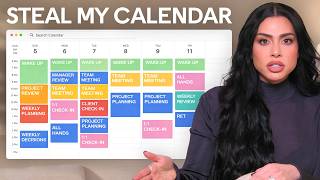
The antidote is themed days. Instead of fragmenting your attention across every dimension of the business every day, dedicate entire days to a single category of work. Examples might include: a filming or content day, a strategy day, a leadership meeting day, and a creative thinking day. This allows for deep cognitive immersion in one domain rather than shallow engagement across many.
 32:10
Speaker describes her own themed day structure including content, strategy, leadership, and creative thinking days
Watch at 32:10 →
32:10
Speaker describes her own themed day structure including content, strategy, leadership, and creative thinking days
Watch at 32:10 →
The secondary benefit is speed and quality. When people say a project will take five months, it often means they can only get to it for one month out of five because everything else is competing for their attention. Concentrated focus compresses timelines and improves outcomes. If you find yourself burned out, it's often not the work itself — it's the constant switching that makes the work feel endless and unresolvable.
5. Make Meetings the Last Resort, Not the Default
Most meetings are a band-aid for something else that's missing: a clear expectations document, a decision framework, a well-documented process. They exist because structure doesn't. The problem is that using meetings to compensate for missing structure means you never build the structure — you just keep scheduling more meetings.
One of the most effective interventions is a simple rule: no memo, no meeting. Requiring a written memo before a meeting forces clarity. Half the time, writing the memo surfaces the answer and eliminates the need to meet at all. The meetings that do happen tend to be shorter, more focused, and actually necessary.
Signs your meeting culture has a problem: recurring meetings that address one-time issues, meetings with too many attendees, status-update meetings that could be a Slack message, and any meeting where the goal is clarity that could have been achieved with documentation. If you're a leader with 30 to 40 meetings a week, that's not leadership — it's reactivity. Those 30 hours could be spent building the systems that eliminate the need for those meetings in the first place.
6. Manage Energy, Not Just Time
You cannot manage time. You can only manage the quality of energy you bring to the time you have. This is the principle that ties everything else together.
Most people design their calendars as if all hours are equal. They schedule eight back-to-back meetings and then wonder why the workout they planned afterward didn't happen, or why the dinner with their partner felt hollow. The energy wasn't there. The hours were, but the person wasn't.
High performers think about their days in energy zones. There's a peak cognitive window — typically a 90-to-120-minute block where thinking is sharpest and decisions are clearest. For many people this is in the morning, before the friction of the day accumulates. Protect that window. Don't fill it with email or low-stakes meetings. Fill it with the work that only you can do and that matters most.
After peak cognitive time passes, shift to work that requires less mental load — physical activity, lower-stakes communication, creative loosening. Decisions made in a depleted state often have to be reversed, which means the time you "saved" by pushing through exhaustion gets spent twice: once making the decision, and again undoing or correcting it.
A practical starting point: map your current calendar against your energy levels throughout the day. Ask yourself honestly — how will I actually feel at each point on this schedule? Design around your biology, not against it. The goal isn't to be switched on all day. The goal is to be fully present during the hours that matter most, and appropriately disengaged when recovery is what's actually needed.
The Shift That Changes Everything
None of these principles require working less in any absolute sense. They require working differently — with more intentionality about what goes on your calendar, more honesty about your cognitive limits, and more discipline about protecting the conditions that allow you to think clearly. The top performers aren't superhuman. They've simply stopped confusing busyness with progress, and learned to treat their judgment as the asset it actually is.


