If you want to know how to get more views on YouTube and build real influence, Alex Hormozi has a blunt answer: you're making too little content, and the content you are making attracts the wrong people. In one month, his team pulled 32.7 million YouTube views. In 72 hours, they sold over $100 million in books. The engine behind both results is a four-part framework he calls SPCL—and it has nothing to do with hacking the algorithm or chasing trends.
How Do You Get Millions of YouTube Views That Actually Convert?
Most creators obsess over view counts. Hormozi thinks that's the wrong metric entirely. A grandma slapping someone across the face will get millions of views—but it won't sell your consulting service. The real goal isn't eyeballs. It's influence, which he defines precisely as the likelihood that someone will comply with a future request. That request could be hitting subscribe, buying a book, or booking a sales call. Views without influence are just noise.
 02:15
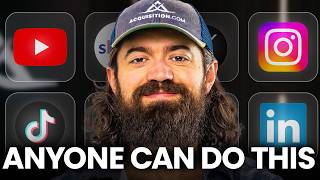
Hormozi writes out the four SPCL letters on camera and begins breaking down each component live
Watch at 02:15 →
02:15
Hormozi writes out the four SPCL letters on camera and begins breaking down each component live
Watch at 02:15 →
His framework for building that influence is SPCL: Status, Power, Credibility, and Likeness. Each element works independently, but when you stack all four inside a single piece of content, your ability to move people to action multiplies dramatically. Think of it like a role-playing game stat sheet—the higher each stat, the easier it becomes to land the ask, whatever that ask is.
What Is the SPCL Framework and Why Does It Beat Chasing Views?
Here is each component broken down the way Hormozi explains it—operationally, not motivationally.
S — Status: Do You Control Something People Want?
Status isn't about being famous. It's about controlling scarce resources in a given environment. The bartender at a packed bar has enormous status in that moment—he controls the one thing everyone wants. Walk him outside and it evaporates. For content creators, demonstrating status means showing your audience that you possess something they want access to: money, results, information, connections, or opportunities. That's why Hormozi opens videos by referencing $100 million launches or 32 million monthly views. It's not bragging—it's signaling that he controls a resource worth paying attention to.
P — Power: Have You Given Advice That Actually Worked?
Power comes from what behavioral science calls say-do correspondence. You tell someone to do something. They do it. A good outcome follows. Repeat that loop enough times, and that person becomes highly likely to follow your next instruction. This is why a financial influencer who gave you ten stock picks that all hit carries ten times more sway than a trust fund kid with the same net worth. The trust fund kid has status. The influencer has status and power. For your content, this means your videos should include actionable directions that, when followed, produce wins for your audience. Every win deposits into your influence account.
C — Credibility: What Third-Party Proof Do You Have?
Credibility is verifiable, observable proof from outside yourself. When Hormozi hired Guinness World Records judges to certify his book launch numbers on-site, he wasn't just showing off—he was buying credibility from one of the most trusted verification brands on earth. For most creators, credibility looks like client results, press mentions, certifications, or documented case studies. The test is simple: can a skeptic verify this claim without taking your word for it? If yes, it's credibility. If no, it's just a claim.
L — Likeness: Are You Actually Being Yourself?
Likeness means your audience sees themselves in you—either literally (same demographic) or psychologically (same values, same vibe). Hormozi points out that he and his wife Leila cover nearly identical business topics, yet her audience is 54% female while his is 89% male. Same content category, wildly different likeness profiles. The practical takeaway: stop cosplaying archetypes. The algorithm rewards authentic specificity. Leaning into the actual nuances of who you are—including the weird sandals you wear because you hate socks—creates a signal that is impossible to fake and attracts people who genuinely resonate with it.
18:40
Hormozi explains the stadium applause story from his conversation with MrBeast, illustrating the influence gap between short-form and live content
Watch at 18:40 →
Why Do Live Streams Build More Influence Than Short-Form Videos?
Hormozi shares a story that reframes the entire short-form-versus-long-form debate. At a UK vs. US influencer soccer match, the crowd response told everything. When traditional A-list celebrities walked out: barely a ripple. When short-form creators came out: polite applause. Long-form YouTubers and podcasters: loud, genuine enthusiasm. And when the live streamers entered? The entire stadium erupted.
The reason is pure math. A 15-second short gives you roughly one reinforcement cycle with a viewer. A one-hour long-form video gives you hundreds. To match the influence built by two hours of long-form content, a viewer would need to watch 480 short videos. That's not a content strategy—that's a fantasy.
This is also why Hormozi believes the 2024 US election was shaped by long podcasts, not social clips. A three-hour Joe Rogan interview gave undecided voters three hours of unscripted time with a candidate. That volume of reinforcement cycles is impossible to replicate with a highlight reel. Live streams extend this further—they are unedited, unscripted, and real in a way that even polished long-form video cannot match. The internet, Hormozi argues, always moves toward truth. Live is as close to truth as digital media gets.
28:55
Hormozi draws the US business owner funnel on camera—showing how the addressable market shrinks from 32M businesses down to roughly 1.5M doing over $1M/year
Watch at 28:55 →
How Much Content Do You Actually Need to Post to Grow?
His team posted 35,000 pieces of content in one year. A solid small business doing 365 posts a year—one per day—is producing roughly one-hundredth of that volume. And the results scale almost linearly. More content means more discovery, more reinforcement cycles, more influence compounding across more prospects. Hormozi doesn't frame this as hustle culture. He frames it as math: if one in ten shorts breaks out, you need to make ten to get one. Want ten breakouts? Make a hundred. The input-output machine is more predictable than most creators want to admit, because admitting it means there's no clever shortcut—only volume.
He points to Rogan, Patrick Bet-David, and Dave Ramsey as examples. Each produces hours of content daily. Each has built massive influence. The pattern isn't coincidence.
How Do You Attract the Right Audience, Not Just More Followers?
Social media, Hormozi argues, has evolved into interest media. The algorithm no longer just shows content to your followers—it reads your background, your language, your topic, and distributes it to people who have historically engaged with similar content. In other words: the content is the targeting.
This means a piano repair technician making videos about fixing pianos will find people who want to fix pianos—even if the view counts look tiny compared to mainstream creators. A thousand highly qualified viewers are worth more than a million bored ones. If you're a service provider or educator, your job is not to entertain the masses. Your job is to change the behavior of a specific person in a specific situation. Make content for that person, and the algorithm will find them for you.
How Do You Build Real Influence Online as a Business Owner?
The SPCL framework is not just about YouTube. It explains why parents have such a profound influence on their children—they max out all four stats simultaneously. They control resources (shelter, food, money). They have decades of say-do correspondence. They have the credibility of lived experience. And they literally look like you. Understanding this helps you reverse-engineer what your own content needs to do: demonstrate status in your niche, create actionable cycles where following your advice produces wins, stack third-party proof, and show up as an unfiltered version of yourself.
Hormozi also emphasizes domain specificity. His SPCL stats are sky-high in the world of business growth—but if he started giving fashion advice tomorrow, they would crater to near zero. Build your influence inside the lane where your proof already lives.
Can You Make Real Money With a Small Social Media Following?
Absolutely—and the numbers back it up. Only 9% of Americans own a business. Of those, 95% make under $1 million a year. The pool of people doing over $10 million annually is roughly one in 250 businesses. If your product serves high-revenue business owners, your realistic total addressable audience in the US might be a few hundred thousand people at most. Chasing millions of views in that niche doesn't just feel wrong—it's mathematically irrelevant.
Hormozi has personally reviewed two businesses doing over $1 million a year in revenue with fewer than 5,000 social media followers. The content was precisely targeted, SPCL was stacked, and the audience was small but loaded with buyers. A small, right audience beats a large, wrong audience every time. Set accurate expectations for your market size, make content that speaks directly to that market, and measure success by IRL responses—texts from respected peers, DMs from ideal customers—not vanity metrics.
The Bottom Line on SPCL and Content Strategy
Getting millions of YouTube views is a byproduct, not a goal. The actual goal is to stack Status, Power, Credibility, and Likeness into every piece of content you make, do it at high volume, do it in formats that maximize time-with-audience (live and long-form), and aim it precisely at the person you actually want to serve. Do those things consistently, and the views, the followers, and the revenue follow as a natural consequence.