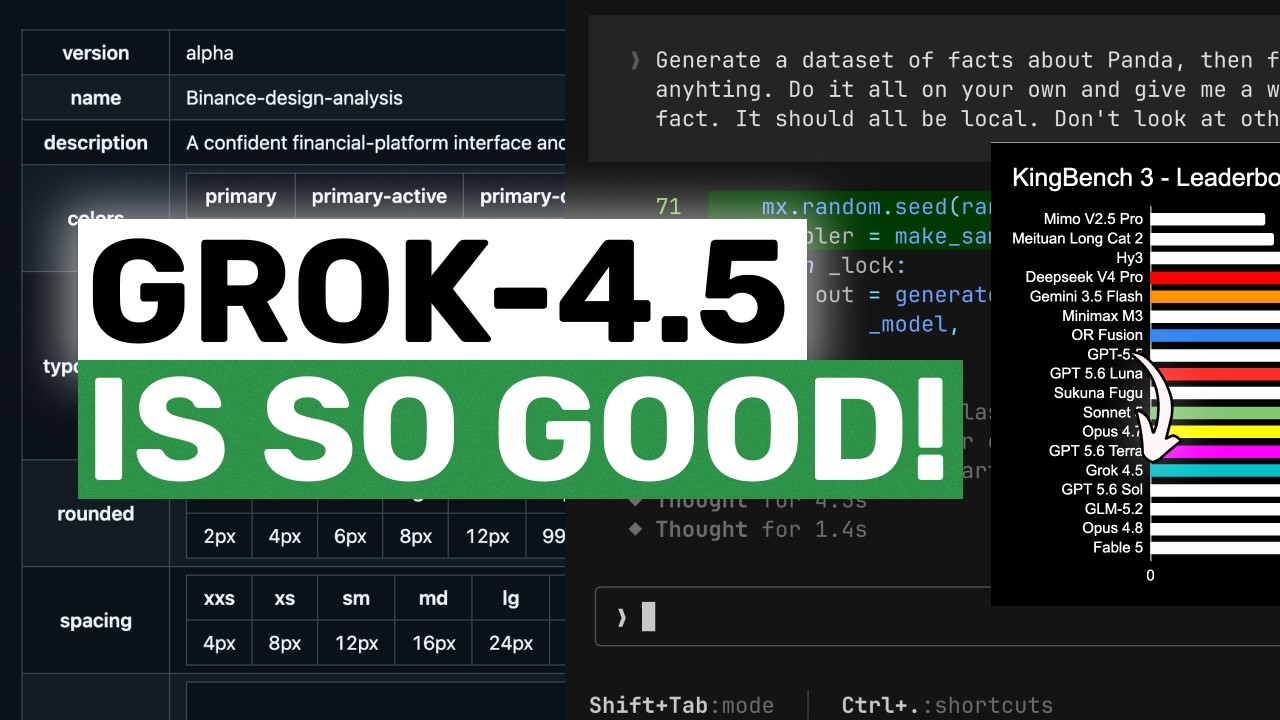

Yes, Grok 4.5 is a legitimately good coding model — and that sentence would have been laughable six months ago. After running it through seven real-world coding and reasoning tests, it scored 51 out of 70 (72.86%), placing it fifth overall and ahead of Claude Sonnet 5, Claude Opus 4.7, and nearly every GPT-4.5 variant. For a model priced at $2 per million input tokens, that performance is frankly hard to argue with. Is it Grok 4.5 a good coding model worthy of the frontier label? In most respects, yes — with some important caveats.
Is Grok 4.5 Actually a Good Coding Model?
Grok 4.5 was released on July 8th and is available through the API, Cursor, and rolling out on grok.com and the X app. On paper, xAI is positioning it as an Opus-class model that's faster, cheaper, and more token-efficient. Based on testing, that claim holds up more than you'd expect.
 04:15
Grok 4.5 benchmark scores across 7 real-world coding and reasoning tests
Watch at 04:15 →
04:15
Grok 4.5 benchmark scores across 7 real-world coding and reasoning tests
Watch at 04:15 →
Across seven practical tests — ranging from 3D simulations and SVG generation to hard combinatorics math and fully autonomous agentic pipelines — Grok 4.5 scored perfect 10s on three of them: the bow-and-arrow game simulator, the combinatorics math problem, and the fully autonomous fine-tuning pipeline. Those aren't easy wins. The combinatorics question alone stumped GPT-4.5, Claude Opus 4.7, and Gemini Flash 3.5, all of which scored zero. Grok 4.5 got it exactly right.
The areas where it fell short were primarily visual and 3D rendering tasks. The elevator simulation had logic issues and janky animations (5/10). The folding table animation lacked smoothness (5/10). The SVG panda was recognizable but the burger looked more like a pancake stack (5/10). These aren't dealbreakers for coding use cases, but they're real gaps compared to the top models.
Grok 4.5 vs Claude Opus 4 vs Gemini 2.5 Pro
Here's where things get interesting. On the full benchmark chart:
08:30
Full model comparison chart: Grok 4.5 vs Claude Opus, Gemini 2.5 Pro, and GPT-4.5 variants
Watch at 08:30 →
- Gemini 2.5 Pro (Fable 5): 88.57% — still the top dog
- Claude Opus 4.8: 87.43% — clearly ahead on visual and 3D tasks
- GPT-4.5 Soul variant: 78.57% — edges Grok out
- Grok 4.5: 72.86% — fifth place overall
- Claude Sonnet 5 / Opus 4.7: 55.71% — both behind Grok 4.5
On official benchmarks, Grok 4.5 lands third on SWE-bench behind only Gemini 2.5 Pro and GPT-4.5, while beating Claude Opus 4.8. On Terminal Bench it scores 83.3, essentially tied with GPT-4.5 at 83.4. Artificial Analysis already ranks it fourth out of 168 models on their intelligence index. That's frontier territory by any reasonable definition.
The honest summary: you're getting roughly 85% of Claude Opus 4.8's capability at a significantly lower price point. For many real-world coding tasks, that gap is negligible.
How Much Does Grok 4.5 Cost on the API?
The pricing is one of the most compelling parts of this release. Grok 4.5 is priced at $2 per million input tokens and $6 per million output tokens. Cached input drops to just $0.50 per million — a 75% discount. Compare that to Gemini 2.5 Pro at $10 input and $50 output, or Claude Opus 4.8's pricing, and you're looking at a model that's roughly five to eight times cheaper than the competition at the top of the chart.
There is one catch worth flagging: if your context exceeds 200K tokens, the price doubles to $4 input and $12 output. That's a meaningful jump for long-context tasks, though most coding requests won't come anywhere near that ceiling. The 500K context window (down from Grok 4.3's 1 million, but still generous) supports vision, tool calling, structured outputs, extended reasoning, and web search — so this is a full agentic model, not just a chat wrapper.
13:45
Grok 4.5 completing the autonomous fine-tuning pipeline end-to-end with no handholding
Watch at 13:45 →
If you're using Cursor, the deal gets even better. Current subscription plans include a meaningful chunk of Grok 4.5 usage, with double usage for the first week and an active 50% discount on top of that. Right now is genuinely a good window to test it at minimal cost.
Why Grok 4.5 Token Efficiency Is the Real Story
The sticker price is just one layer. The bigger advantage is how few tokens Grok 4.5 actually burns to get its results. On the same coding evaluation tasks:
- Gemini 2.5 Pro: ~7 million tokens per task → ~$2.75 per task
- Claude Opus 4.8: ~9 million tokens per task → even higher
- Grok 4.5: ~2 million tokens per task → ~$0.31 per task
That's not a small difference. That's a 9x cost advantage per task over Gemini 2.5 Pro for comparable output quality. When you're running agentic pipelines where output tokens stack up fast over many steps, this gap compounds quickly. It also effectively ends the GLM 5.2 value argument — GLM scored higher on the chart, but its token consumption brings its real-world cost to around $0.37 per task, while Grok 4.5 achieves 90% of the result cheaper and faster.
Can Grok 4.5 Handle Agentic Coding Tasks Autonomously?
This is where the Cursor acquisition pays the biggest visible dividend. The most demanding test — generating a dataset of panda facts, fine-tuning a Gemma 2B model locally, and then serving results through a web UI, all without any files provided or hand-holding — Grok 4.5 completed end-to-end on its own. It generated the dataset, wrote the training script, ran the fine-tuning to completion, and delivered a working web UI where each refresh pulls a new panda fact. Perfect 10 out of 10.
This makes sense once you understand how it was trained. The model is a 1.5 trillion parameter mixture-of-experts architecture (up from the ~500B parameter previous Grock models), trained on trillions of tokens of real Cursor interaction data — actual developers working with real codebases. On top of that, xAI ran reinforcement learning on hundreds of thousands of multi-step software engineering tasks with rollouts lasting hours. The result is an agentic feel that's dramatically more reliable than any previous Grok release.
One transparency note worth highlighting: xAI chose not to publish a Cursor Bench score because an early snapshot of Cursor's own codebase leaked into training data, which would have inflated the number. They disclosed this themselves. That kind of intellectual honesty is rare in this space and worth acknowledging.
What Are the Real Weaknesses of Grok 4.5?
Two genuine limitations stand out after extended testing.
First, it overthinks trick questions. On puzzle-style or adversarial prompts, Grok 4.5 burns very long reasoning chains hunting for the catch — averaging over 2,000 reasoning tokens per response on that type of task. That makes it slower and more expensive precisely where it's least likely to shine. Other models handle these more efficiently.
Second, and more importantly, it's not yet an orchestrator. The new generation of top models — Gemini 2.5 Pro and GPT-4.5 — can spin up sub-agents, decompose large problems into chunks, and manage the whole pipeline. Grok 4.5 doesn't have that muscle yet. When pushed to delegate across multiple agents, it struggled with how to split work and occasionally got stuck when a spawned process hung. It's an excellent individual agent, but not a multi-agent manager.
The clearest way to frame it: Grok 4.5 is the best possible version of the previous generation of models, rather than a native member of the new generation that Gemini 2.5 Pro and GPT-4.5 represent. That's still a remarkable achievement — but it's a real distinction for teams planning complex orchestration workflows.
How Was Grok 4.5 Trained? The Cursor-xAI Collaboration Explained
Grok 4.5 is not a fine-tune of previous Grok models. It's a ground-up pre-training run on a 1.5 trillion parameter mixture-of-experts architecture, run on tens of thousands of NVIDIA's GP300 GPUs. The training data went through heavy filtering, deduplication, and quality scoring — a noticeably more rigorous curation process than earlier releases.
The Cursor acquisition is doing real work here. Cursor's codebase of developer-agent interactions provided trillions of tokens of training signal representing how real people interact with real code across real projects. Combined with hours-long RL rollouts on hundreds of thousands of software engineering tasks, this created the agentic reliability that previous Grok models always promised but rarely delivered.
The result is a model running at around 80 tokens per second with a 500K context window, full tool calling, vision support, structured outputs, and web search. It's available now through the API at $2/$6 per million tokens, through Cursor with subscription discounts, and rolling out on grok.com and the X app.
Six months ago, Grok wasn't part of the frontier conversation at all. The fact that a single release has it genuinely competing with Anthropic and OpenAI's best — at a fraction of the price — is one of the more surprising developments in the AI space this year. More competition means faster, cheaper, smarter models for everyone. On that front, Grok 4.5 is very good news.